You know the feeling when you walk into a room with a high wood ceiling and your shoulders drop a little. The air is different up there — warmer, quieter, like the room is holding you instead of towering over you. Wood cathedral ceiling ideas work because wood does what plaster never can: it makes height feel like shelter. Here are 15 ideas that make a tall wood ceiling the most inviting part of the house, from warm planks and dark beams to skylights at the ridge and a reading corner tucked under the vault.
Let the Wood Be the Star of the Room
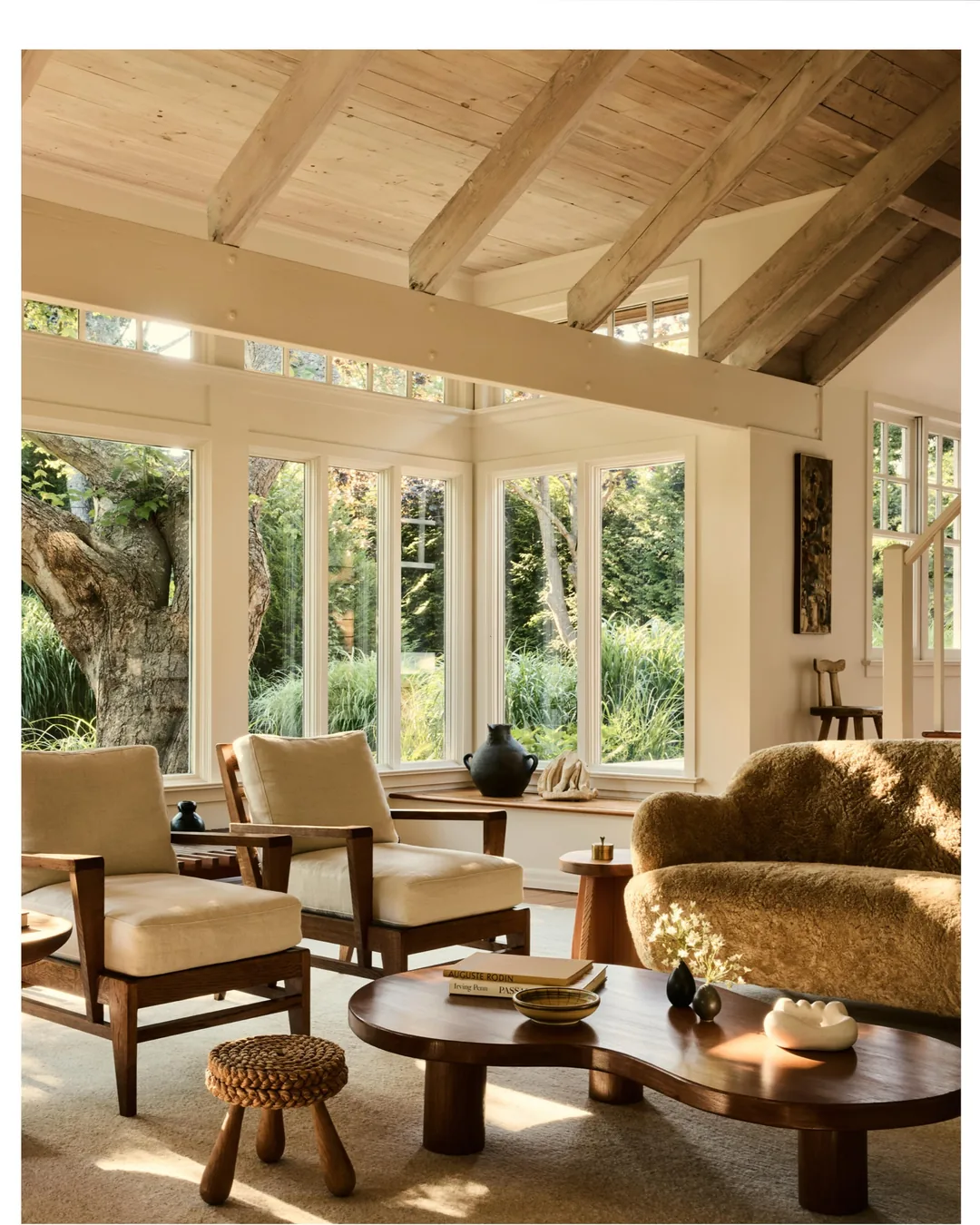
Some ceilings ask to be ignored. A wood cathedral ceiling does the opposite — pale planks and exposed beams fill the whole upper half of the room, floor-to-ceiling windows bring the greenery in, and armchairs with a sheepskin sofa sit below like they know they are not the main event. When the ceiling is this good, everything else in the room can stay quiet.
Start with the wood itself, because the tone sets the whole mood. Pale, honey-toned planks keep a tall room bright and airy; the grain does the decorating, so the furniture can stay simple — a low wood coffee table, a few books, linen upholstery that does not compete with the ceiling. Keep the walls pale too, and the wood reads as warmth rather than weight.
The practical point: choose the wood tone before you choose anything else. A pale ceiling forgives dark furniture; a dark ceiling needs pale furniture to balance it — get the tone wrong and the room fights itself.
Why Warm Wood Makes a Tall Room Feel Like Home
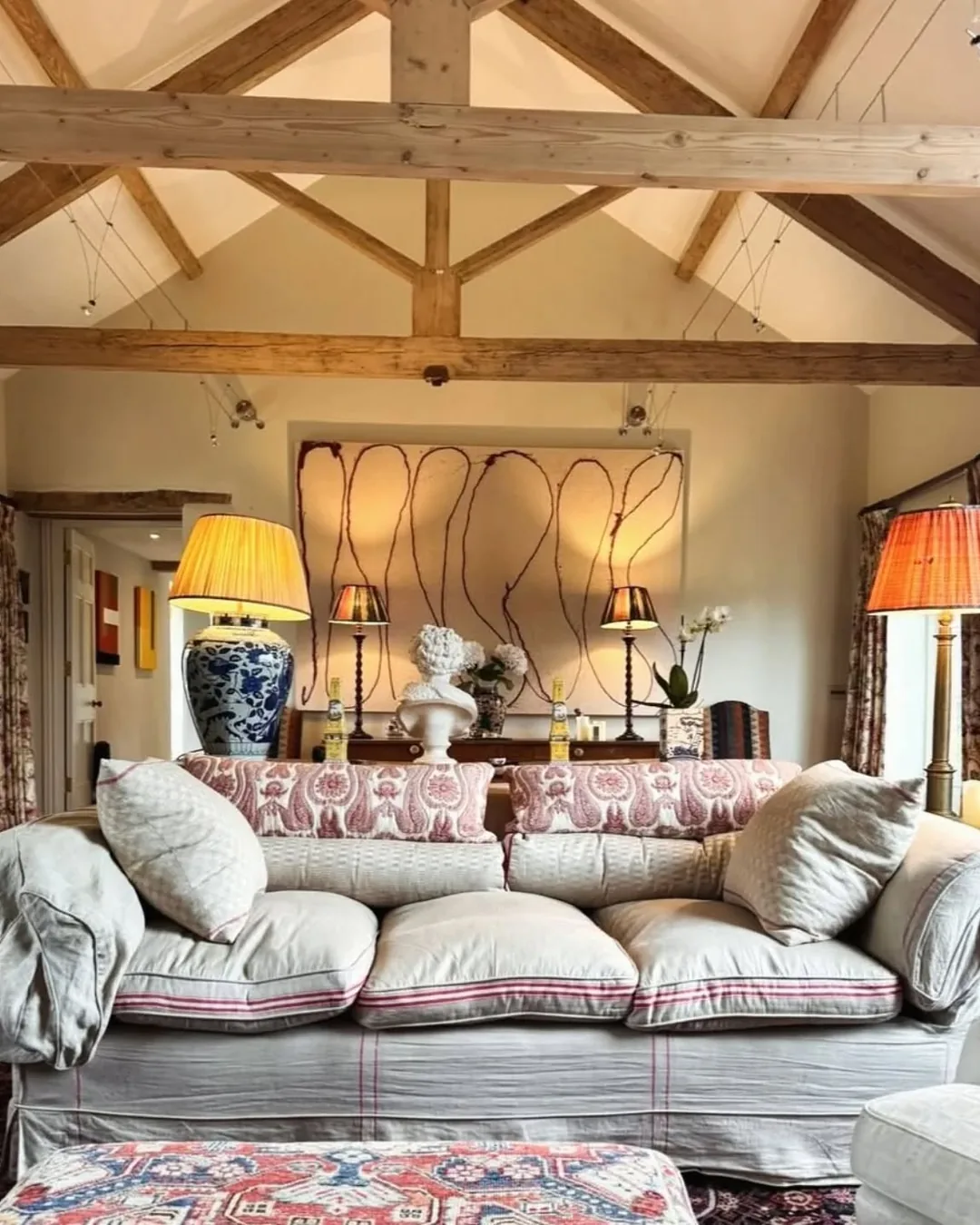
Tall rooms have a cold problem. White plaster and high ceilings can feel like a hall, not a home — but warm wood changes the temperature without touching the thermostat. In this room the vaulted ceiling is lined with warm beams, the sofa is deep and light-grey, paisley cushions in red and white warm it up further, and a brass floor lamp with an orange shade throws a glow that makes the whole space feel held.
Warmth in a tall room comes from the middle of the colour scale, not the ends. Mid-tone wood, beige upholstery, a patterned rug underfoot — none of them shouts, and together they stop the height from feeling empty. One warm accent, like that orange lamp shade, is enough; three or four start to look like a theme park.
The practical point: test the wood tone in the room’s own light before you commit. A sample that looks honey-gold in the shop can turn pink under warm bulbs and grey under daylight — hold it up at the ceiling height, not at eye level.
Run the Beams Up to the Peak
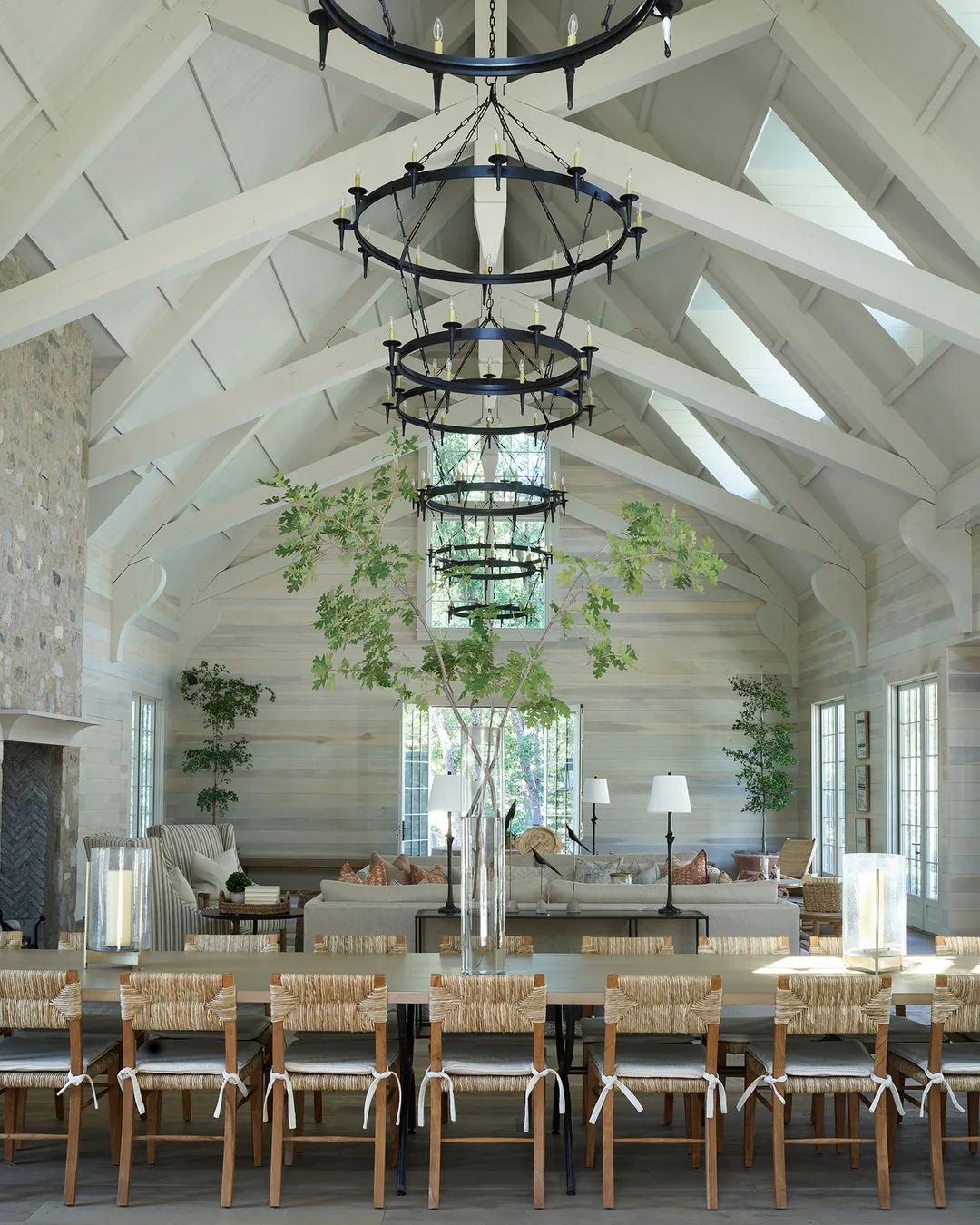
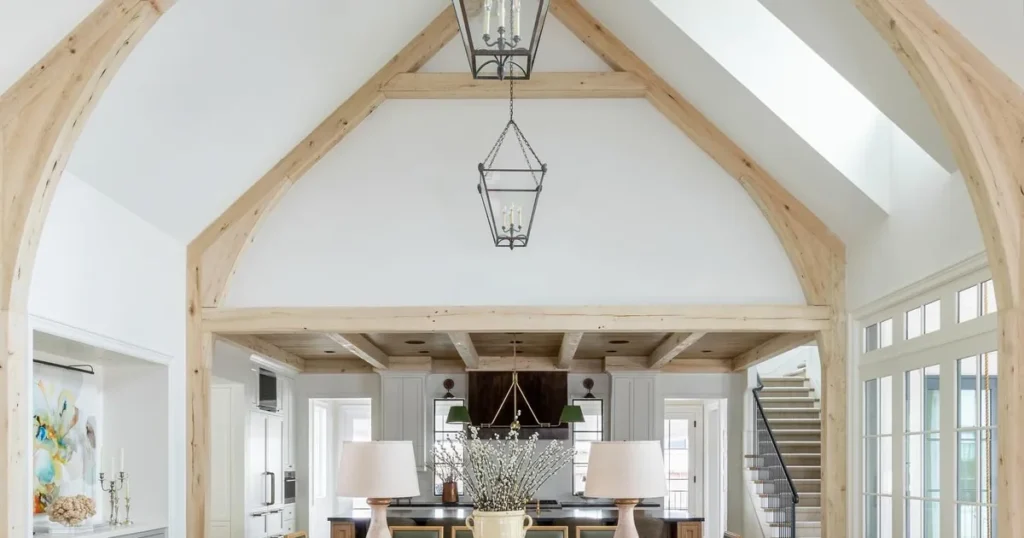
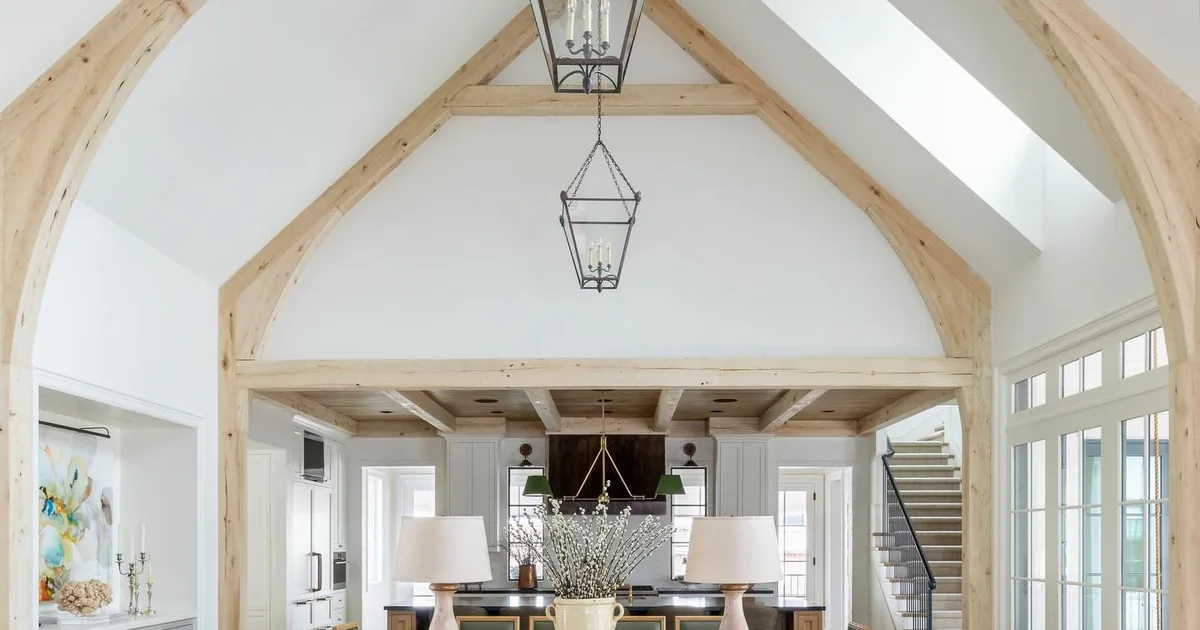
Beams are the bones of a cathedral ceiling, and the best ones do not stop halfway — they run up both slopes and meet at the ridge, the way the roof itself does. Here the trusses are painted white, which makes them read as architecture rather than timber, and below them a long dining table with woven chairs and a stone fireplace turn the height into a room for gathering, not just looking.
Painted beams suit rooms that already have a lot of wood elsewhere. When the trusses are white, the ceiling keeps its shape without adding another wood tone to juggle, and the room stays light. Leave the beams natural when the rest of the room is pale and needs the warmth; paint them when the room needs the structure without the colour.
The practical point: follow the roofline, not the furniture. Beams that run down the slope and meet at the peak lengthen the room; beams laid across the slope chop it into bands.
Pair Wood with White Walls for Balance
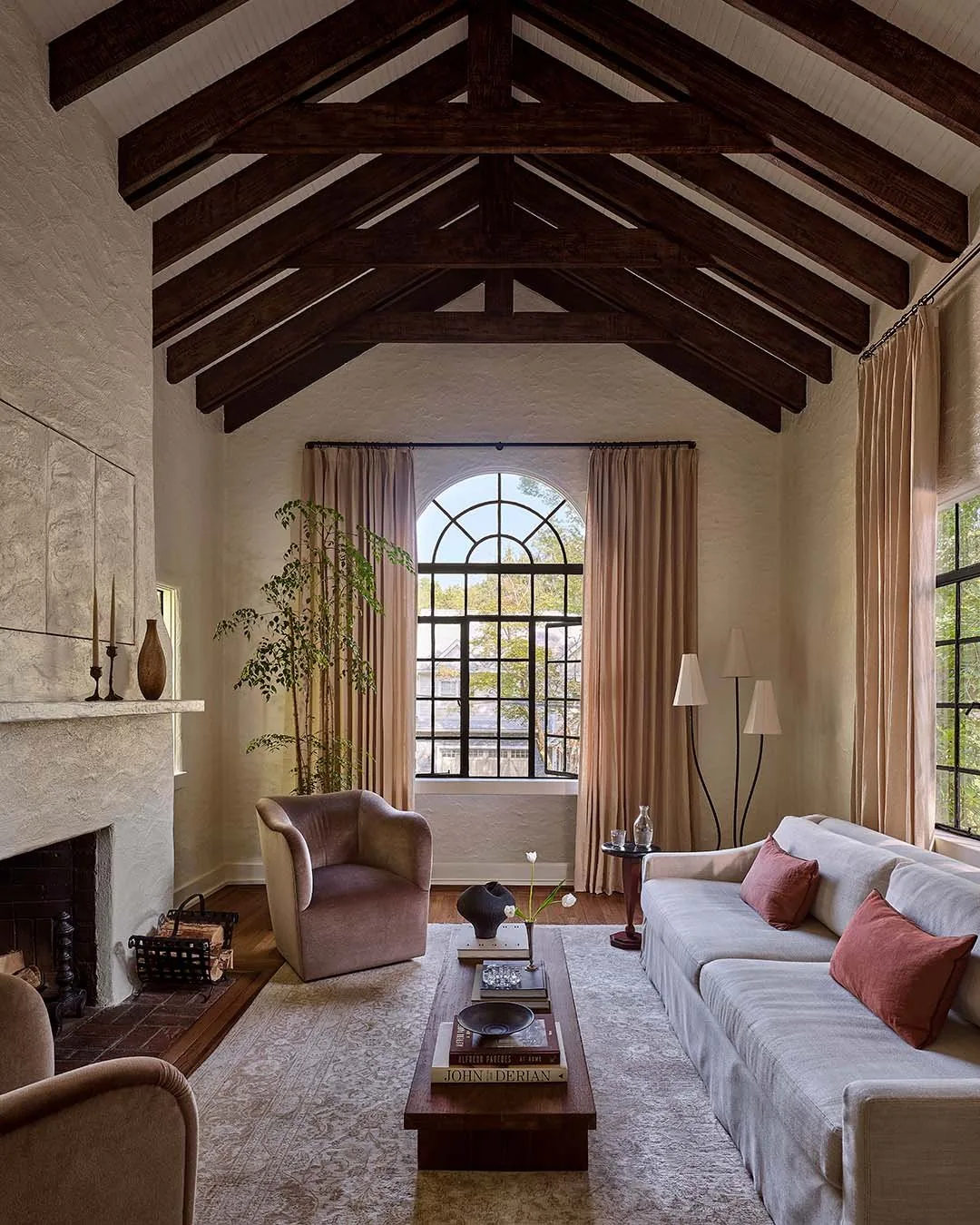
Wood ceilings and white walls are the oldest partnership in the book, and it works because each one lets the other breathe. Dark wood trusses cross a white vault here, an arched black-framed window with curtains anchors the far wall, rust pillows warm a light sofa, and a fireplace with a tall plant fills the left side — the wood gives the room its character, the white gives it its air.
Balance is a ratio, not a feeling. Roughly a third wood to two-thirds pale surfaces keeps a tall room from going heavy; flip the ratio and the ceiling starts to press down. White walls also bounce the light around, which matters when the ceiling is dark — without them, the top of the room can go gloomy by mid-afternoon.
The practical point: pick one white and use it everywhere — walls, trim, ceiling between the trusses. Two different whites side by side read as a mistake, and the eye will find it every time.
Put a Skylight at the Ridge
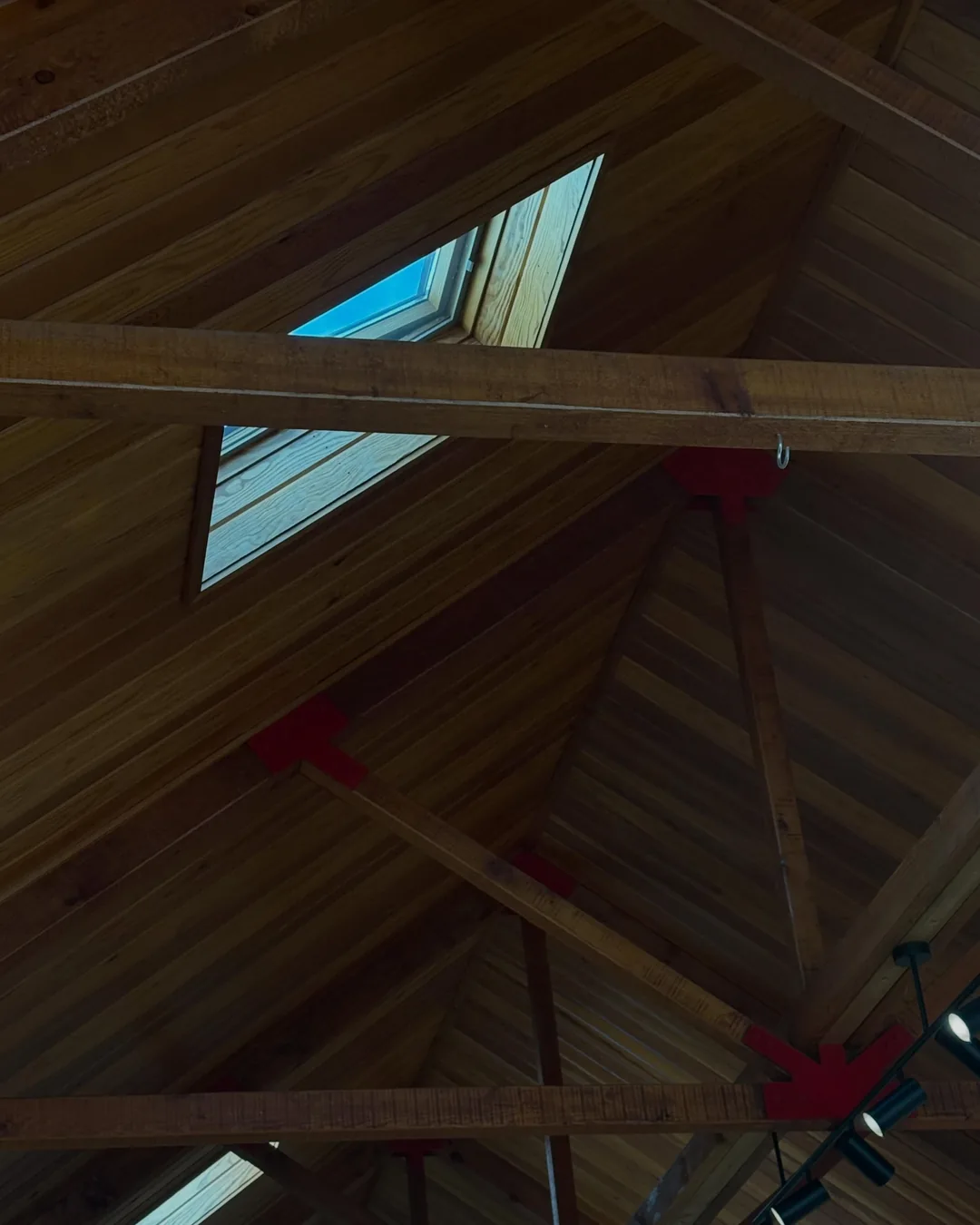
Cathedral ceilings are already angled toward the sky, so a skylight at the ridge is the most natural move in the book. Two rectangular skylights cut into a dark wood-panelled vault show plain blue sky, and the light falls straight down the middle of the room — no furniture below, no view to compete with, just the ceiling doing what it was built to do.
Skylights belong at the ridge rather than halfway down the slope. At the top they light the whole room evenly; lower down they throw a bright patch on one side and leave the other in shade. Look at the beam joints, too — red steel connection plates hold the timbers together, and on a dark ceiling they read as honest hardware rather than a flaw. Dark ceilings can carry that kind of detail; pale ones show every bolt.
The practical point: put the skylight where the ceiling is highest and the room is used most. Light falling on the middle of the room is the point; light falling on a wardrobe or a hallway is wasted.
Hang Sculptural Pendants from the Highest Point
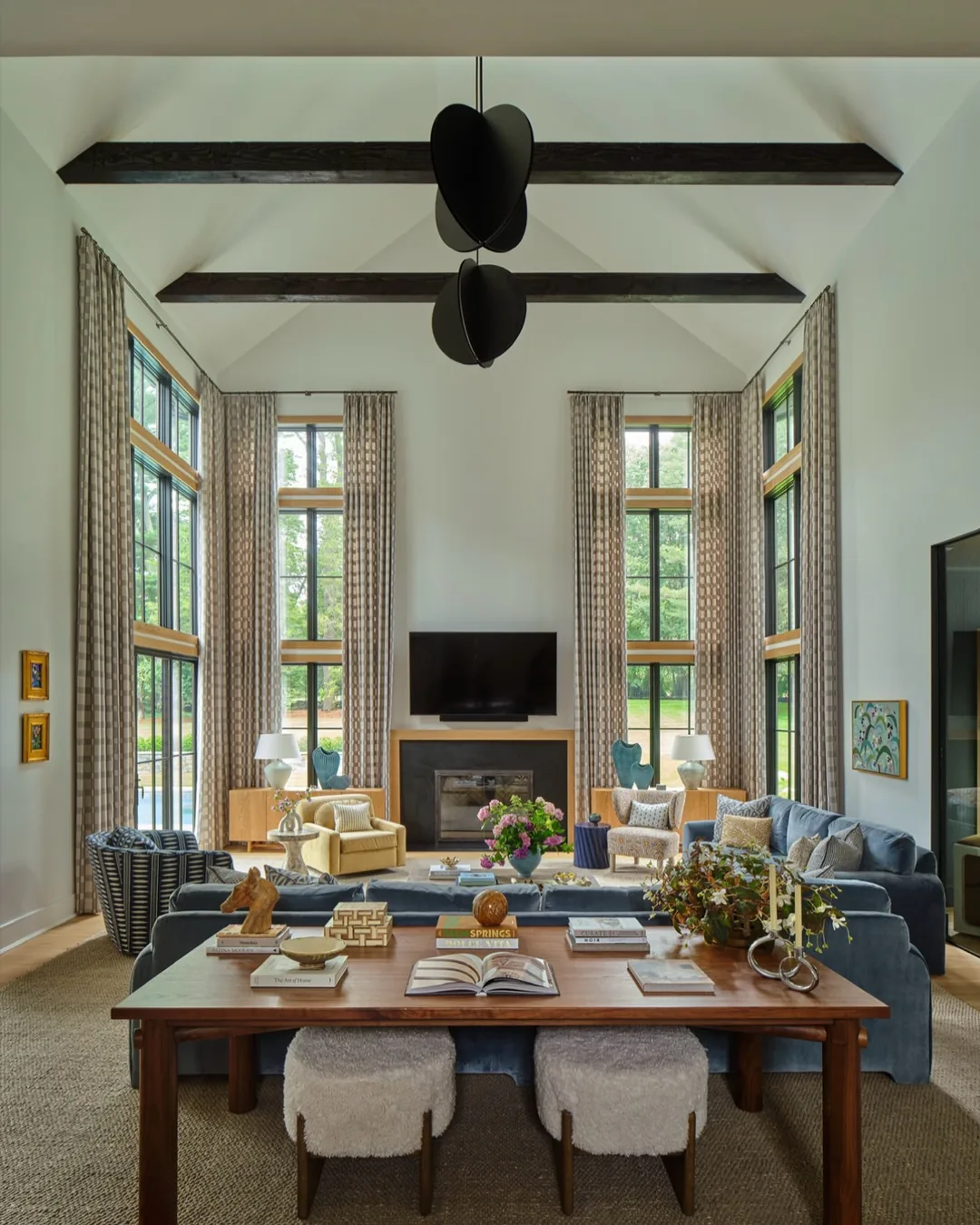
High ceilings have one obvious place for a light, and it is the highest point. Two black sculptural pendants hang in a line down the peak here, dark beams crossing above them, a blue sofa below and a dining table in the foreground — the pendants hang where the ceiling is tallest, and everything else in the room arranges itself around them. One pair of lights gives a tall ceiling a centre.
Sculptural pendants work because they are seen from below, which is exactly how you see a cathedral ceiling. A flat fitting disappears against the height; a pendant with a shape — rings, discs, a cluster of globes — holds its own against the beams. Hang them low enough to feel present, about seven feet off the floor, and centre them over the table or the sofa rather than the middle of the room.
The practical point: size the pendants to the ceiling, not the table. A pendant that looks big in the shop can vanish against a fourteen-foot vault — hold it up, or mock it up with cardboard, before you buy.
Does Dark Wood Make a Tall Room Feel Smaller?
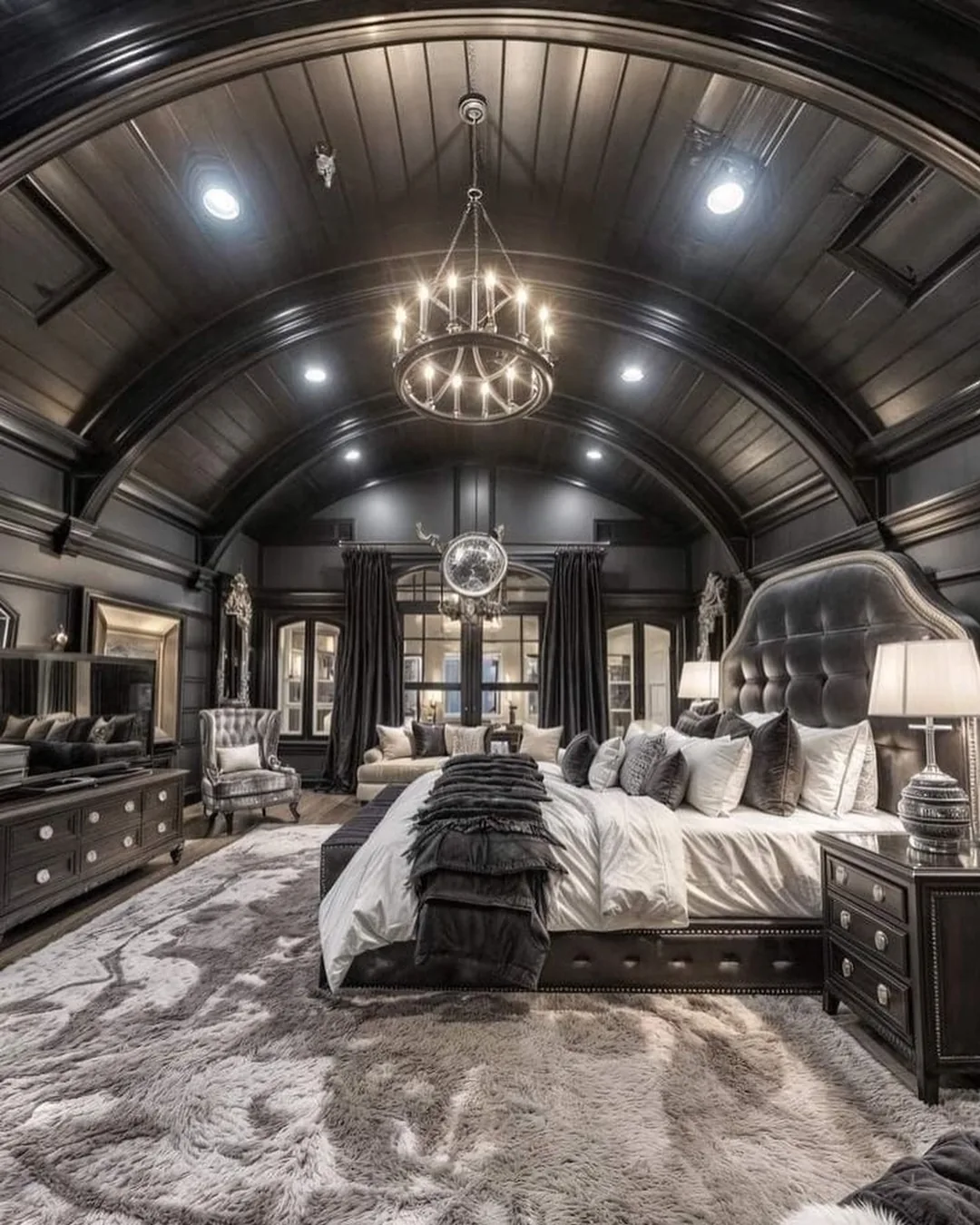
No — and this bedroom is the proof. A dark barrel-vaulted wood ceiling curves over a finished master bedroom, a tufted leather headboard with white linens and a dark throw below, a ring chandelier hanging from the peak, and a sitting area with an armchair before large windows with black curtains at the far end. The dark ceiling does not shrink the room; it wraps around it like a canopy, and the room feels grander for it.
Dark only fails when everything else goes dark with it. Keep the bedding pale, keep the rug light, and let the windows do their work — the dark vault above pale bedding reads as drama, not a cave. One dark surface is a feature; every surface dark is a decision you have to live with. There is even a disco ball by the far windows, and in this room it reads as part of the theatre rather than a joke — dark ceilings can carry that kind of confidence. If the rest of the room needs the same treatment at a smaller scale, these Bedroom Ceiling Designs That Give You a Reason to Look Up show how a ceiling can carry a bedroom.
The practical point: balance dark overhead with pale at eye level. If the bedding, the rug and the curtains are all light, the ceiling can go as dark as you like; darken those too and the room closes in.
Reclaimed Wood Brings a Story with It
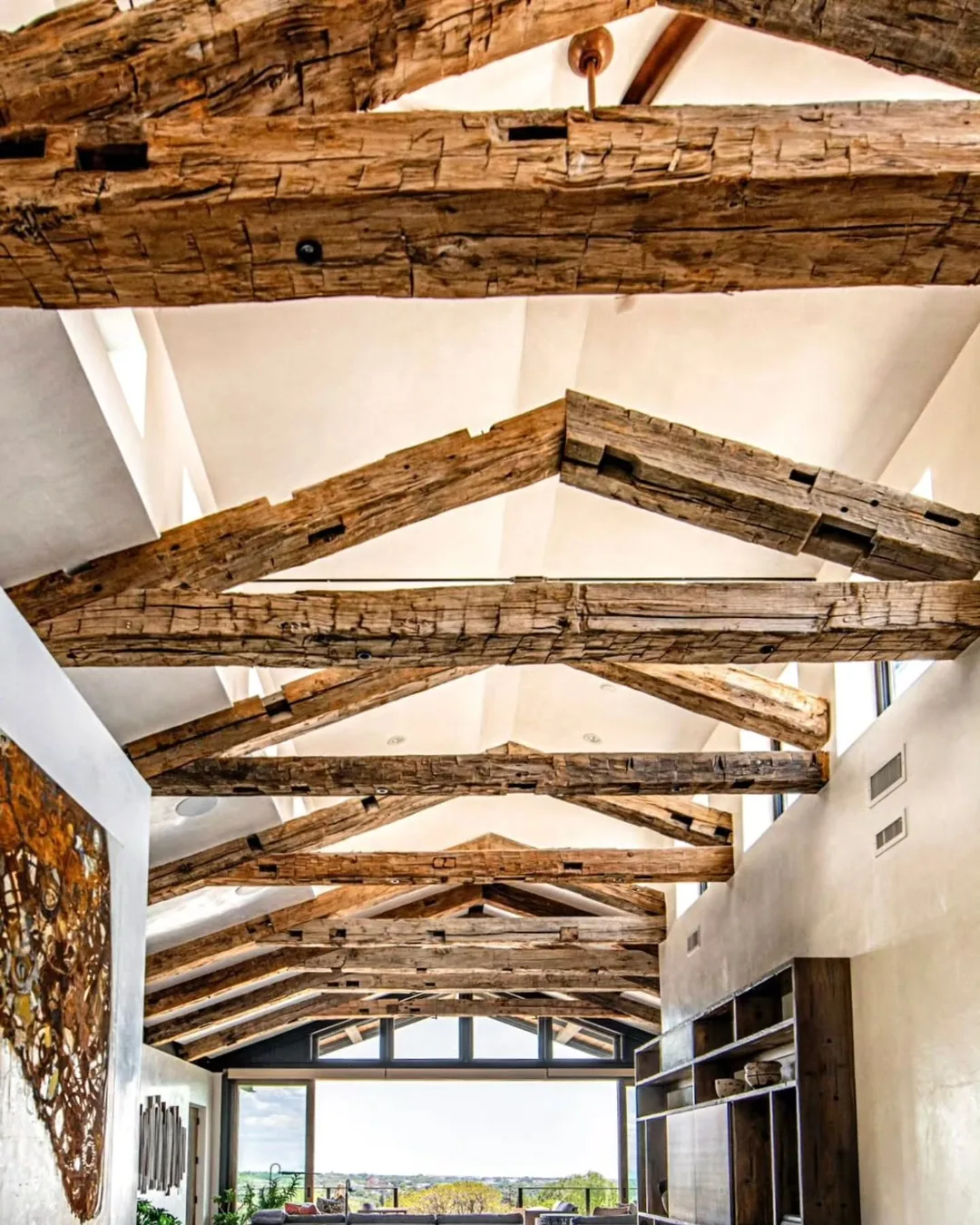
New wood is polite. Reclaimed wood has a past — hand-hewn trusses with mortise holes, cracks and patina spanning a white vaulted ceiling, a living area with big windows below, and every beam carrying the marks of the hands and years that shaped it. The beams are the story here; the room is just where the story lives now.
Reclaimed timber suits cathedral ceilings because the scale matches. Small reclaimed details get lost under a high vault; big hand-hewn trusses with visible joints hold their own against the height. Ask where the wood came from and what it was — a barn beam, a factory joist, a bridge timber — because the story is half the pleasure, and a beam with no story is just an expensive plank.
The practical point: check the wood is properly dried and treated before it goes overhead. Old timber can carry moisture, insects or old finishes that do not belong above a bed — a reputable supplier will have the paperwork, and a cheap one will not.
Ground the Height with Low, Solid Furniture
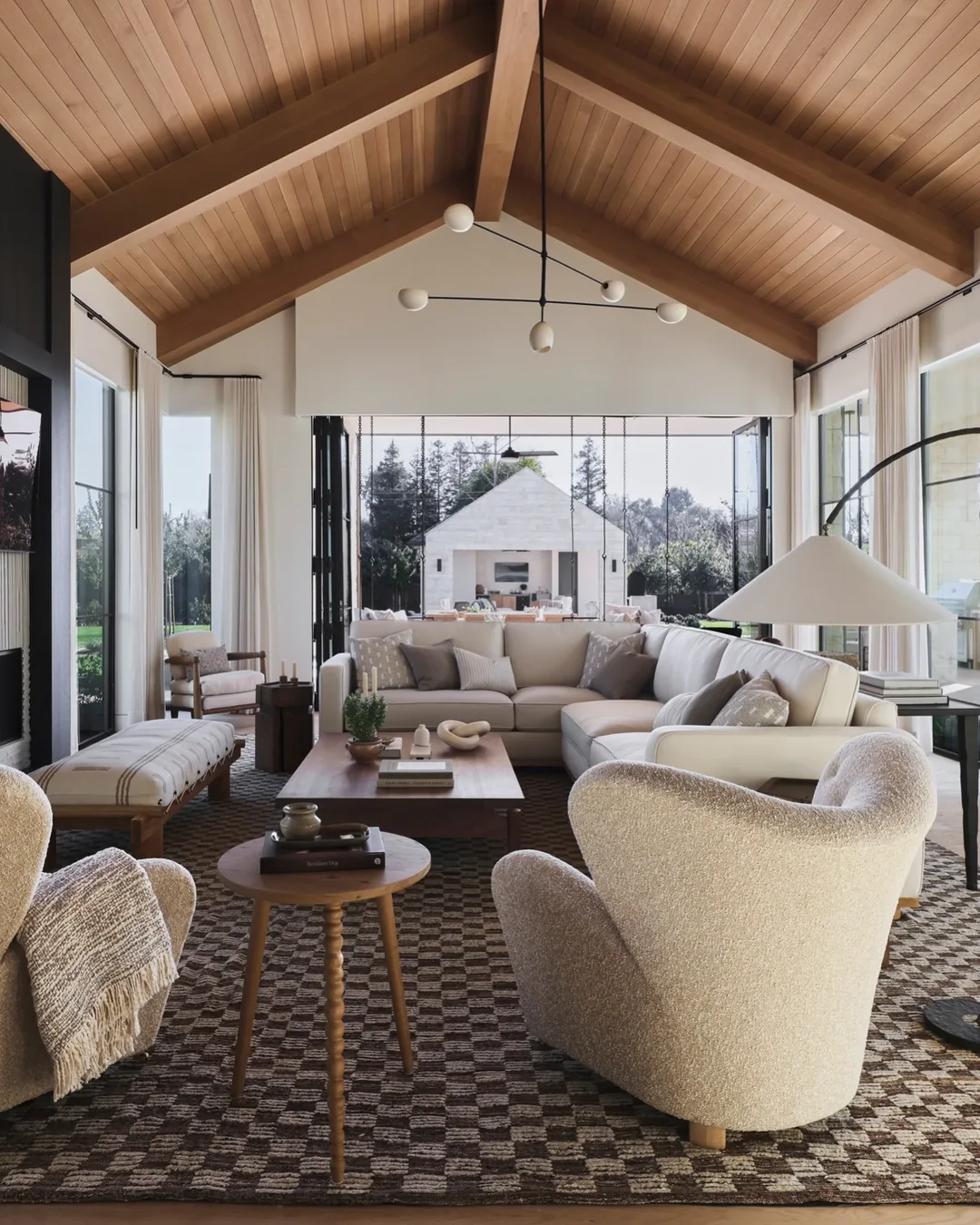
Tall ceilings have a floating problem: if everything in the room is tall, the room feels like a hall. Low furniture fixes it. A low cream sectional, low bouclé armchairs, a low striped bench and a low coffee table sit under a tall wood vault here, a patterned rug tying them together — the furniture reads distinctly low against the height, and the ceiling stops towering and starts sheltering.
Low works because it opens up the gap between the top of the furniture and the ceiling, and that gap is what the eye reads as air. A tall bookcase or a high-backed sofa under a vault eats that gap; a sectional that sits close to the floor gives it back. Keep the pieces solid, too — light, leggy furniture under a heavy wood ceiling looks lost, while solid low pieces hold their ground.
The practical point: measure the furniture against the ceiling, not against the room. A sofa that is fine in a flat room can look stubby under a fourteen-foot vault; go lower and wider than you think, and let the rug anchor the group.
Soften All That Wood with Layers of Textile
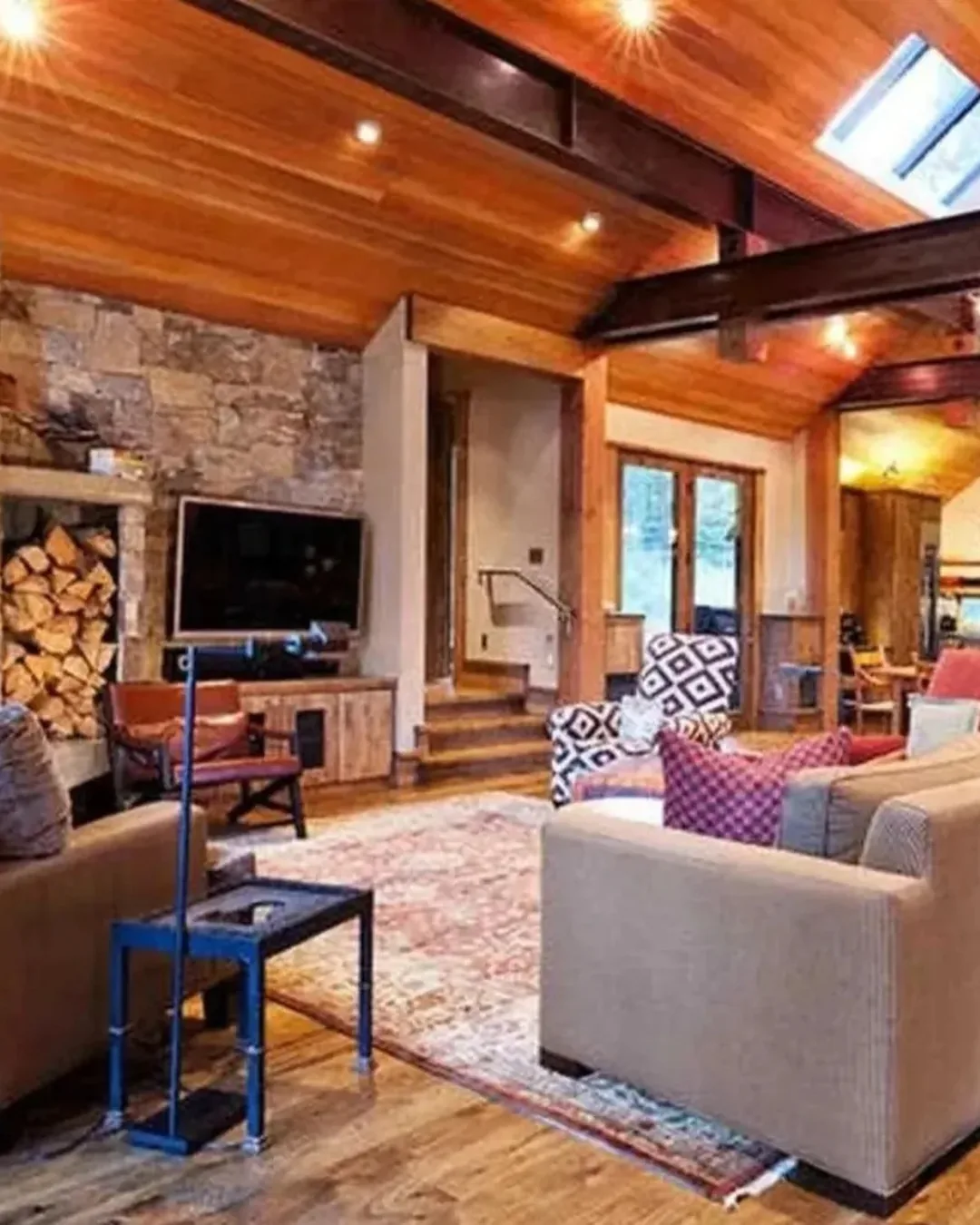
Wood is hard, and a room full of it can feel hard too — until the textiles arrive. A true vaulted wood ceiling with a skylight sits above a living room softened by magenta patterned cushions, a large patterned rug, a throw on the sofa and a stone fireplace with stacked firewood. The wood gives the room its bones; the textiles give it its softness.
Softness in a wood room comes from contrast, not quantity. One deep rug underfoot does more than five small cushions, and a single heavy throw across the sofa arm beats a pile of thin ones. Choose textiles that look touchable — nubby wool, washed linen, a rug you want to stand on barefoot — because a wood ceiling makes the eye expect hardness, and the hand wants the opposite.
The practical point: put the softest thing where you sit, not where you look. A throw folded on the sofa that you actually pull up in the evening is the difference between a styled room and a comfortable one.
Mix Stone and Wood for a Room That Feels Rooted
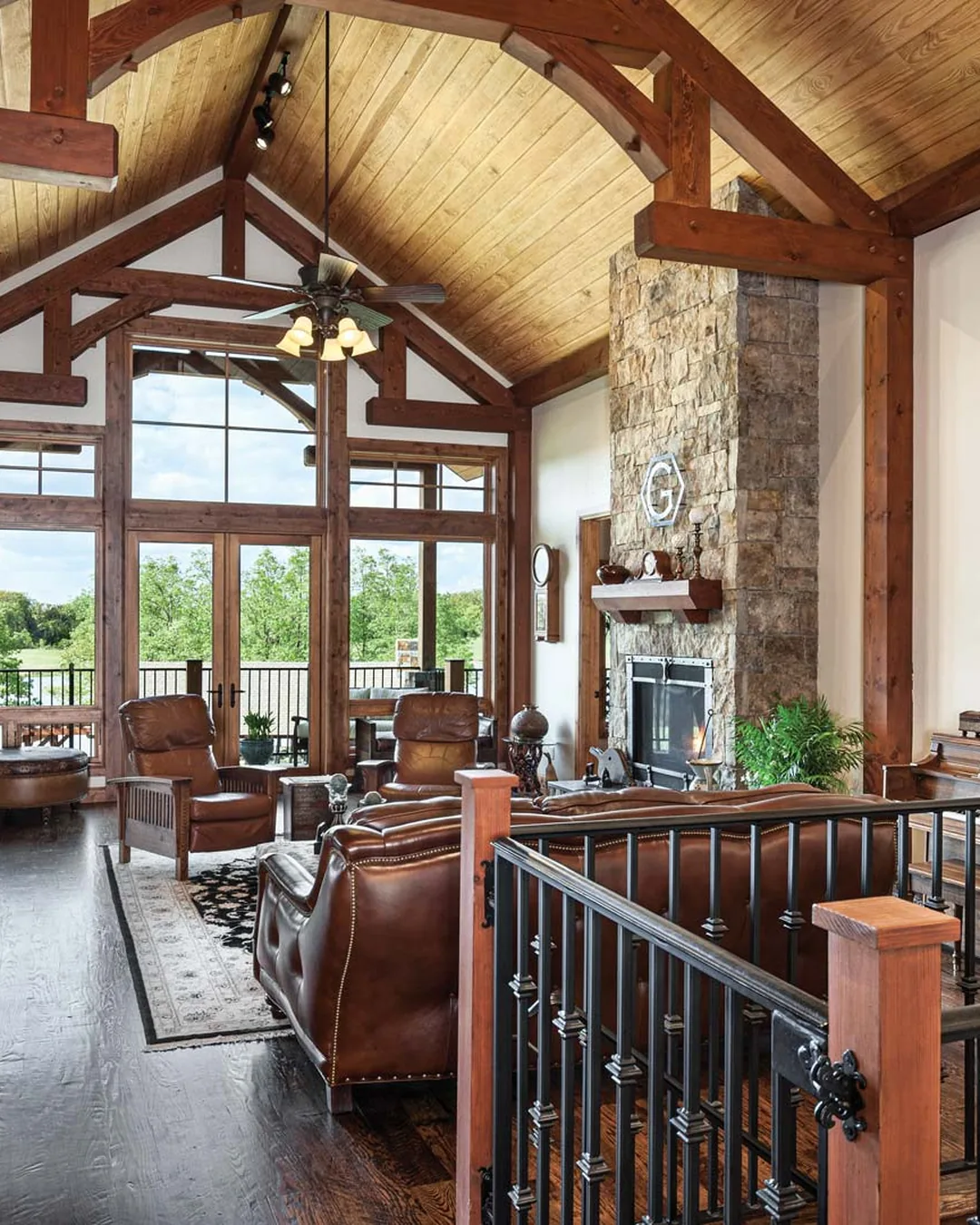
Stone and wood are the two oldest building materials, and together they make a room feel rooted — like it grew out of the ground rather than being built on it. A vaulted wood-plank ceiling with dark timber trusses spans this great room, a stone-clad fireplace with a wooden mantel stands on the right wall, and floor-to-ceiling windows bring the green trees in. Nothing in the room is pretending to be something else.
Stone works best as one strong element, not a theme. One fireplace wall in real stone, with a wooden mantel to tie it to the ceiling, is enough; stone on every wall turns a living room into a grotto. Keep the stone’s tone close to the wood’s — warm stone with warm wood, grey stone with dark timber — and the two materials will sit together instead of arguing.
The practical point: let the mantel do the joining. A wooden mantel on a stone fireplace is the handshake between the two materials — match it to the ceiling timber and the room reads as one piece.
Can a Wood Cathedral Ceiling Work in a Small Room?
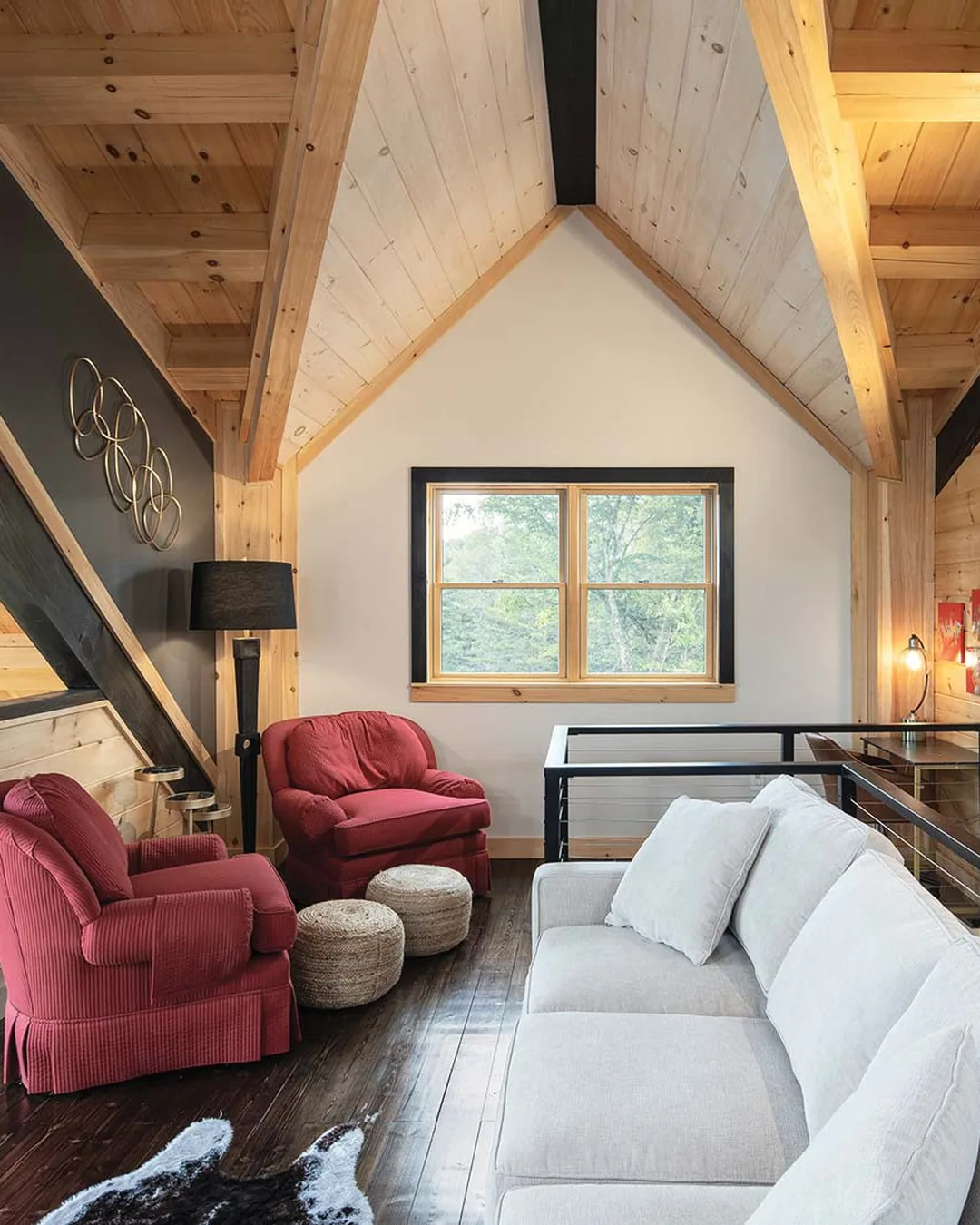
Yes — and the trick is that a small room with a high wood ceiling feels bigger than a small room with a low flat one. This compact attic loft proves it: a light sofa, two vivid red armchairs, woven ottomans and a black-and-white cowhide rug under a vaulted ceiling with exposed wooden beams, a dark grey accent wall, and large windows with a tree-filled view. The ceiling lifts the room; the furniture keeps it cosy.
Small rooms need the ceiling to do the lifting, so keep the furniture low and the palette tight. Wood, red, white and black carry this room — four colours, no more — and the beams draw the eye up instead of around the walls. A dark accent wall helps too: it gives the room depth without eating the light, as long as the windows are big enough to balance it. And if your ceiling slopes low instead of rising high, these Low Sloped Ceiling Bedroom Ideas That Feel Cozy, Not Cramped make a virtue of the angle instead.
The practical point: keep the furniture count low in a small vaulted room. One sofa, two chairs and a rug is a room; add a bookcase, a desk and a sideboard and the vault stops mattering because there is nowhere left to stand.
Painted Wood or Natural Grain — Which One Suits You?
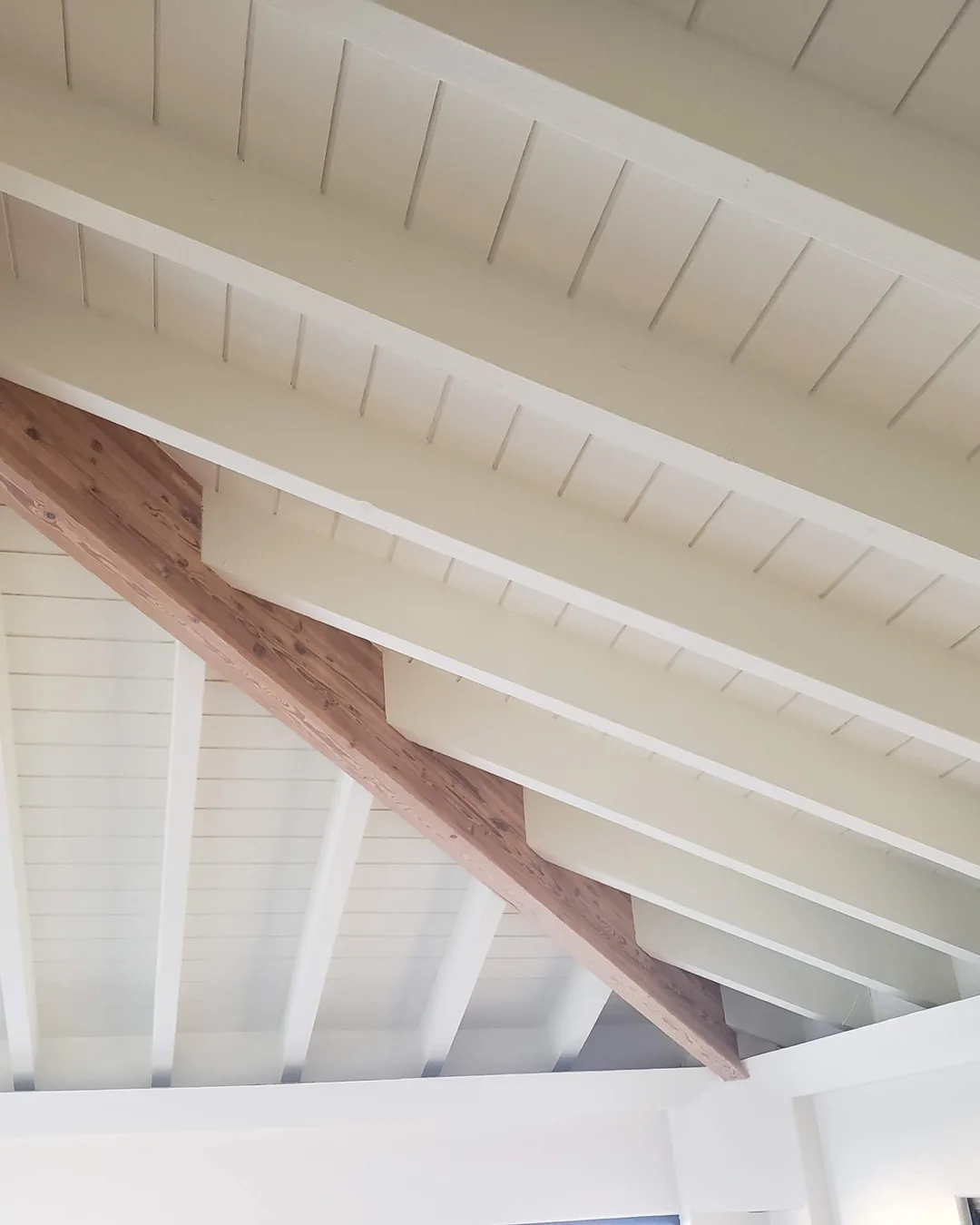
Every wood ceiling forces one decision, and this photo settles it by refusing to choose: a high vaulted ceiling of white tongue-and-groove panelling with evenly spaced white-painted rafters, crossed by one thick natural-finish wooden beam. Painted wood and natural wood in the same frame — the white keeps the room bright, the single dark beam keeps it warm.
Painted wood suits rooms that need light more than they need warmth. White panelling bounces daylight around a tall room, and the grain still shows faintly through the paint, so the ceiling reads as wood rather than plaster. Natural grain suits rooms that already have plenty of light and need the wood to do the warming. When you cannot decide, do what this room does: paint the field and leave one beam natural — the contrast is the design.
The practical point: paint a test board and hold it up at the ceiling before you commit. White paint on a ceiling reads a shade darker than the same white on a wall, and a grain you love at eye level can vanish entirely under a coat of paint.
Let the View Outside Do Half the Work
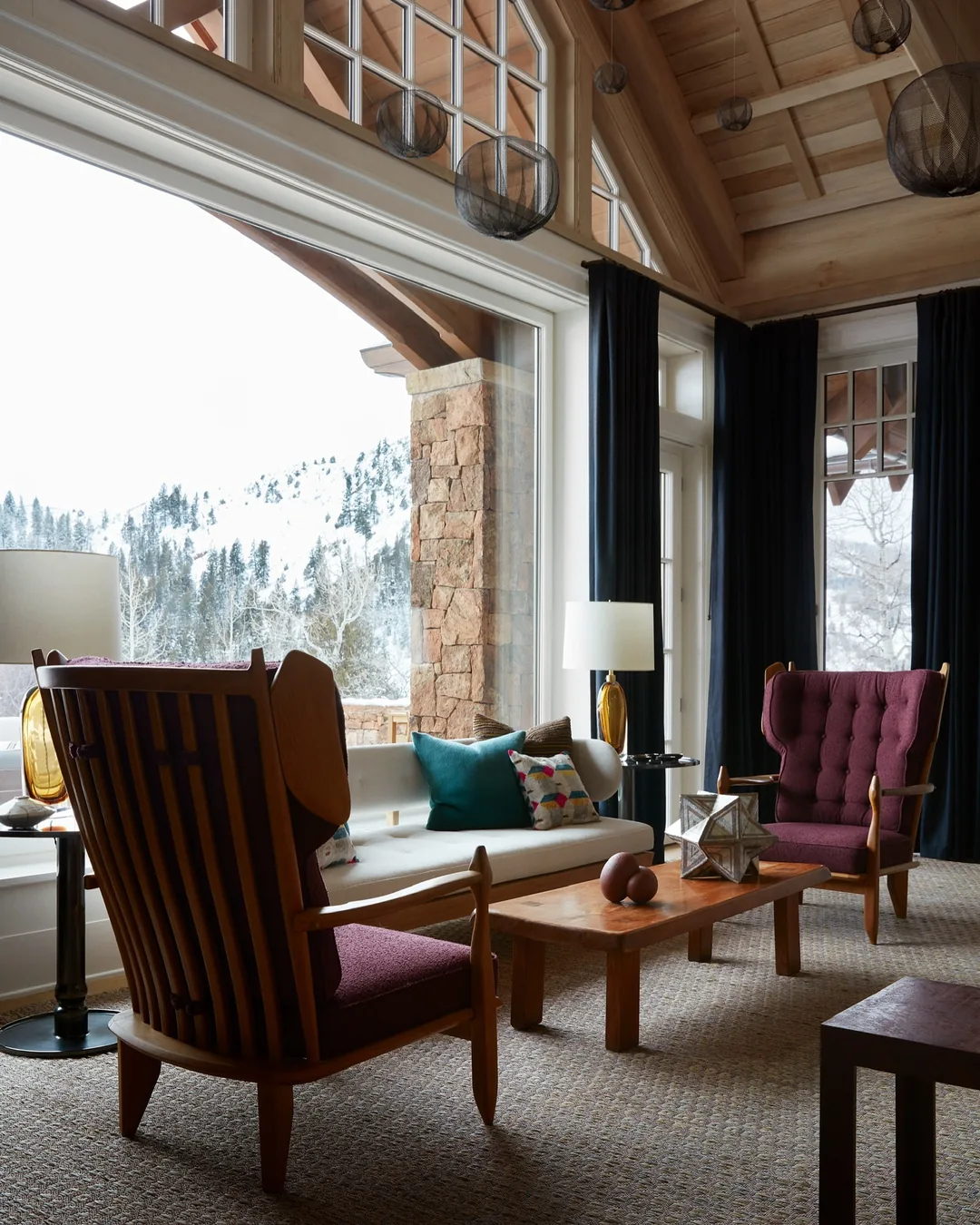
High wood ceilings frame a view the way a picture frame frames a painting — and the view does half the decorating for you. High vaulted wood beams cross this ceiling, floor-to-ceiling windows open onto snow-covered mountains and evergreens, burgundy armchairs and a light sofa with teal pillows sit below, and a low wooden coffee table with spherical mesh pendants keeps the middle of the room quiet. Nobody looks at the furniture first; the mountains win.
Views need the room to get out of the way. Keep the window wall free of tall furniture, keep the colours calm so they do not compete with the landscape, and let the ceiling’s wood tone echo something outside — the dark beams here pick up the evergreens, the warm floor picks up the sunlit snow. A view you have to look past a bookcase to see is not a view at all.
The practical point: hang nothing on the window wall. Curtains, if you need them, should stack clear of the glass; art belongs on the side walls, where it does not fight the landscape.
Carve Out a Cosy Corner Under the Vault
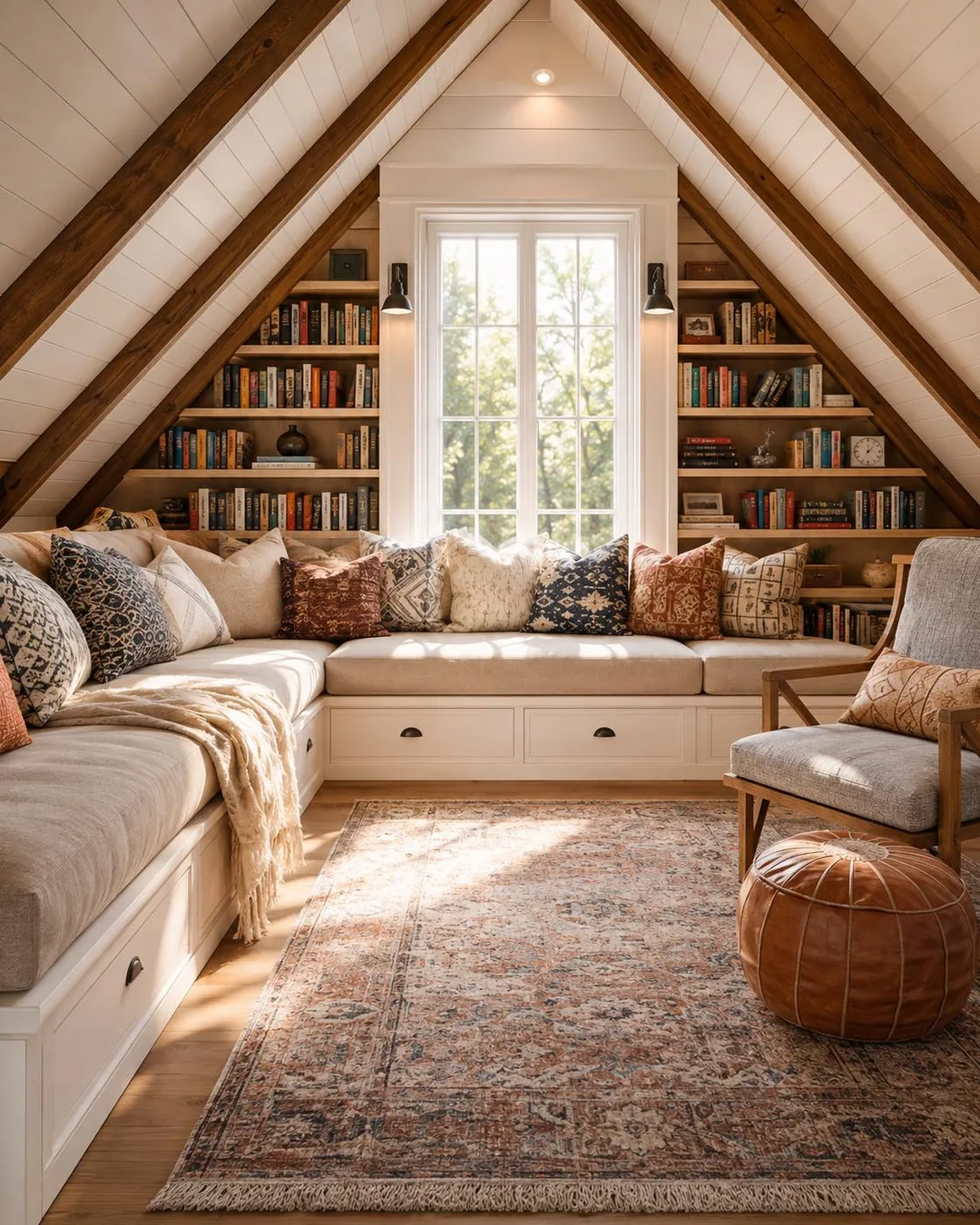
Tall ceilings can make a room feel grand, but grand is not the same as cosy — cosy needs a corner. This bright vaulted attic reading lounge has one: white shiplap vault with dark wood beams converging to a tall central window, built-in bookshelves flanking the window, an L-shaped built-in banquette with patterned pillows, a light-grey armchair with wooden arms, a round leather pouf and a vintage rug. The vault is still there above you; the corner is where you actually sit.
Corners work because they give the height somewhere to land. Bookshelves on both sides of the window, a banquette built into the angle, a rug that defines the floor — each one pulls the scale down to human size without touching the ceiling. Keep the corner’s palette soft and the textures touchable, and the tallest room in the house gains its most-used seat.
The practical point: build the corner around one window, not one wall. Daylight is what makes a reading corner get used; a corner built around a blank wall becomes a place for things, not for people.
Warm from Above
None of these ideas needs a new roof or a big budget. A coat of paint here, a beam there, a skylight at the ridge, a rug underfoot — the ceiling is the biggest surface in the room, and wood is the warmest thing you can put on it. Try one of these ideas, sit down underneath it, and look up: the room will feel taller and warmer at the same time, which is the whole point of a cathedral ceiling.