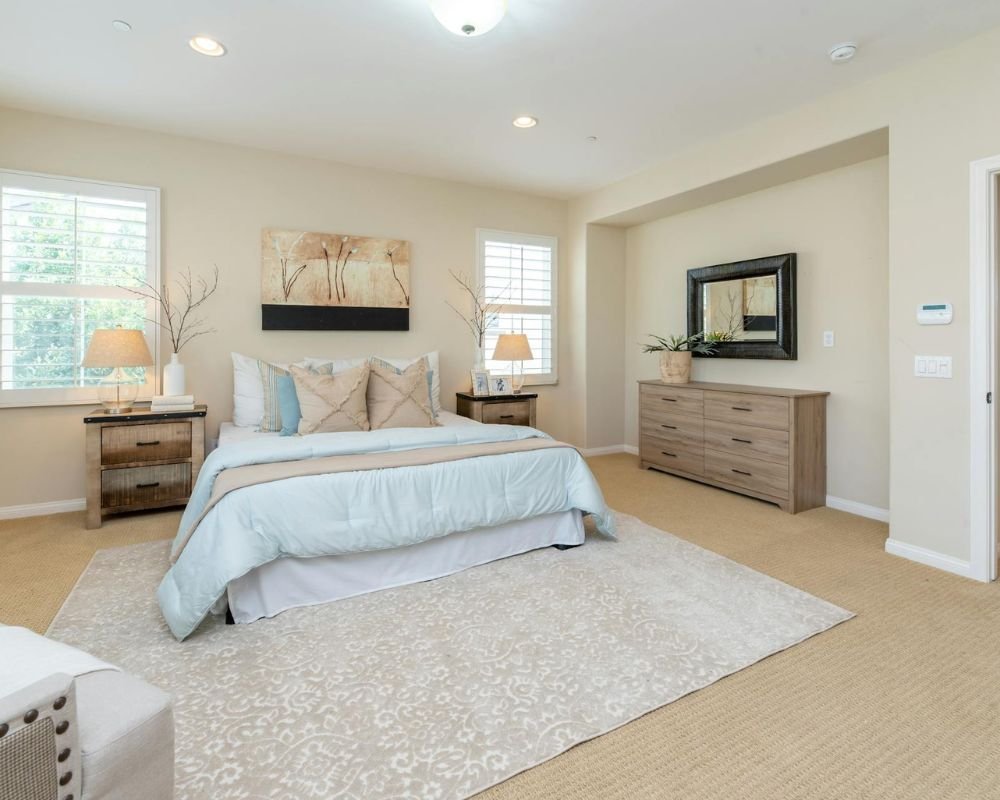
Lie flat on your back in bed tonight and look up. Chances are you will see the plainest surface in the whole house — flat white paint, maybe a light fitting you stopped noticing years ago, and nothing else. It is the one part of the bedroom you actually stare at every single night, and somehow it is the last thing anyone thinks to decorate.

It does not need much. A ceiling does not need to shout; it just needs something worth looking at. Bedroom ceiling designs work best when they give the room a quiet kind of interest — texture above the bed, a beam that draws the eye across, a colour that makes the whole room feel warmer after dark.
Here are 15 ideas that do exactly that, from coffered ceilings and exposed beams to a ceiling painted like the night sky — and a bedroom that finally feels finished from the floor to the top of the walls.
A Coffered Ceiling That Frames the Whole Room
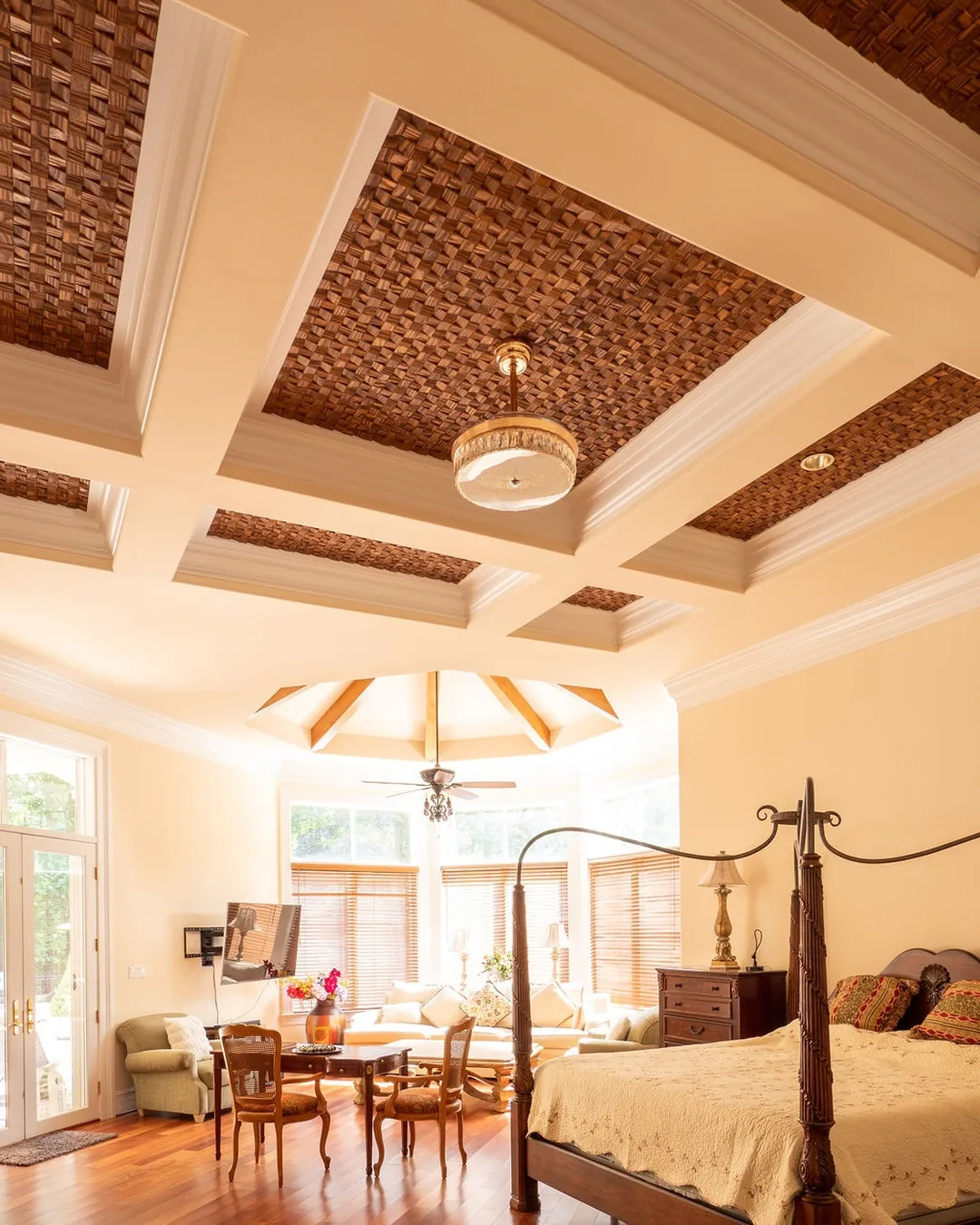
A coffered ceiling turns the whole ceiling into a piece of furniture. Deep square panels with woven-wood texture inside them, a four-poster bed below, light coming in from a bay window — the ceiling is the first thing you notice walking in, and it makes the room feel considered rather than simply furnished. Coffers suit bedrooms with a bit of height, nine feet or more, because the depth of the panels needs room to breathe.
Proportion is the trick. Panels about two feet square read calm; anything much smaller starts to look busy, and anything much bigger loses the grid effect altogether. Paint the coffers the same colour as the ceiling for a quiet version, or pick out the beams in a slightly deeper tone if you want the grid to show. Either way, keep the bed simple underneath — a coffered ceiling and a fussy headboard fight each other for attention.
The practical point: measure the ceiling height before you commit. Coffers need at least nine feet, and the deeper the panel, the more height they eat.
Leave the Beams Exposed
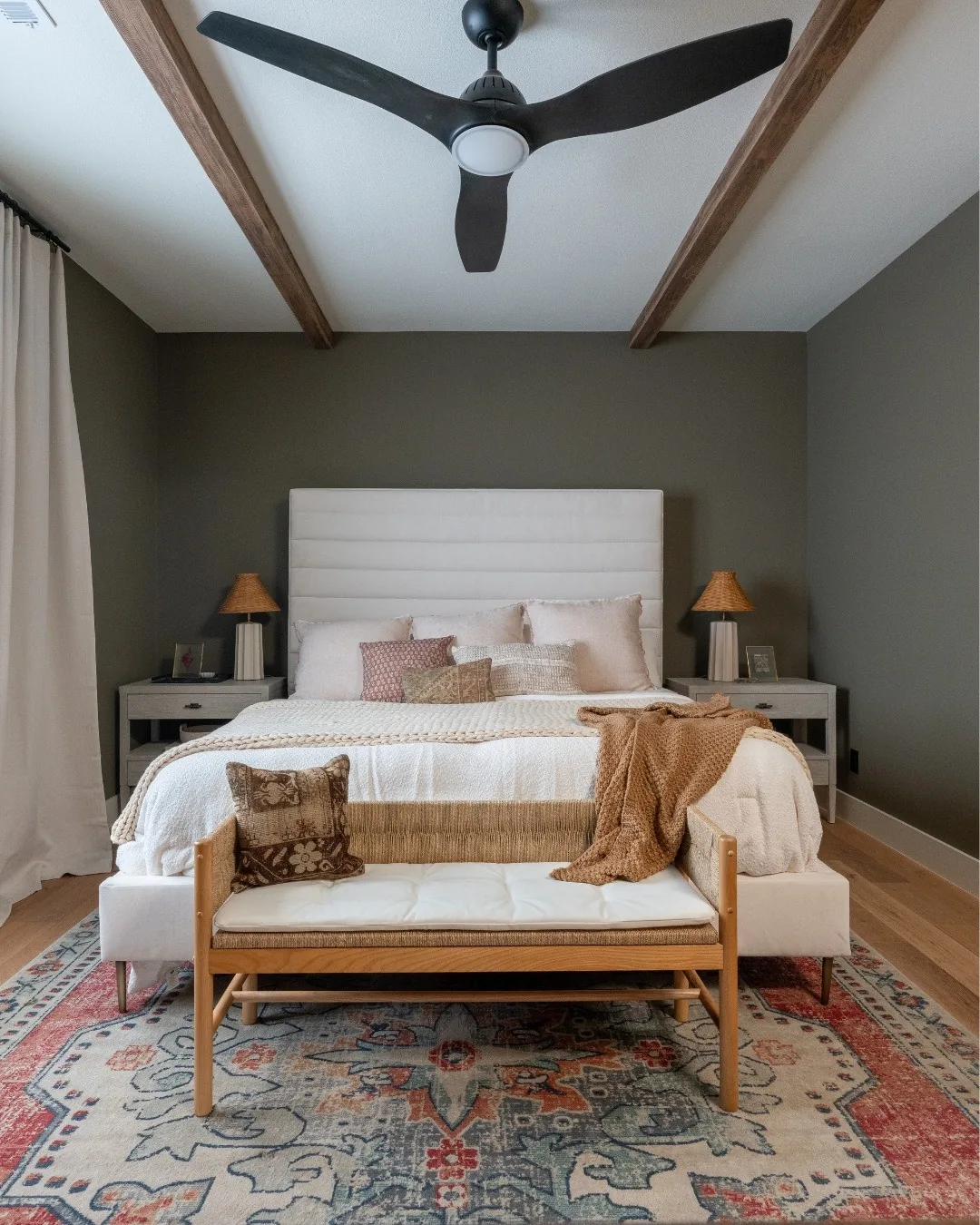
Some bedrooms already have the best ceiling design hiding above a layer of plasterboard. Dark wood beams crossing a white shiplap ceiling, a black ceiling fan hanging between them, a white bed with a bench at its foot — the beams do all the decorating the room needs. They give a flat ceiling a direction to look in, and they make a plain room feel built rather than decorated.
Exposed beams work on a flat ceiling, which is the whole point here: no vault, no slope, just straight beams across a level surface. Paint them dark against a white ceiling and they read bold; leave them pale wood and they read soft. The ceiling underneath matters less than the beams themselves — in this room it happens to be white shiplap, but the beams would carry the look on plain plaster too.
The practical point: space beams about four feet apart and keep them the same depth. Uneven spacing is the one thing that makes exposed beams look accidental instead of deliberate.
Why a Tray Ceiling Works in a Small Bedroom
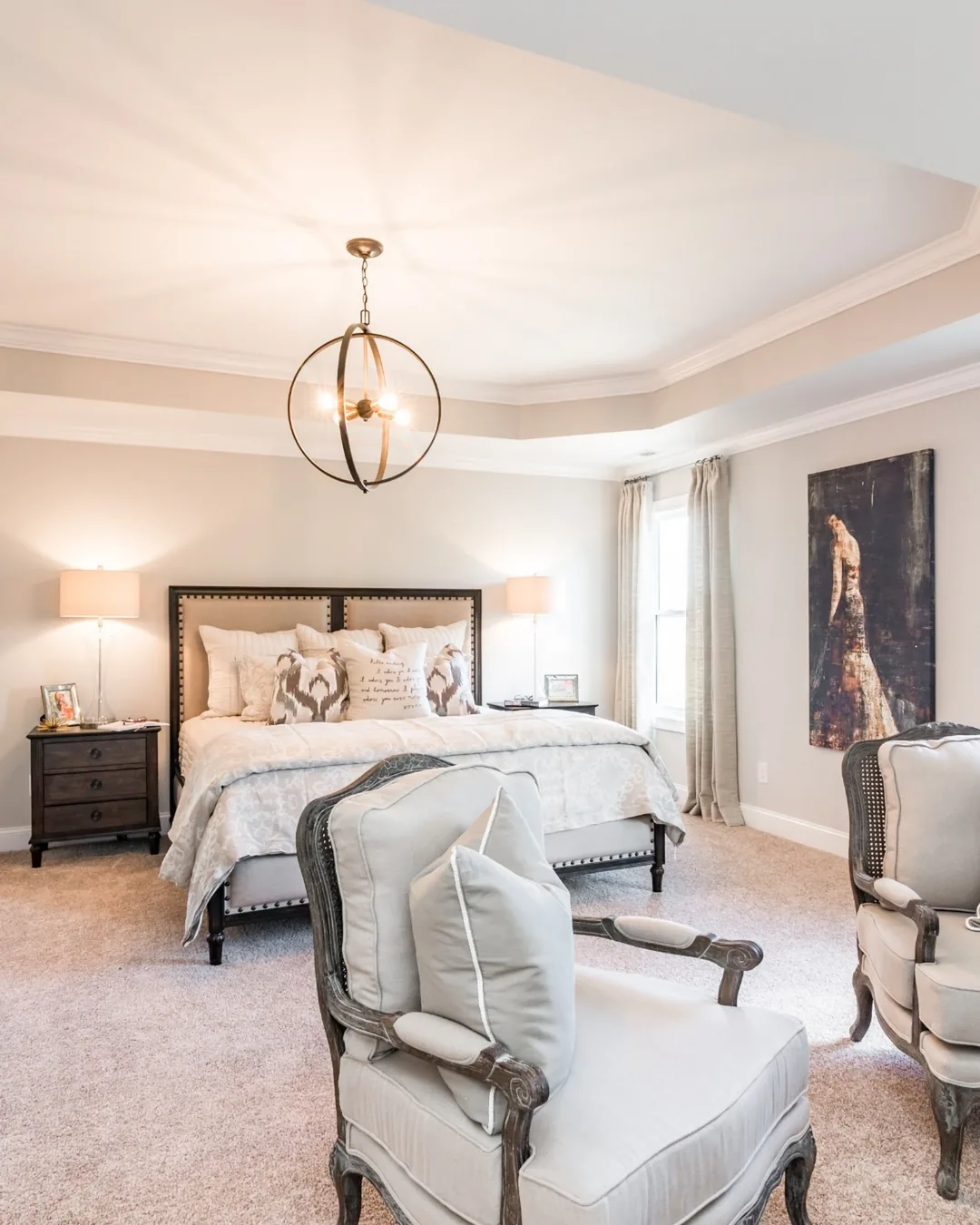
A tray ceiling is a shallow step up in the middle of the ceiling — a recessed panel that makes the room feel taller than it is. A white tray with an orb chandelier hanging in the middle of it, a bed and two armchairs below: the recess reads clearly even from the doorway, and the whole room gains a sense of height it does not actually have. That is why it works so well in a small bedroom, where every inch of perceived height counts.
In the photo, the idea appears in a larger room, but the effect is the same at any size — and in a small room it matters more. If the rest of the room needs the same treatment, these Ways to Make a Small Bedroom Look Bigger Than Its Square Footage use the same kind of visual tricks at eye level. Paint the inside of the tray a shade lighter than the rest of the ceiling, or add a thin LED strip around its edge, and the recess deepens. Keep the chandelier small, though: a tray ceiling with an oversized light hanging in it defeats the whole purpose.
The practical point: keep the tray shallow — four to six inches of recess is plenty. Any deeper and it starts to look like a hole in the ceiling instead of a design feature.
Shiplap Overhead, Painted White
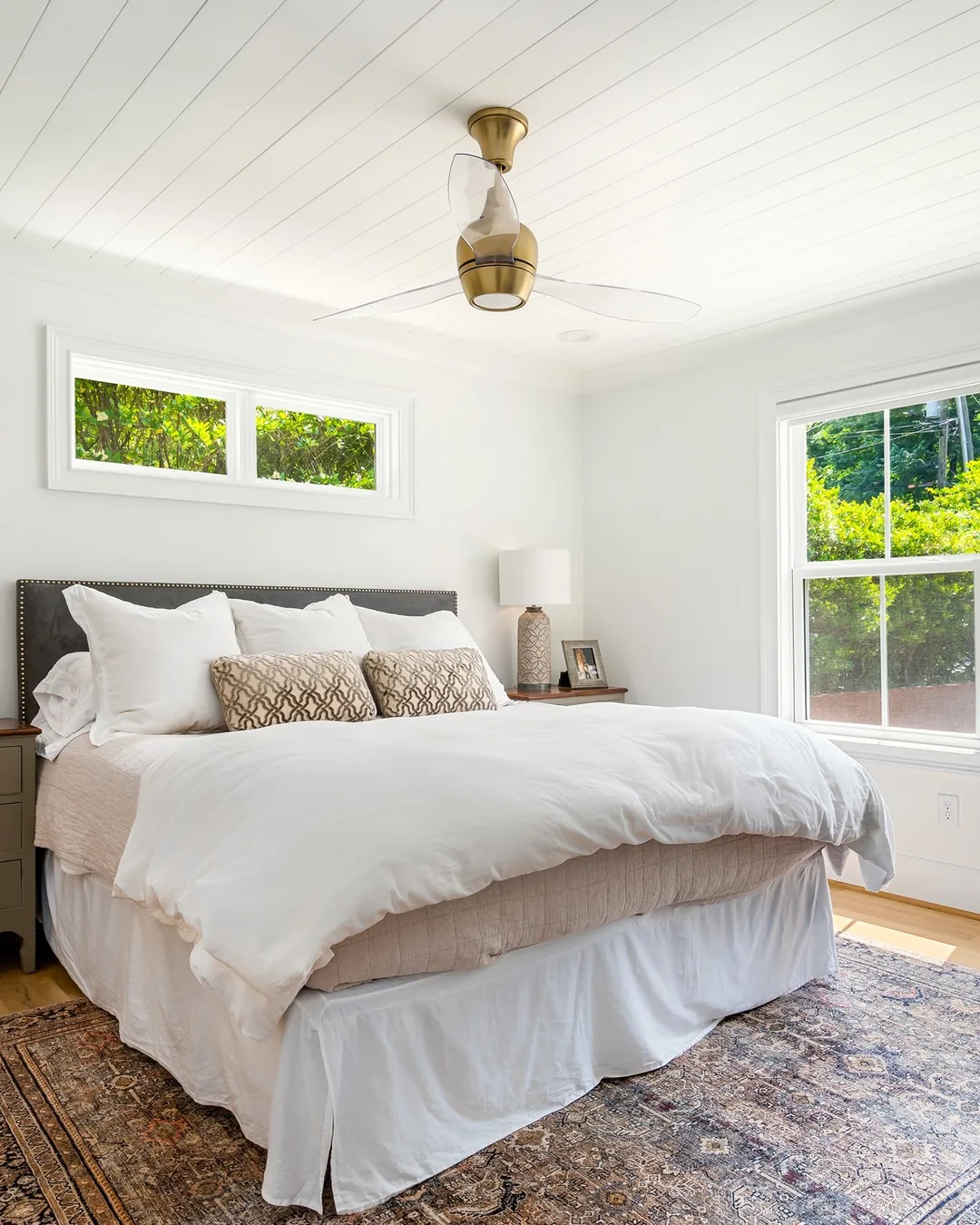
Shiplap on a ceiling does something paint never can: it gives the ceiling a texture you can see from the bed. White painted planks running across the ceiling, a brass fan in the middle, a bed with white linens below and big windows letting the green outside in — the ceiling feels calm and finished without a single extra decoration. It is the same material people put on walls, but overhead it reads completely differently.
Paint it white and the planks nearly disappear into the ceiling, which is the point: you get texture without colour, and the room stays light. Leave the wood natural and the ceiling becomes the warmest thing in the room, which suits a bedroom better than a living room. Either way, run the planks across the short side of the room — planks running the long way make a narrow room feel like a corridor.
The practical point: use real tongue-and-groove boards, not stick-on strips. Stick-on shiplap peels at the edges within a year, and overhead is the worst place for it to fail.
Wallpaper the Ceiling, Not the Walls
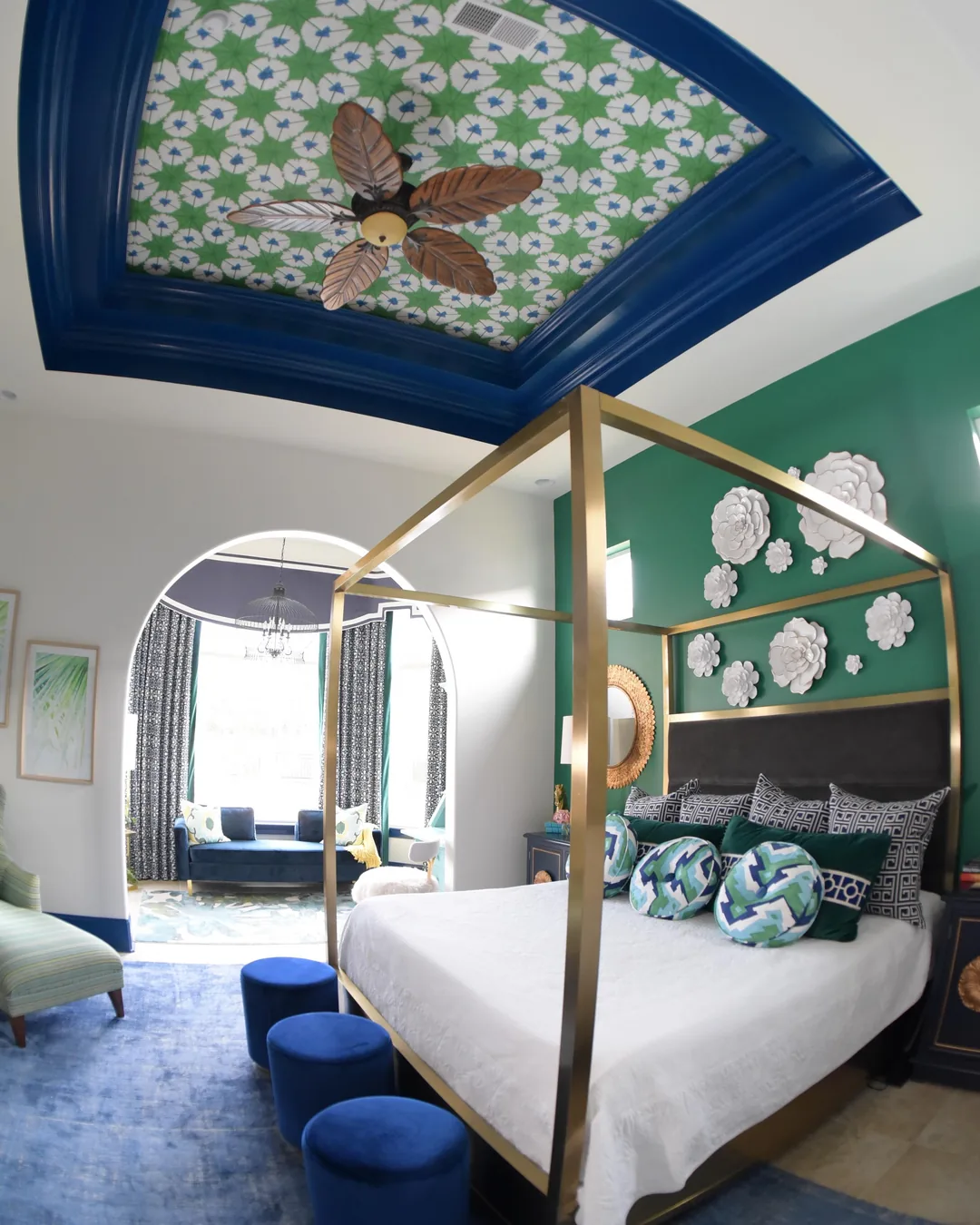
Here is the boldest idea in this list, and the easiest to get wrong: paper the ceiling and leave the walls plain. A green-and-white floral wallpaper inside a blue-trimmed tray ceiling, green painted walls below, a gold four-poster bed — the patterned ceiling is unmistakable at a glance, and the walls being plain paint is what makes it work. Paper the walls too and the room would close in on itself.
Choose a pattern with a small repeat and a light background, because a ceiling pattern is always seen at an angle and from a distance. Big dark florals overhead feel heavy; small light ones feel like a canopy. Paste it carefully — a ceiling is the hardest surface in the house to paper, and every crooked seam shows from the bed.
The practical point: hire a paperhanger for a ceiling, even if you paper your own walls. Gravity is not on your side up there, and a bad ceiling job cannot be hidden.
Paint It Dark and Let the Room Glow
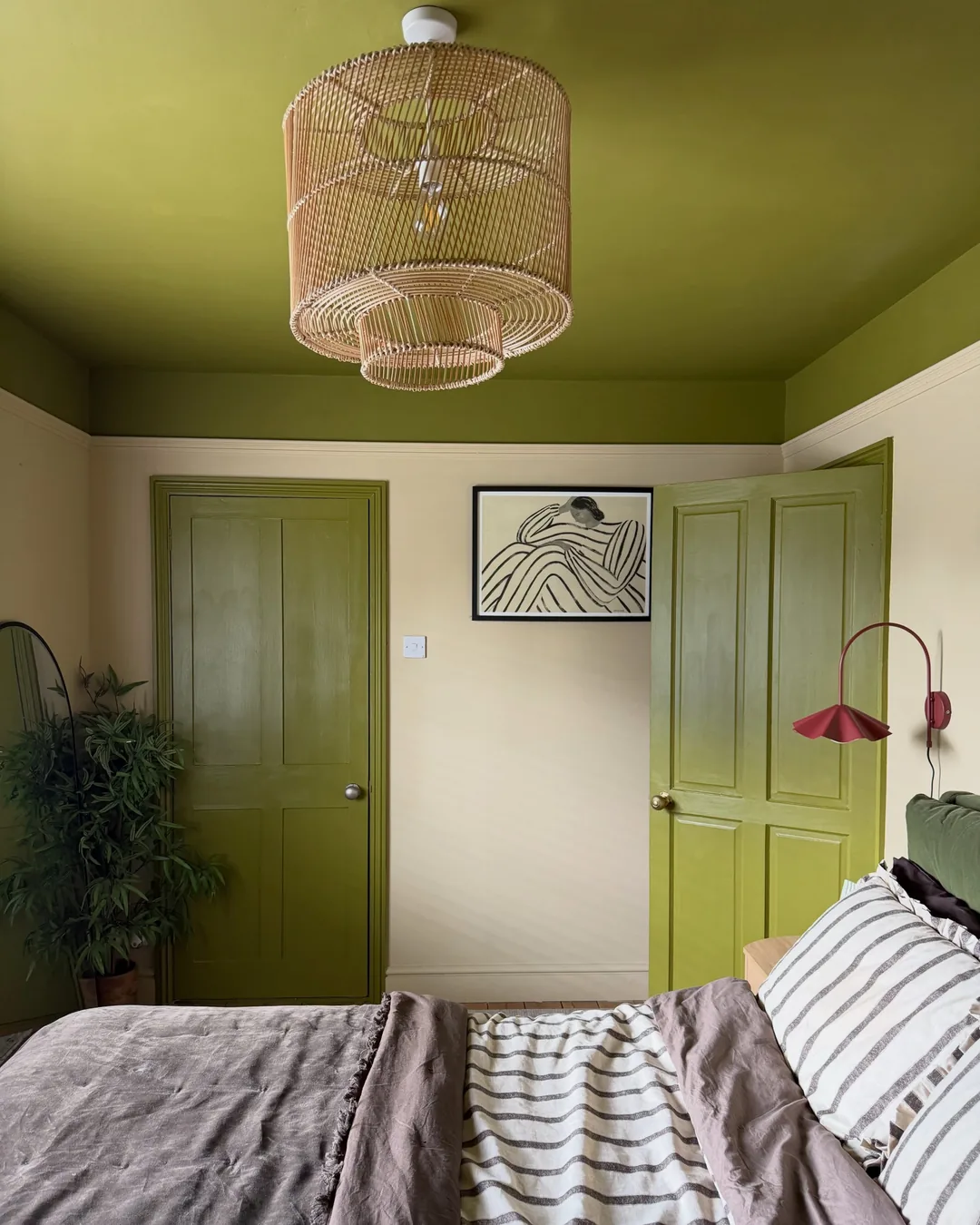
Dark does not have to mean black. An olive-green painted ceiling with a big rattan pendant hanging low, matching green panelled doors, striped bedding below — the ceiling is a saturated mid-tone, not near-black, and the room glows warm because of it. Dark ceilings work in bedrooms precisely because bedrooms are meant to feel enclosed after dark; a dark ceiling pulls the room in around you like a blanket.
The rule is simple: if you paint the ceiling dark, keep the walls lighter and the lighting warm. Dark ceiling plus dark walls plus cool white bulbs is a cave; dark ceiling plus pale walls plus warm lamplight is a cocoon. One dark surface is a feature; every surface dark is a decision you have to live with.
The practical point: paint a test patch at least a metre square and live with it for a week. A dark ceiling looks different at 7 a.m. than it does at 11 p.m., and the evening view is the one that matters.
Pressed Tin Tiles for a Vintage Ceiling

Pressed tin tiles are the fifth wall’s best-kept secret. An elaborate black tin ceiling — square tiles with floral and geometric embossing, deep relief catching the light — filling the whole frame, dark wood panelling at the bottom edge. The pattern is so detailed it does the work of a chandelier, a mural and a moulding all at once, and it suits a bedroom with a vintage streak better than any modern ceiling treatment.
Real tin is heavy and needs a solid ceiling to fix to; modern faux-tin panels in PVC or polystyrene are lighter, cheaper and far easier to fit, and from the bed nobody can tell the difference. Paint them black for drama, or white for a ceiling that reads like carved plaster. Either way, keep the rest of the room quiet — a tin ceiling with busy bedding is too much pattern in one place.
The practical point: order one extra box of tiles beyond what you measure. Tin patterns have to line up across the ceiling, and the offcuts at the edges eat more tiles than you expect.
Beadboard That Makes a Low Ceiling Feel Taller
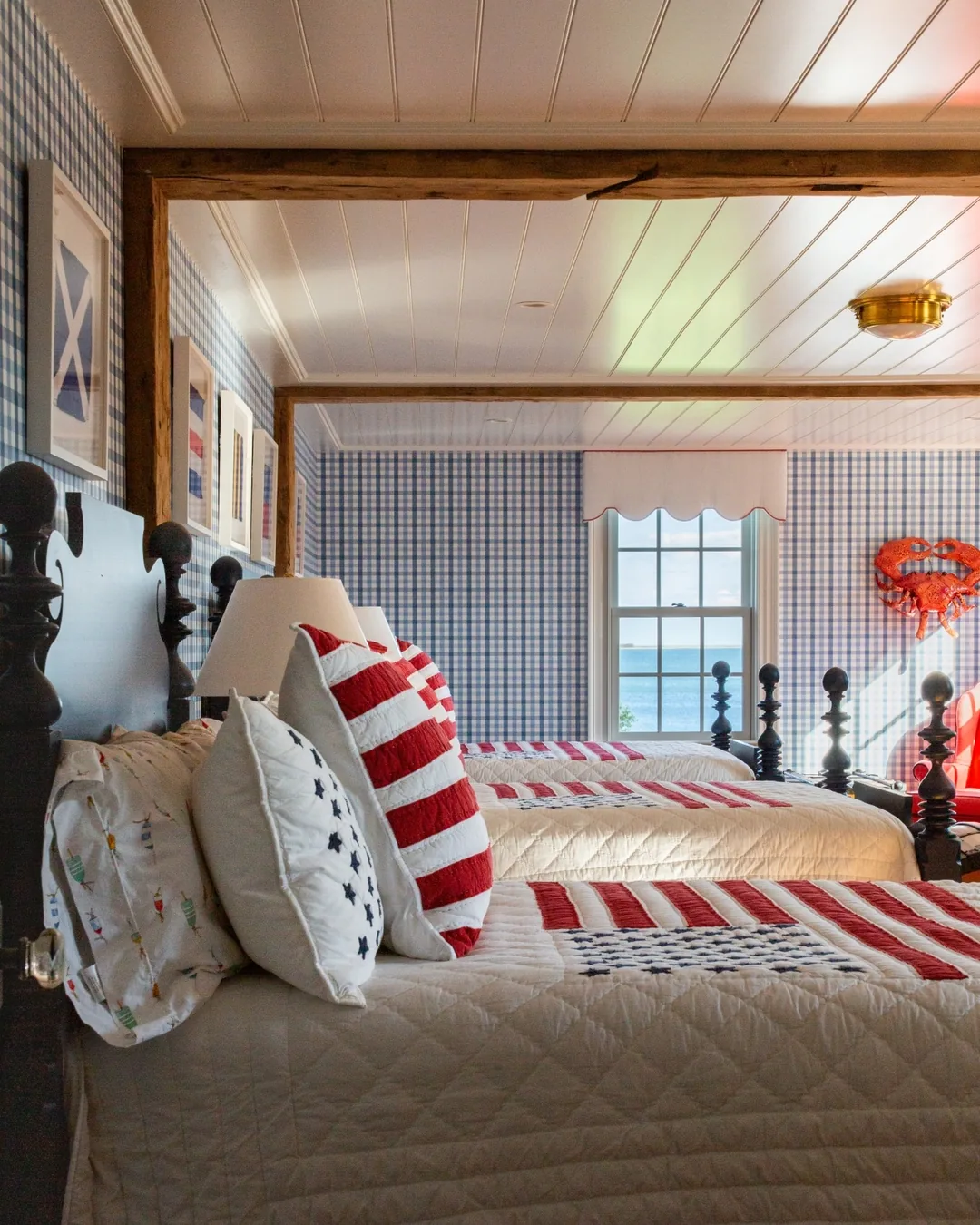
A low ceiling feels lower when it is blank, and taller when it has a direction to it. White beadboard-style planks running across the ceiling of a nautical guest bedroom — three twin beds in red, white and blue below, gingham wallpaper on the walls — give the eye lines to follow, and lines going across a room make it feel wider and taller than it is. It is a small visual trick with a big payoff in a room that cannot grow any taller.
Look closely and the planks read as wide tongue-and-groove boards with wood beams rather than classic narrow beadboard strips, but the effect is the same: the ceiling gains texture and the room gains height. Paint them white and they disappear into the ceiling; paint them a pale blue or sage and they become a feature in their own right. If you are working on a guest room, these Guest Room Decorating Ideas Inspired by Beautiful Weekend Retreats carry the same calm, welcoming feeling through the rest of the room.
The practical point: run the planks across the shortest wall of the room. Planks running the long way stretch a room out; planks running the short way widen it.
Picture-Frame Moulding, Up High
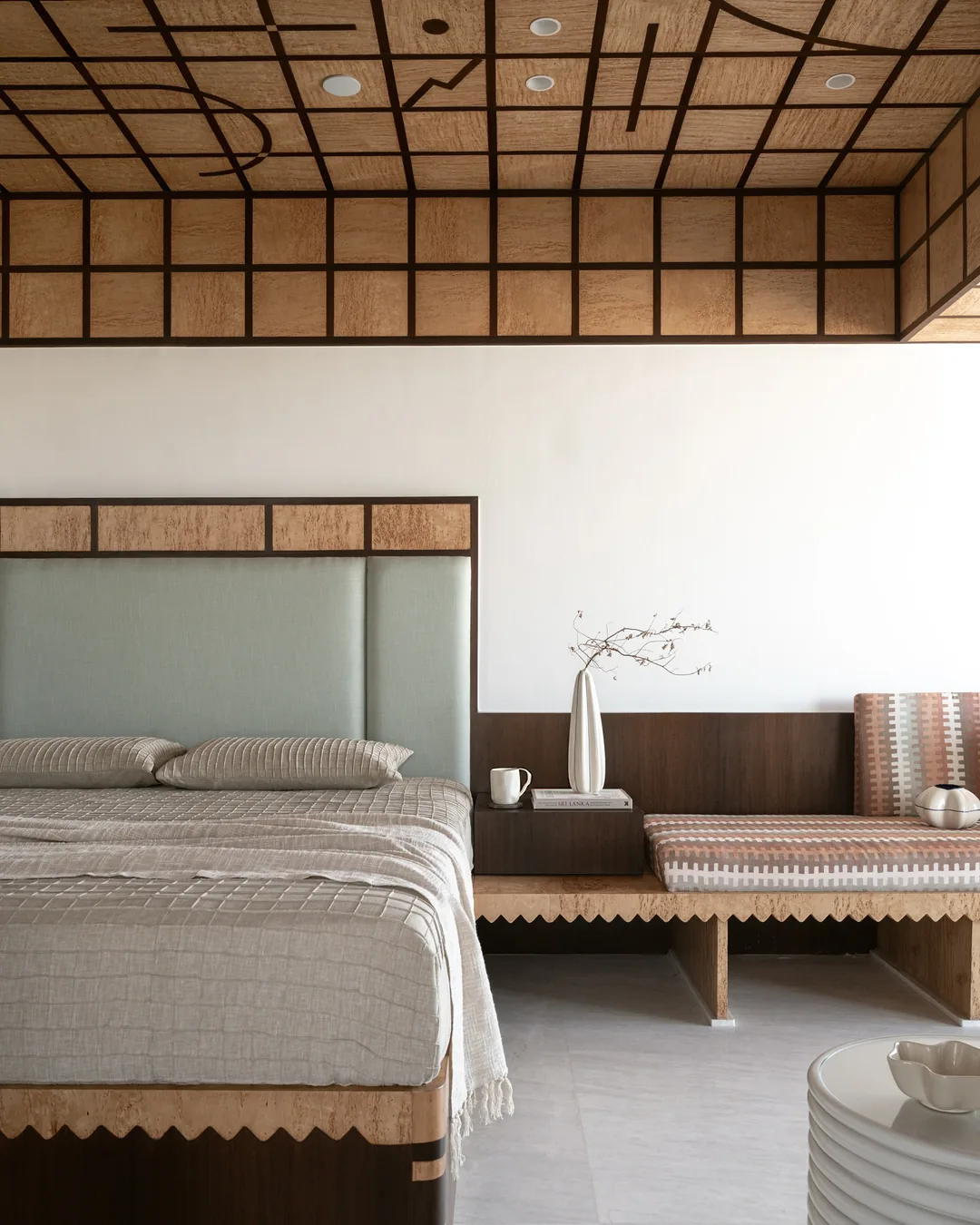
Picture-frame moulding belongs on ceilings as much as on walls. A dark-wood grid of framed square panels over woven insets, spanning the top of a contemporary bedroom above a pale green upholstered bed — the ceiling reads as a series of framed pictures, and the room gains a tailored, finished look without a single new piece of furniture. It is the same idea as wall moulding, turned ninety degrees.
The classic version is white plaster moulding on a white ceiling, but this dark-wood version proves the idea works in any material. The grid is what matters: evenly spaced rectangles, crisp corners, the same proportions repeated across the whole ceiling. Measure twice and use a laser level — a moulding grid that drifts even a centimetre off square is visible from the bed for years.
The practical point: keep the rectangles in proportion to the ceiling. On a low ceiling, use wide flat rectangles; on a high one, taller panels suit the height.
Hang One Statement Light in the Middle
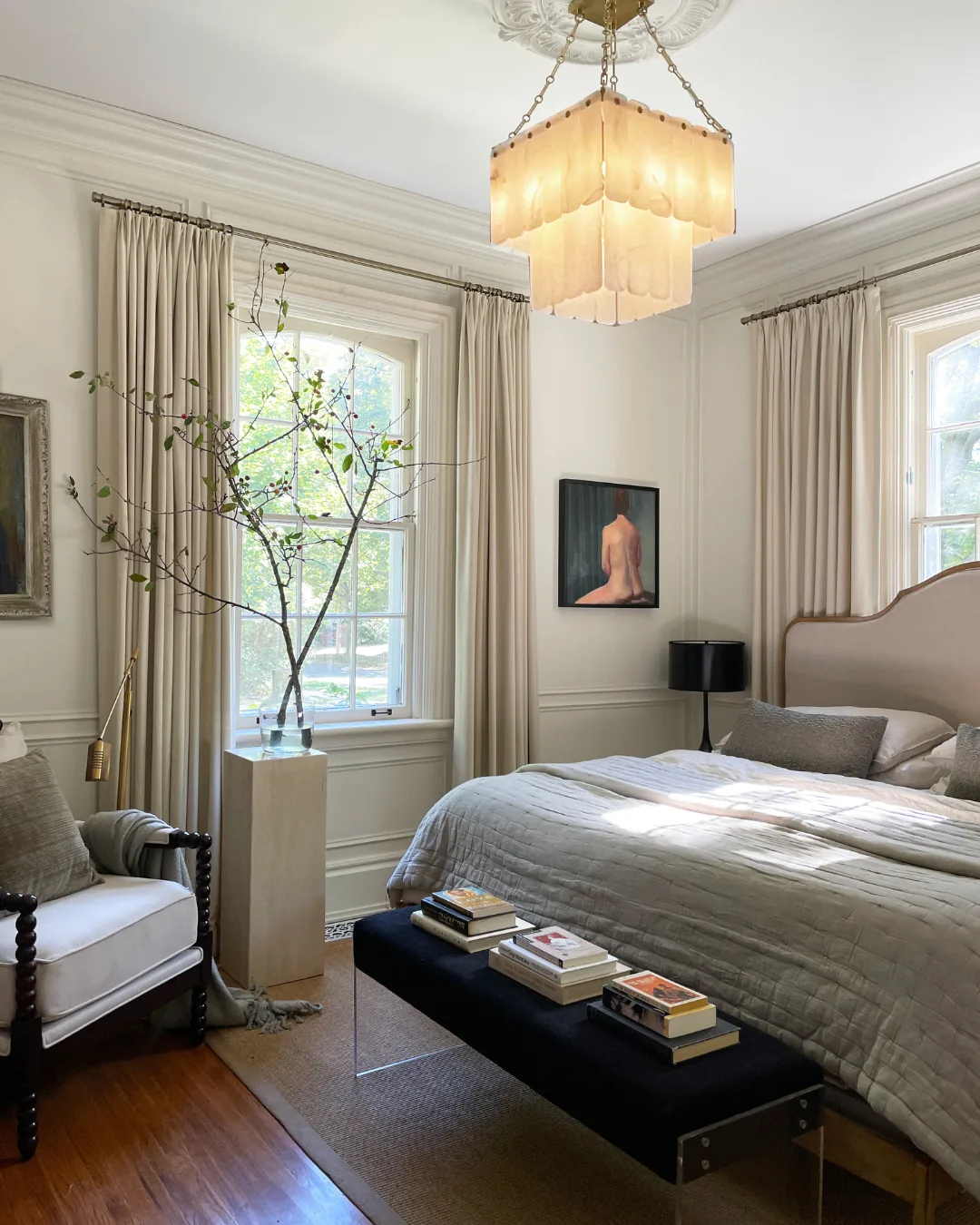
Sometimes the ceiling does not need a new surface at all — it needs one thing hanging from it. A large glowing tiered chandelier in the middle of a traditional bedroom, centred over the bed, windows and curtains on both sides: the light is the ceiling’s centrepiece, and everything else in the room arranges itself around it. A statement light gives a plain ceiling a reason to exist.
Size matters more than style. A chandelier that is too small looks lost; one that is too big crowds the room. The old rule still works: add the room’s length and width in feet, and that number in inches is roughly the right diameter for the fixture. Hang it so the bottom sits about seven feet off the floor — low enough to feel present, high enough that nobody walks into it.
The practical point: centre the light over the bed, not over the middle of the room. In a bedroom, the bed is the centre, and a light hung anywhere else looks like a mistake.
Hide the Light in a Cove
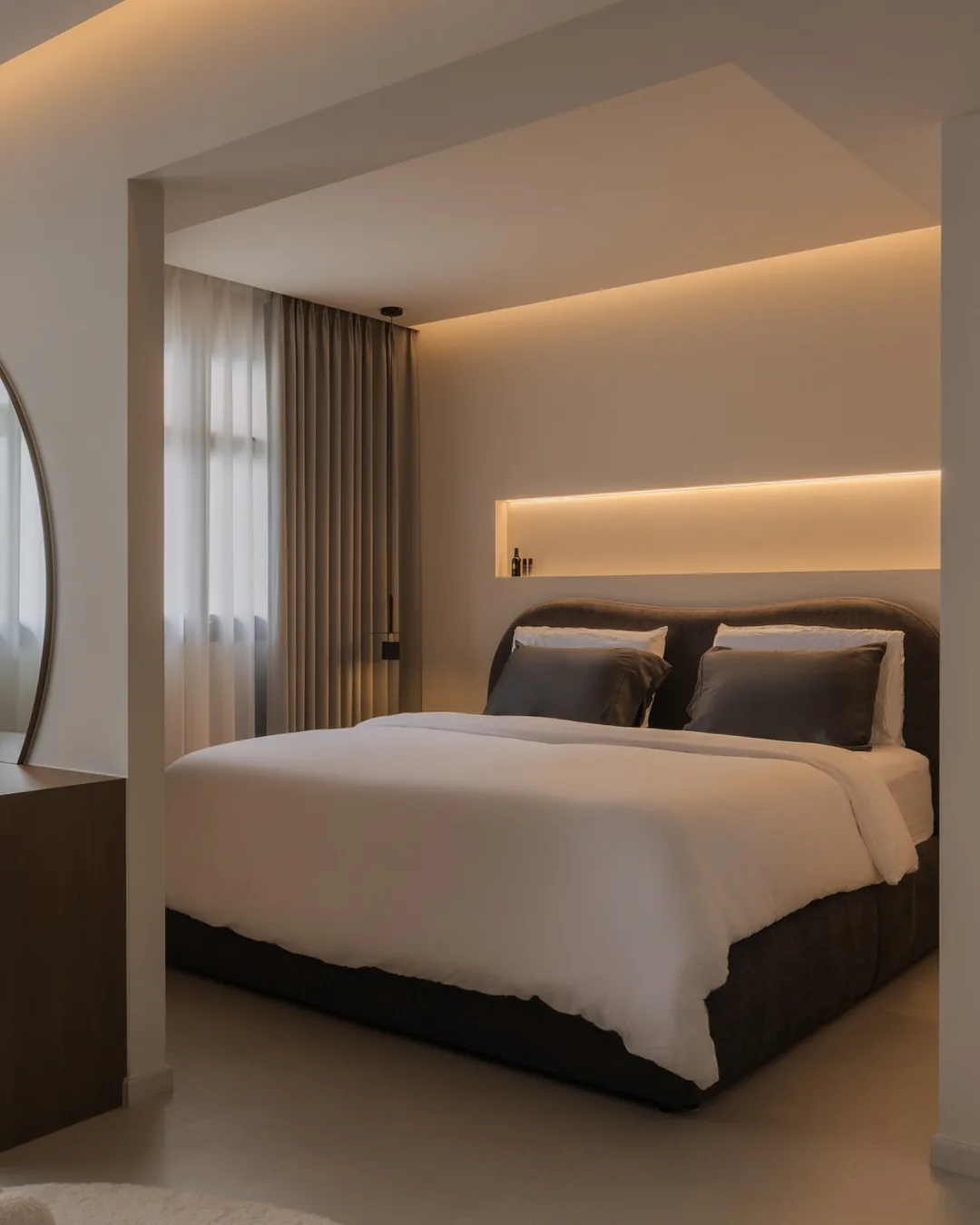
Cove lighting is the quietest trick in this list, because the light itself is invisible. A warm glow washing the wall above the headboard from a hidden strip, a warm LED cove tracing the ceiling edge at the top of the room, a bed with white linens and dark pillows below — you see the light, never the bulb. The ceiling seems to float, and the whole room feels softer for it.
The strip sits in a shallow channel where the ceiling meets the wall, or behind a small pelmet above the headboard, and all that reaches the room is the glow. Warm white — 2700K — is the only choice here; cool white cove lighting in a bedroom feels like an office corridor. Put it on a dimmer, because cove light at full brightness is glare, and at half brightness it is atmosphere.
The practical point: hide the strip completely — if you can see the LED dots from the bed, the cove is not deep enough. A deeper channel costs a few centimetres of ceiling and saves the whole effect.
Cut in a Skylight
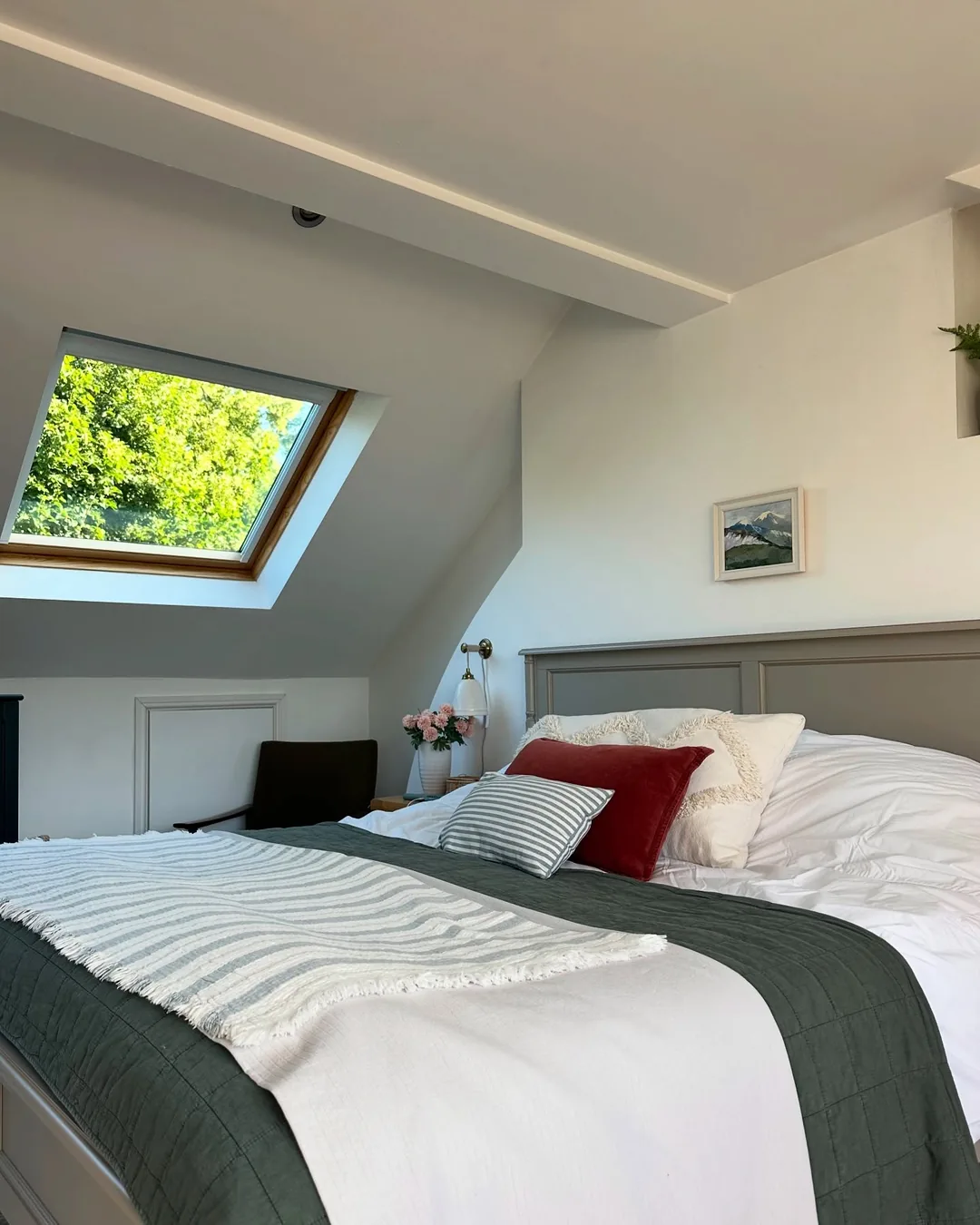
A skylight changes a bedroom more than any decoration can, because it changes the light itself. A large rectangular skylight set into the ceiling of a loft bedroom, framing green trees outside and flooding the room with soft daylight, a bed with white linens and a dark-green throw below — the room feels bigger, brighter and more awake than any window on a wall could make it. This one sits in a sloped loft ceiling, which is where skylights naturally belong, but the skylight is the subject here, not the slope.
Skylights need a roof above them, so they suit top-floor bedrooms and lofts best. Get one that opens, even if you only open it twice a year — a bedroom that can vent hot air out of the top of the room sleeps cooler all summer. And fit a blind: a skylight without a blind is a 5 a.m. alarm clock in June.
The practical point: put the skylight over the bed, not over the wardrobe. Light falling on the bed is the point; light falling on your clothes is a faded wardrobe.
Drape Fabric Like a Canopy
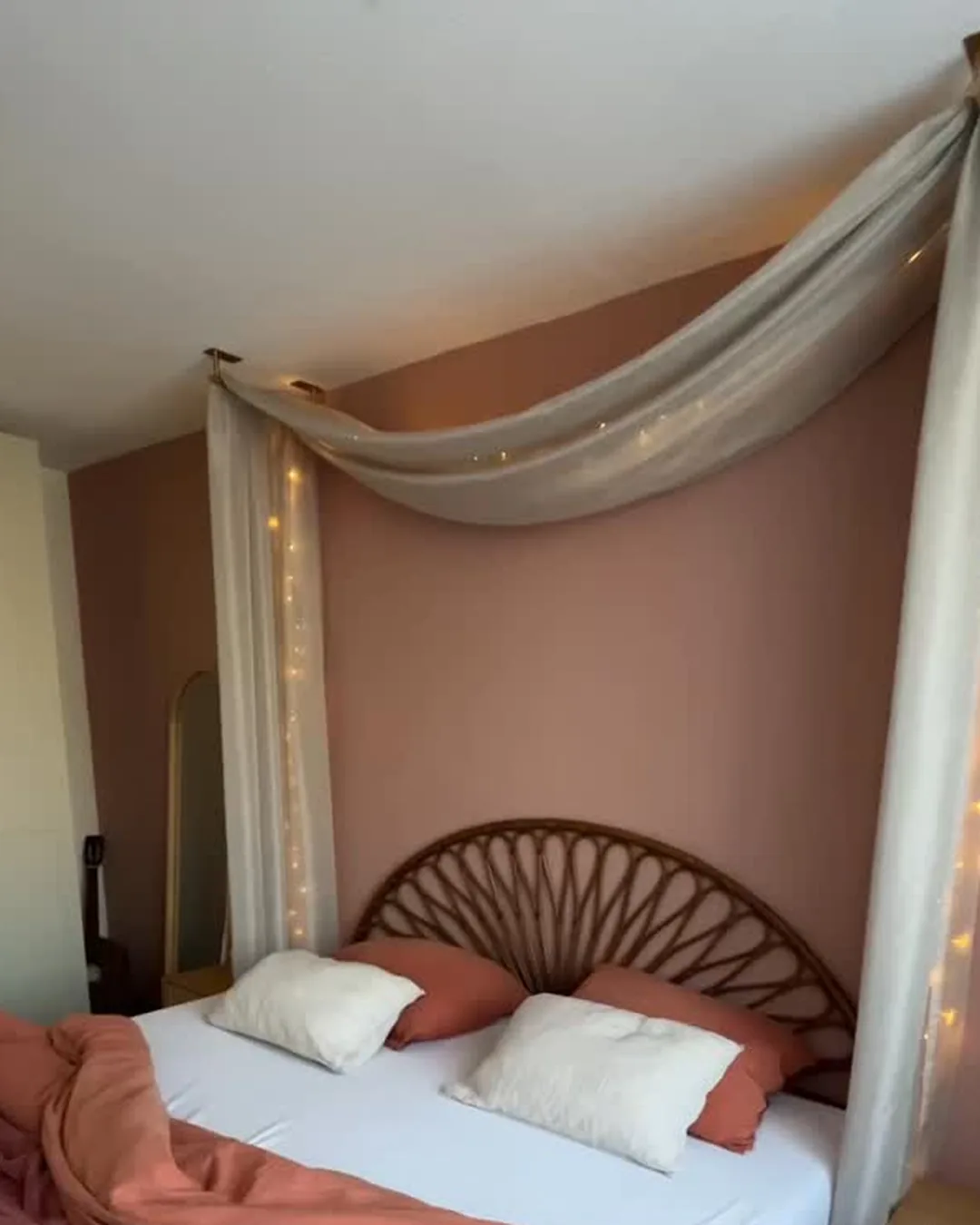
Fabric on a ceiling is the softest idea in this list, and the most romantic. Sheer cream fabric draped in deep swags from golden rods across the ceiling, fairy lights woven through it, a rattan headboard and white-and-terracotta bedding below, pink walls around it — the whole ceiling becomes a canopy, and the bed feels like a room inside the room. It is the closest a bedroom ceiling gets to feeling like a tent.
Use a light sheer fabric, not a heavy one: voile, muslin or a thin linen lets light through and hangs in soft folds, while heavy fabric sags and gathers dust. Fix the rods properly into ceiling joists, not just plasterboard, because draped fabric plus fairy lights is heavier than it looks. And keep the fabric away from any pendant light that gets hot.
The practical point: drape the fabric loosely, with deep swags, not pulled tight. Tight fabric reads like a bedsheet; loose swags read like a canopy.
Start with a Medallion
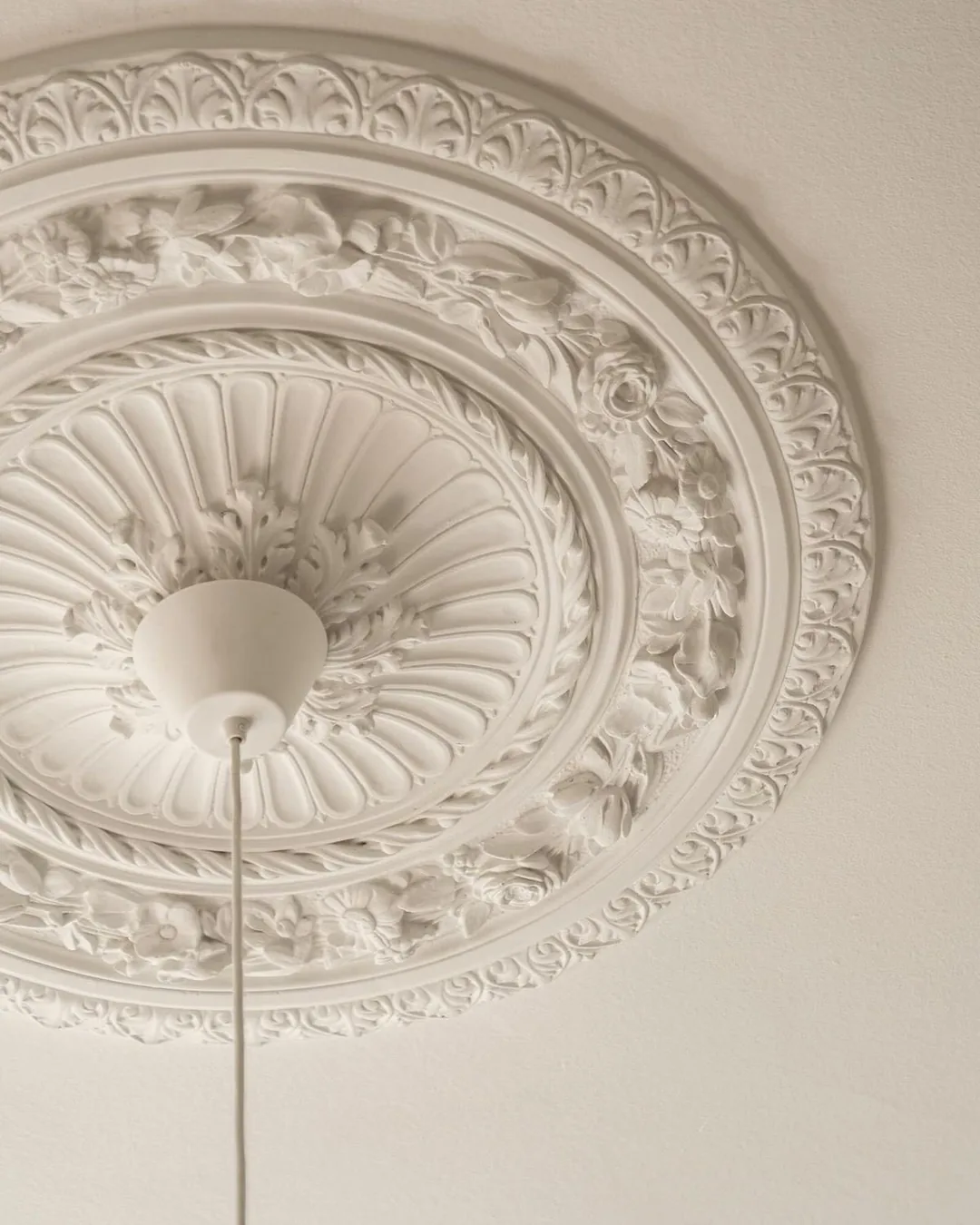
A ceiling medallion is the smallest change in this list and one of the most effective. A large circular white plaster medallion seen from directly below — concentric rings of acanthus scrollwork, roses, rope borders and radiating fluting, with a simple pendant hanging from its centre — the plasterwork fills the whole frame, and it is easy to see why medallions have survived every decorating trend. They give a plain ceiling a centre.
Medallions come in every size from a dinner plate to a cartwheel. Match the medallion to the light fitting, not to the room: a small pendant on a huge medallion looks lost, and a huge chandelier on a tiny medallion looks like it is wearing a hat that does not fit. Modern polyurethane medallions are light, cheap and indistinguishable from plaster once painted.
The practical point: paint the medallion the same colour as the ceiling. A medallion painted a different colour looks like a stuck-on ornament; the same colour makes it look like part of the ceiling.
Paint the Night Sky Over Your Bed

The most personal ceiling in this list is a painted one. A whole bedroom ceiling hand-painted as Van Gogh’s ‘The Starry Night’ — deep-blue swirling sky, bright yellow stars and a crescent moon, the room’s circular ceiling light sitting at the centre of the vortex like a sun. It is a copy of a famous painting, not an original design, and that is exactly why it works: everyone recognises it, and everyone smiles at it.
Painting a ceiling is a weekend project with a big payoff, but it needs a steady hand and a good night’s sleep before you start — painting overhead is tiring, and tired brushwork shows. Use a projector to trace the main shapes first if you are copying a painting; freehand swirls are fine for stars and clouds, but a recognisable painting needs its composition right. Seal it with a matt varnish so it survives years of looking up at it.
The practical point: paint the ceiling before you paint the walls, not after. Drips go down, and a painted ceiling over fresh walls is a ruined weekend.
Look Up More Often
None of these ideas needs a new house or a big budget. A tin tile here, a dark coat of paint there, a medallion, a skylight, a length of sheer fabric — the ceiling is the biggest empty surface in the bedroom, and it has been waiting for someone to notice it. Try one of these ideas, lie back on the bed, and look up: the room will feel finished in a way it never did before.