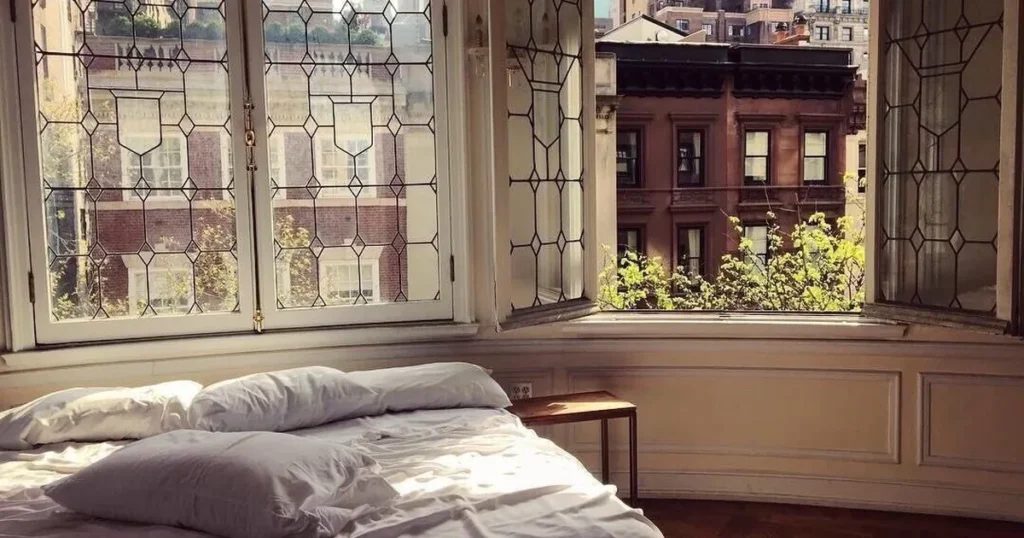
Everyone tells you never to put a bed in front of a window. It blocks the light, it wastes the view, it looks like the bed ended up there because nowhere else would take it — and for a flat window on a flat wall, they are mostly right. But a bay window is not a flat window. It pushes out from the house, it wraps around you on three sides, and it turns the wall behind the bed into a small room of its own. Put the bed there and the window stops being an obstacle and starts being the whole point.
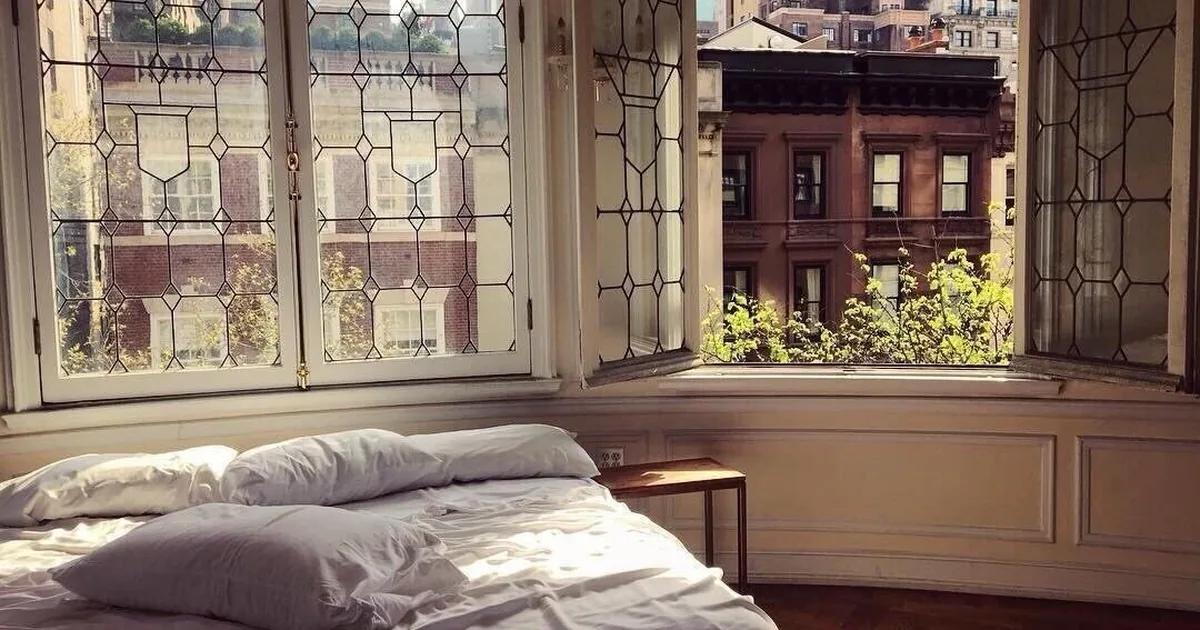
Once you see it that way, the rules change. You do not need a headboard when the bay is the headboard. You do not need art on the wall when the view outside does the work. And you do not need to apologise for the bed being in front of the glass, because the glass is the best thing in the room. These 15 beds in front of bay windows show how it works in real bedrooms — low beds and window seats, sheers and storage, small rooms and grand ones — and every one of them starts with the same move: stop fighting the bay and let the bed live in it.
Let the Bay Window Be the Headboard
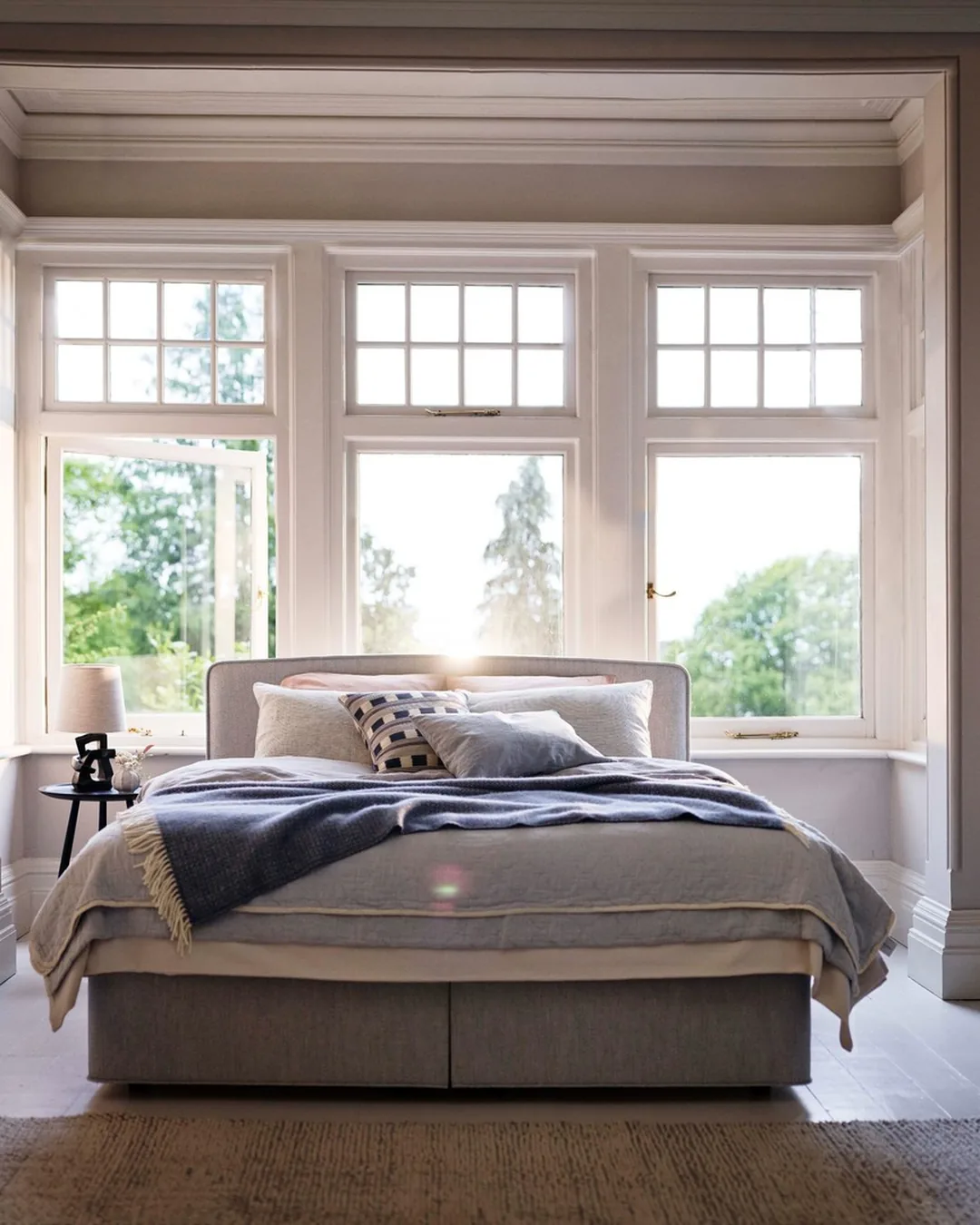
In the photo, a bed sits centred directly in front of a large three-part bay window, sunlight streaming through the open left pane — light grey upholstered frame, layered neutral bedding, a blue throw folded at the foot, a wardrobe on one side and a small console on the other. There is no headboard at all. The bay is doing that job: three tall windows rising behind the pillows, the middle one wide, the two sides angled back, framing the bed the way a carved wooden headboard would, only with sky in it.
It works because a bay gives the bed something a flat wall never can — depth. A headboard is a flat panel; a bay is a space, and the bed sits inside it rather than against it. Keep the bedding quiet so the windows stay the star, and keep the furniture at the sides low — tall wardrobes crowding the bay’s edges make the whole arrangement feel squeezed, while low pieces let the windows breathe. The same thinking — the wall doing the headboard’s job — is what makes No Headboard Bed Ideas That Make the Wall Behind Your Bed the Main Attraction work, where paint, art and mirrors take over instead.
The practical point: centre the bed on the middle pane of the bay, not on the room — a bed centred on the room but off-centre on the bay looks wrong from the moment you walk in, and you will notice it every single morning.
Why a Low Bed Works Best in Front of a Bay
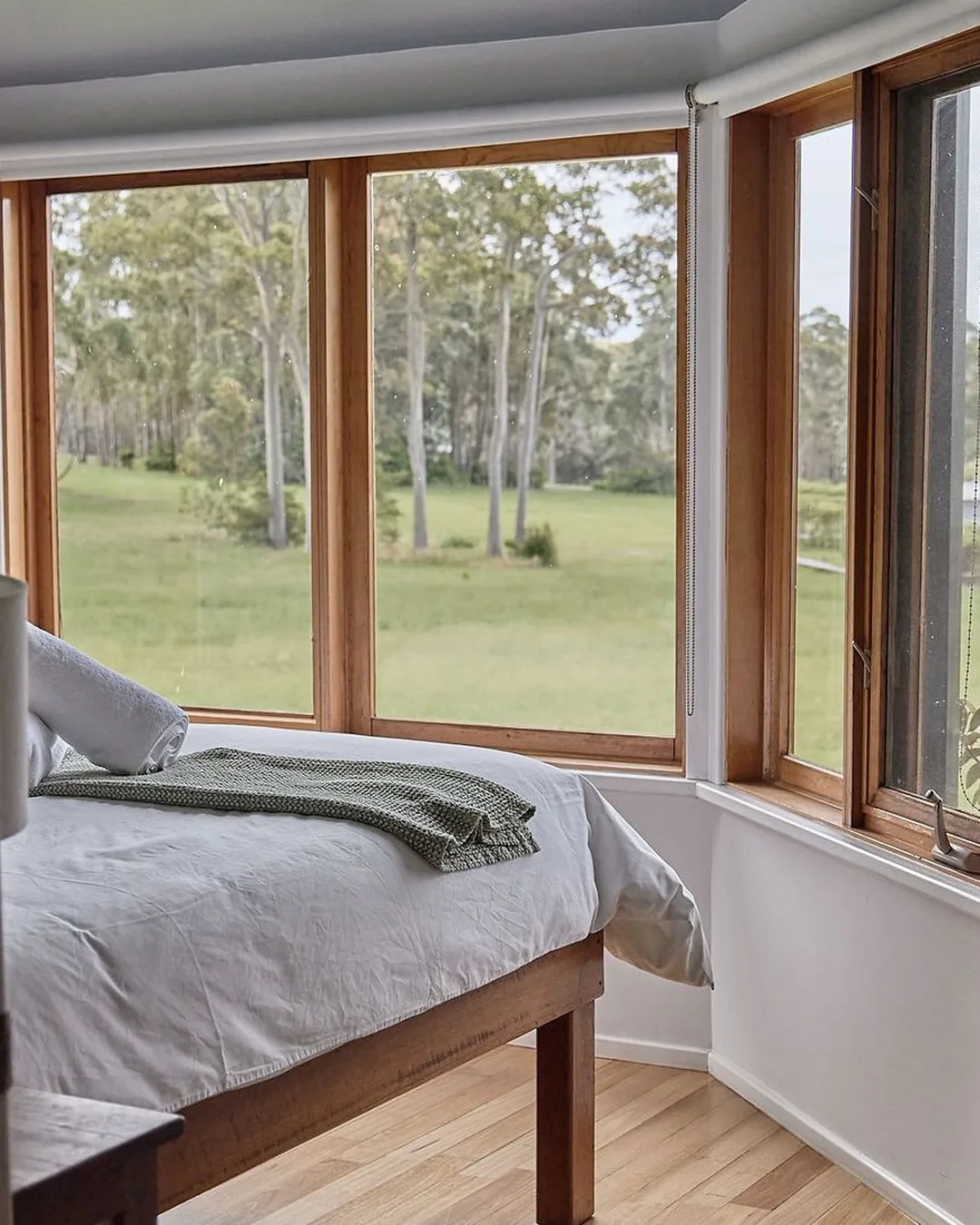
Picture a low wooden platform bed with white linens and a green throw, placed directly beneath large wood-framed bay windows looking onto green garden and trees, light wood floor underfoot. The bed is genuinely low — mattress on a platform a few inches off the floor — and the bay rises directly behind it, so the whole wall of glass is visible above the pillows. Nothing is hidden, nothing is blocked, and the room feels taller than it is.
Height is the whole argument here. A tall bed in front of a bay eats the bottom third of the windows and turns the bay into a backdrop you can barely see; a low bed leaves the glass alone and lets the view do the work. It also changes how the room feels at night — lying low with the windows above you, the room feels open rather than boxed in, more like sleeping in a glasshouse than in a bedroom. Do not put the mattress straight on the floor, though: a slatted base underneath lets air move and stops damp building up, and it keeps the platform looking like furniture rather than a mattress someone gave up on.
The practical point: keep the top of the mattress below the bottom third of the bay’s glass — once the bed covers more than a third of the window, the bay stops being a view and starts being a wall you paid extra for.
Curtains That Frame the Bed, Not Hide It
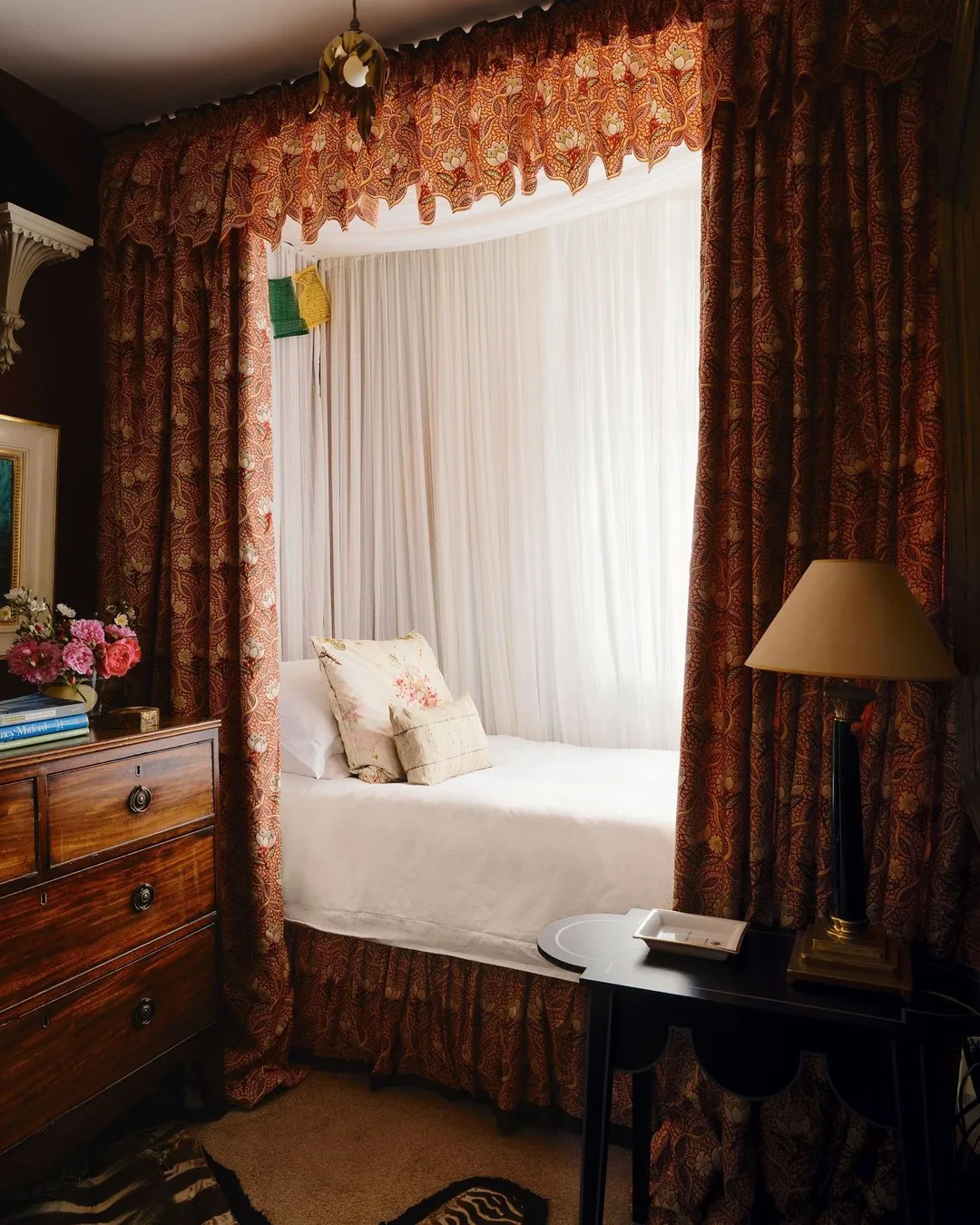
Tucked into a bay window alcove, a single bed with white linens and floral pillows sits framed by heavy red and gold patterned drapes with a matching valance, sheer white curtains behind them — a dark wood dresser with books and pink flowers on one side, a small black side table with a lamp on the other. The curtains do not cover the bay; they frame it, the way a picture frame holds a painting without hiding it.
Curtains fail in front of a bay when they are treated like curtains on a flat window — pulled shut across the whole thing, turning the bay into a dark pocket. Hang them at the bay’s outer edges instead, on a rod that follows the bay’s angles, and let them fall where the bay meets the room. Sheers behind the drapes soften the light without blocking it, and the bed stays bright even with the curtains drawn. One thing to know: this is a single bed in an alcove, and the idea scales to a double only if the alcove is wide enough — a double crammed into a narrow bay looks stuffed, not cosy.
The practical point: hang the rod on the bay’s angles, not straight across the room — a straight rod in front of a bay flattens the whole shape and wastes the depth you bought the house for.
How Much Space Should Sit Between the Bed and the Glass?
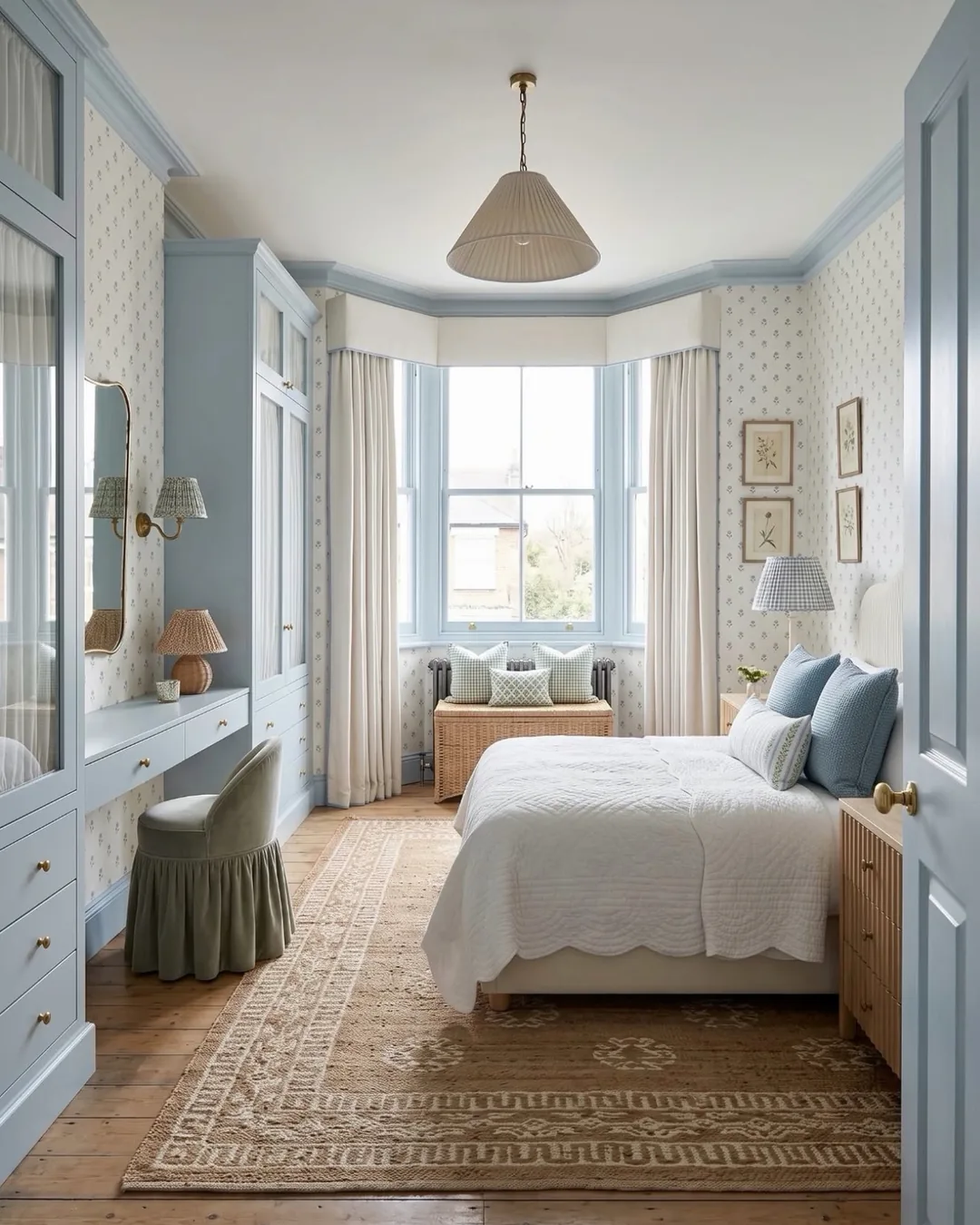
In the photo, the bed sits in the foreground on the right, and the bay window with cream curtains is at the far end of the room — a wicker storage bench beneath the bay, a vanity and chair on the left, a patterned rug running between the bed and the window. The gap between the bed and the glass is the whole composition: you can walk it, you can see it, and the bed and the bay are two separate things with a room between them.
Some space is always better than none. A bed pushed hard against the glass leaves nowhere to clean the windows, nowhere to open them, and a cold draught straight onto the pillows in winter. Two or three feet is enough to open the casements, wipe the glass, and let the curtains hang properly — and that strip of floor is where a bench or a rug earns its place. Too much space, though, and the bed loses its connection to the bay entirely; past about six feet, the bay becomes a window at the end of the room rather than the bed’s backdrop.
The practical point: leave two to three feet between the bed and the glass — enough to open the windows and clean them, close enough that the bay still belongs to the bed.
A Window Seat Behind the Bed Doubles as a Headboard
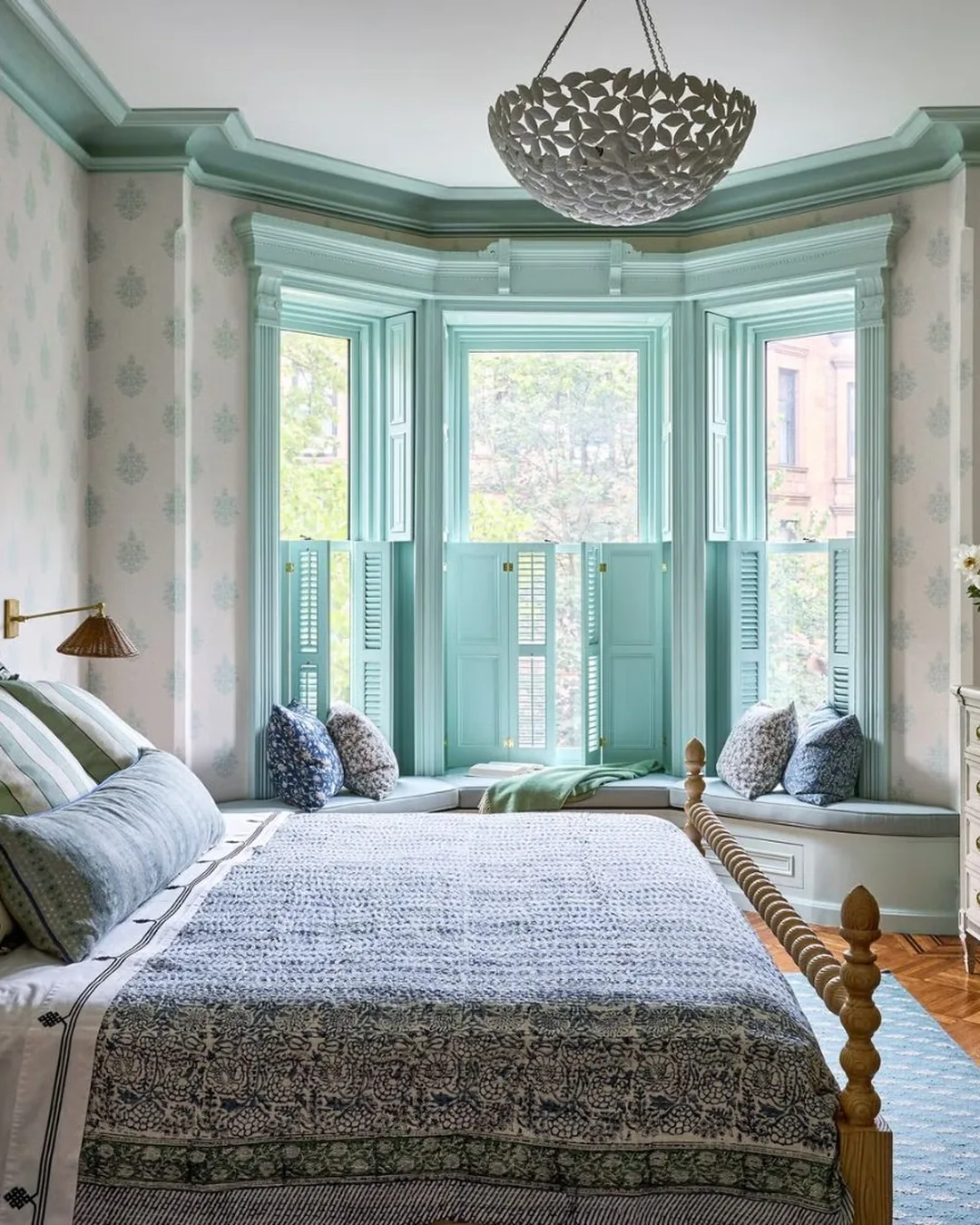
Behind a wooden spindle bed with striped and patterned bedding, a three-sided bay window in mint-green trim holds a built-in window seat dressed with decorative pillows and a green throw, shutters open, patterned wallpaper around it, a white dresser at the side. The seat sits directly behind the bed at exactly the height a headboard would — and it does everything a headboard does, plus a few things a headboard never could.
It works because a window seat is furniture at the right height in the right place. Pillows can lean against it, books can sit on it, and in the morning you can sit on the bed with your back to the seat and your feet on the mattress, reading in the light. Build the seat deep enough to sit on — eighteen inches is the minimum — and pad it with a proper cushion, not a thin scatter pad that slides off. Keep the pillows on the seat washable, because anything behind a bed collects dust faster than anything else in the room.
The practical point: build the seat at least eighteen inches deep with a fixed cushion — a shallow ledge with loose pillows looks like a headboard, but nobody can sit on it, and the whole idea falls apart the first time someone tries.
Keep the Bedding Pale and Let the View Do the Talking
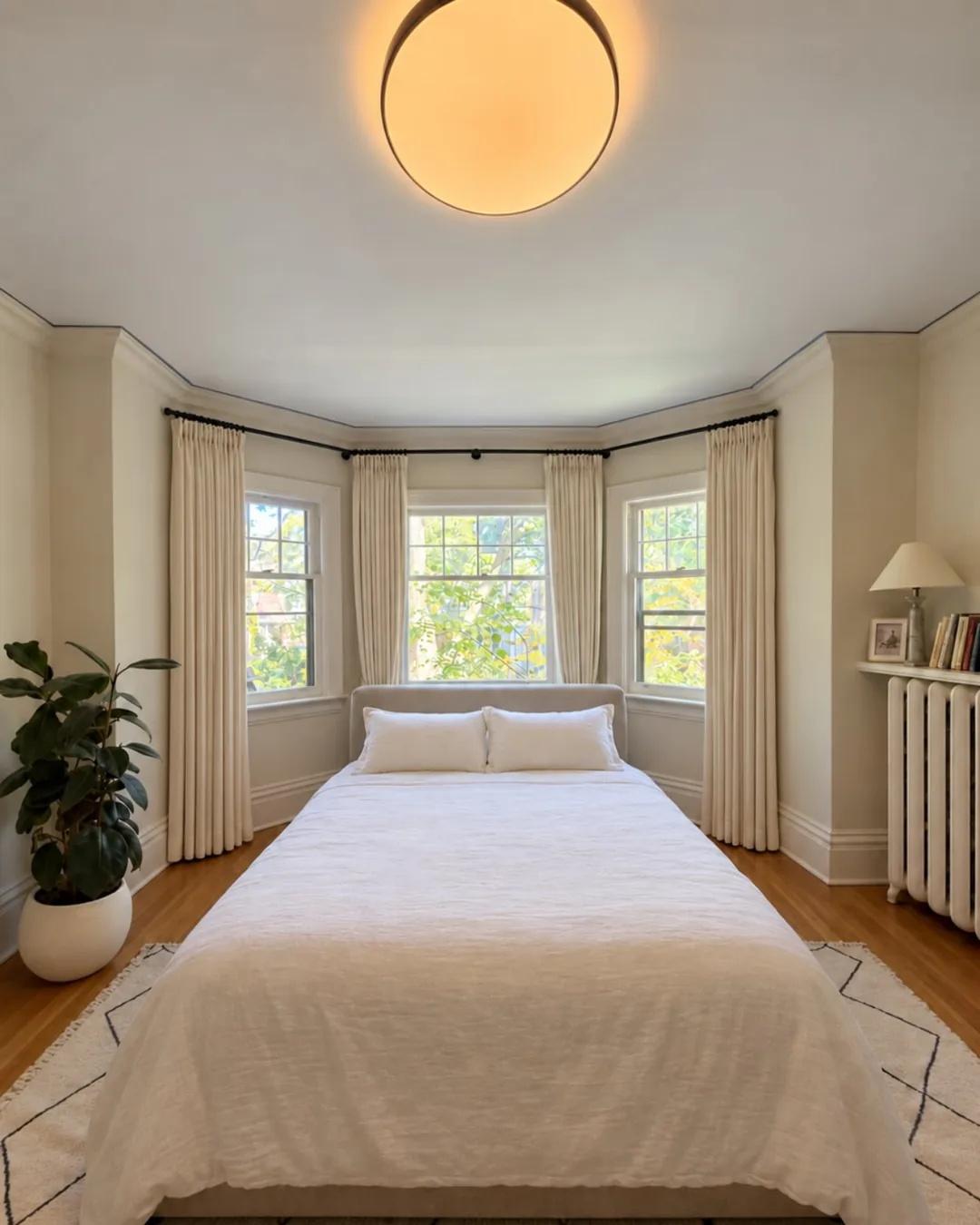
White linens on a bed centred in front of a three-pane bay window, cream floor-length curtains on both sides, greenery outside the glass, a potted plant in a white pot on the floor, a geometric rug under the bed. Nothing in the room competes with the view: the bedding is white, the curtains are cream, the walls are pale, and the only colour that matters is the green outside the window.
Pale bedding is the right choice in front of a bay because the bay is already doing the decorating. Bold bedding next to a bay is two loud voices talking over each other — the pattern on the duvet fights the view outside, and the room ends up feeling busy instead of calm. White or pale linen lets the window be the colour in the room, and it has a practical side too: pale bedding shows the light changing through the day, so the bed looks different at dawn and at dusk without you changing a thing. Keep one texture in the mix — a woven throw, a linen duvet — so the paleness reads as deliberate rather than washed out.
The practical point: keep the bedding one pale shade and let the view supply the colour — the moment the duvet is louder than the window, the bay stops being the feature and starts being a backdrop.
What Happens to Light When the Bed Faces the Window?
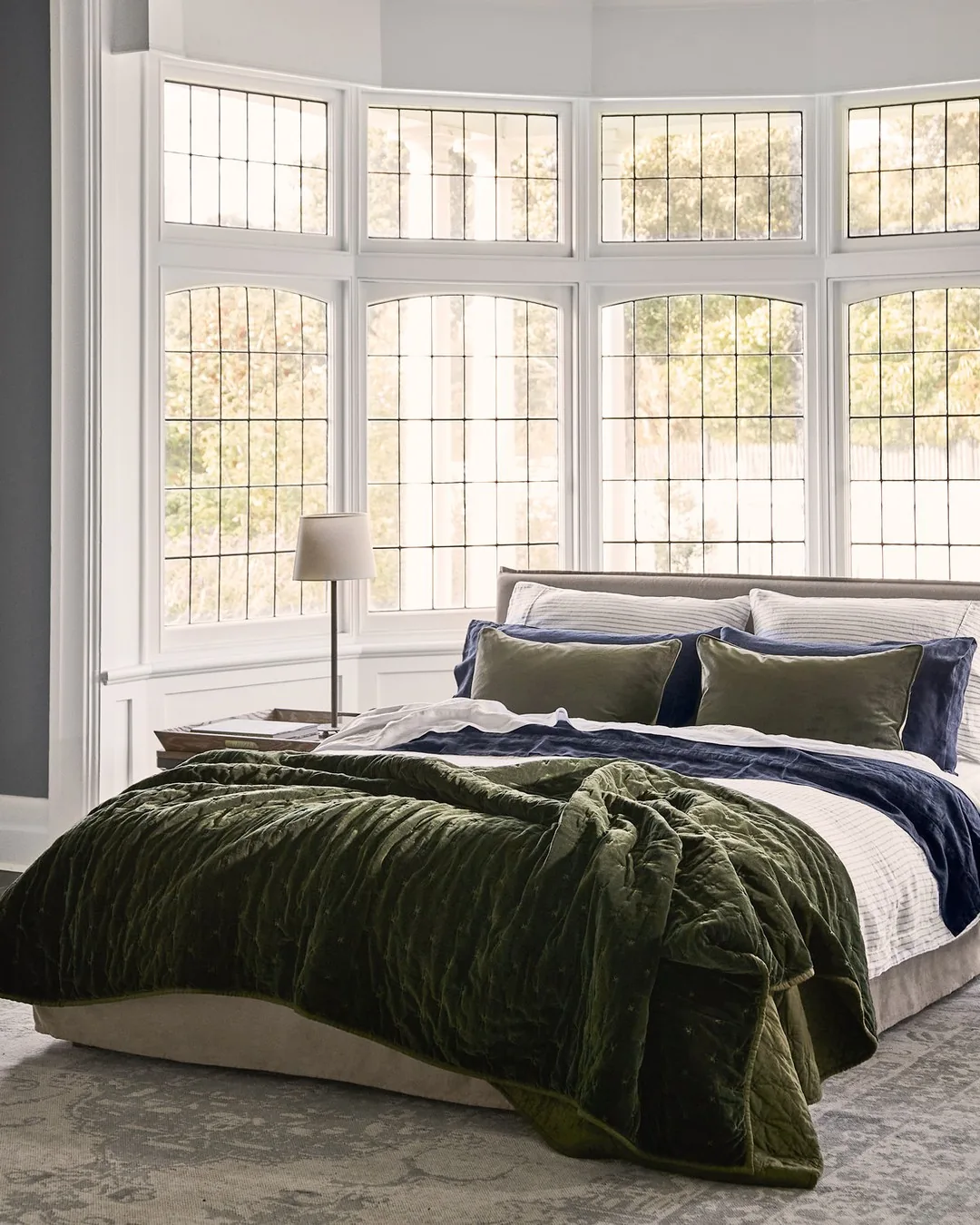
Morning light pours through a huge multi-pane bay window, and the bed sits centred directly in front of it — white striped sheets, olive-green and navy pillows, a dark green velvet throw, a bedside lamp on a nightstand at the left. The light is the subject here: it falls across the bedding in bright bands, it fills the room before the lamps are ever switched on, and the bed feels like it is sitting inside the daylight rather than in front of it.
Light is the reason to put a bed in front of a bay at all, and it is also the thing that can go wrong. Too much of it and you wake at dawn whether you want to or not; too little and the bay might as well be a wall. East-facing bays give the best mornings and the easiest sleep, because the light arrives early and leaves by midday — west-facing bays are gorgeous at sunset and brutal at seven in the morning. A blind fitted to the bay itself, rather than a curtain across the room, is what makes the light manageable: it lets you dim the glass without hiding the bay.
The practical point: fit the blind to the bay, not to the room — a blind on the bay lets you control the light pane by pane, while a curtain across the whole window hides the thing you put the bed there for.
Plants on the Sill Soften the Bed’s Hard Edge

An unmade bed with white linens sits in front of a wide bay window wall, and on the sill a lilac bouquet in a glass vase, a blue-and-white teapot and cup, a plate of peaches — dense green foliage outside, a lace curtain at the right, a hanging plant at the left edge. The plants do the softening here: the bed is all straight lines and flat white, and the sill brings in colour, scent and something alive at exactly the height your eyes rest when you wake.
Sills are the easiest place in a bedroom to keep plants, because the light is already there and the watering can is never far from the glass. Choose plants that like bright light and do not mind a draught — the sill behind a bed gets both — and keep them small enough that they do not block the glass. A trailing plant at the edge of the sill works better than a tall one in the middle, because it softens the corner without eating the view. Watch the water, though: a saucer that overflows onto the bedding is a morning nobody enjoys, so water over the sink, not over the bed.
The practical point: keep the plants low and to the edges of the sill — a tall plant in the middle of the glass blocks the view, and the whole point of the bay is the view.
Build Storage into the Bay and Free the Bedroom
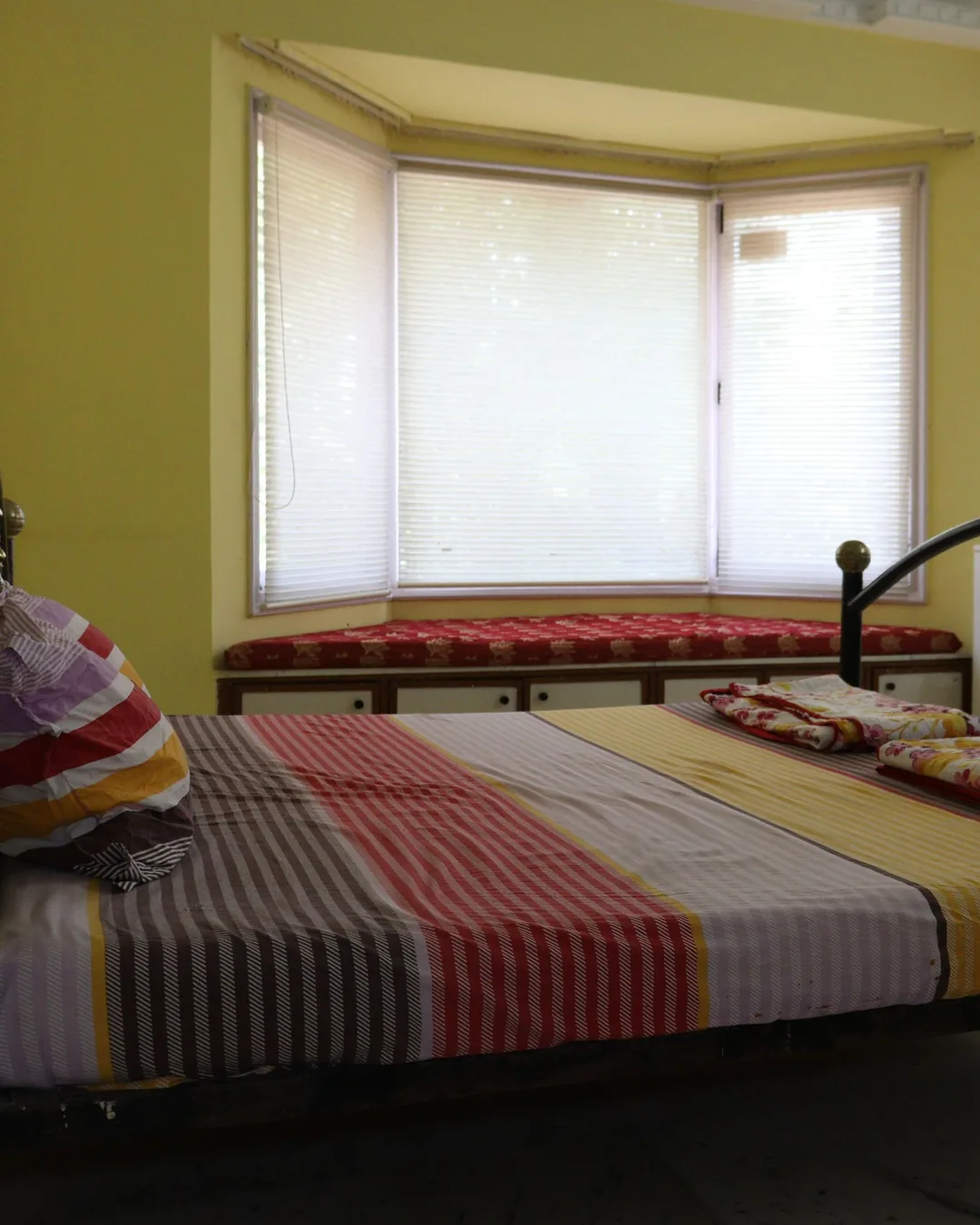
Under a bay window with white blinds, a built-in bench runs the width of the bay — red patterned cushion on top, five white cupboard fronts with round knobs underneath — and in front of it a bed with striped bedding, yellow walls around the room. The storage is the quiet hero here: everything the bedroom used to keep in a chest of drawers lives under the window instead, and the floor stays clear.
Built-in storage works in a bay because the bay’s awkward shape is otherwise wasted — the space under the sill is too shallow for furniture and too deep to ignore. Cupboards with doors suit it better than drawers, because the space is wide and low, and doors open flat without needing clearance in front. Measure twice before you build: the bay’s angles are never quite the ones on the plan, and a bench built to the drawing will gap at the corners. Keep the cushion washable — it sits behind a bed, it will collect dust, and a fixed cushion you cannot wash is a mistake you live with for years.
The practical point: build cupboards, not drawers, under the bay — doors suit the wide low space, and a drawer that needs clearance in front of it has nowhere to open when the bed is right there.
Can a Bay Window Bed Work in a Small Room?
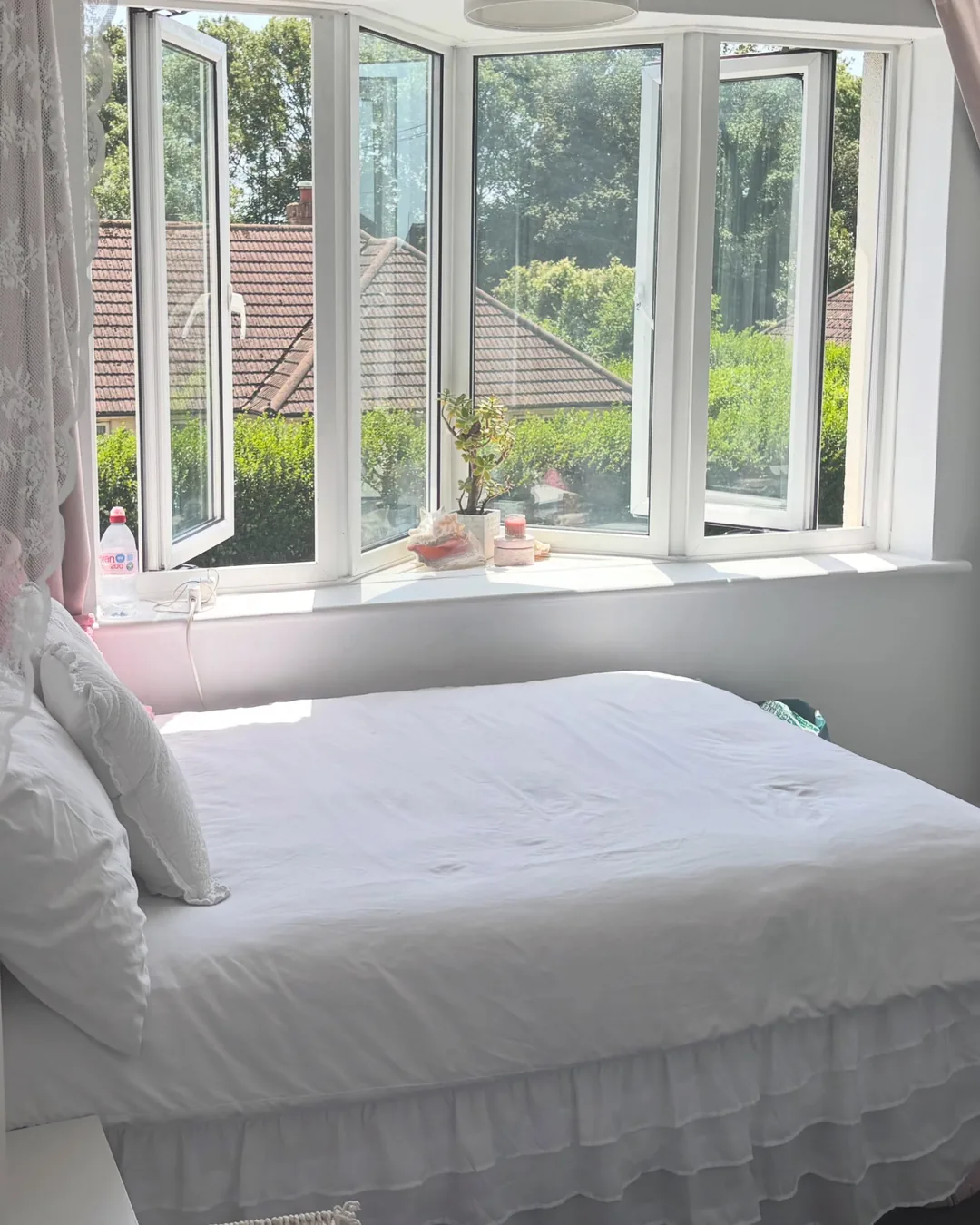
Shot from the doorway, the room reads genuinely small — a bed with white linens and a ruffled skirt fills the space beneath a large bay window with angled panels and open casements, green trees and rooftops outside, a small plant on the sill, a white wardrobe squeezed tight beside the bed. The bed takes up most of the floor, and that is exactly the point: in a small room, the bay is not taking space away from the bed, it is giving the bed a place to be.
Small rooms suit bay-window beds because the bay adds floor space the room does not have on its own — the window’s footprint is room you did not pay for, and the bed uses it. Keep everything else in the room tight to the walls and low, and let the bay carry the light, because a small room with a bay feels bigger than the same room with a flat window. If the same thinking helps across the whole room, Ways to Make a Small Bedroom Look Bigger Than Its Square Footage covers how light, order and clear surfaces do more than square footage does.
The practical point: let the bay carry the light and keep the rest of the room low and tight to the walls — in a small room, the bay is the extra space, and clutter anywhere else cancels it out.
A Symmetrical Bed in Front of the Bay

Dead-centre beneath an expansive multi-pane bay window with a calm lake and green hills outside, a bed sits on the bay’s centre line — two matching pendant lights flanking it, two matching dark nightstands, two matching boucle ottomans at the foot, plaid pillows and a dark green throw. Everything is mirrored, and that is the whole effect: the bay gives the bed a centre, and the room answers it on both sides.
Symmetry works in front of a bay because the bay is already symmetrical — three panes, a middle and two sides — and a centred bed completes a shape the room was already suggesting. It fails the moment anything is off by a few inches: one nightstand wider than the other, one lamp higher, the bed shifted left to make room for a door. Measure from the bay’s centre, not the room’s — in an old house the two centres are rarely the same, and the bay is the one your eyes trust. Keep the pairs identical, not merely similar: matching lamps, matching tables, matching ottomans, because near-matching is what the eye catches and real matching is what it rests on.
The practical point: measure the centre from the bay, not from the room — the bay is what your eyes line up on, and a bed centred on the room but off-centre on the bay looks wrong every morning.
Layer Sheers for Privacy Without Losing the Light
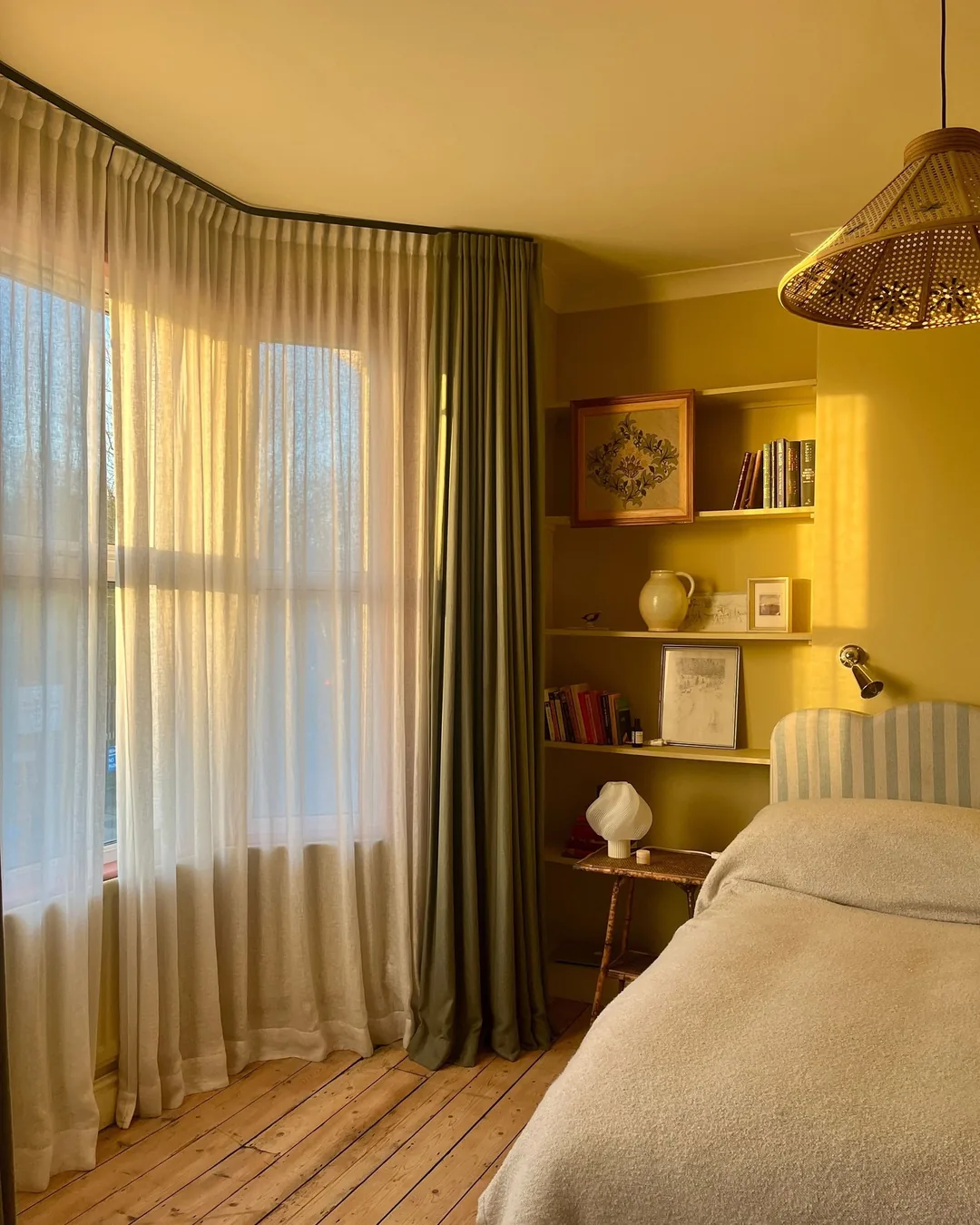
Golden-hour light streams through a large bay window covered in sheer white curtains with heavier green drapes at the sides — the bay’s shape is clearly visible, the angled panels, the sheers following the curve, the curtain rod bending round the bay — and in the foreground right, a bed with a striped headboard and neutral bedding, built-in yellow shelves with books and a framed floral print at the side. The sheers are doing exactly what they should: the room is bright, the garden is a soft blur outside, and nobody outside can see in.
Sheers suit a bay because they follow its shape instead of fighting it. Heavy curtains pulled across a bay flatten it; sheers hung pane by pane let the bay keep its angles and still give you privacy, because the light comes through and the view stays a glow rather than a picture. Layer them — sheers for the day, drapes at the edges for the night — and the bed gets soft light in the morning and real darkness when you need it. One small thing: the books on the shelves carry ordinary titles on their spines, the kind of detail a camera catches and a room lives with, nothing more than that.
The practical point: hang the sheers pane by pane following the bay’s angles — one flat sheet across the whole bay hides the shape, and the shape is what you put the bed there for.
Why the Bed Should Never Block the Bay’s Best Angle
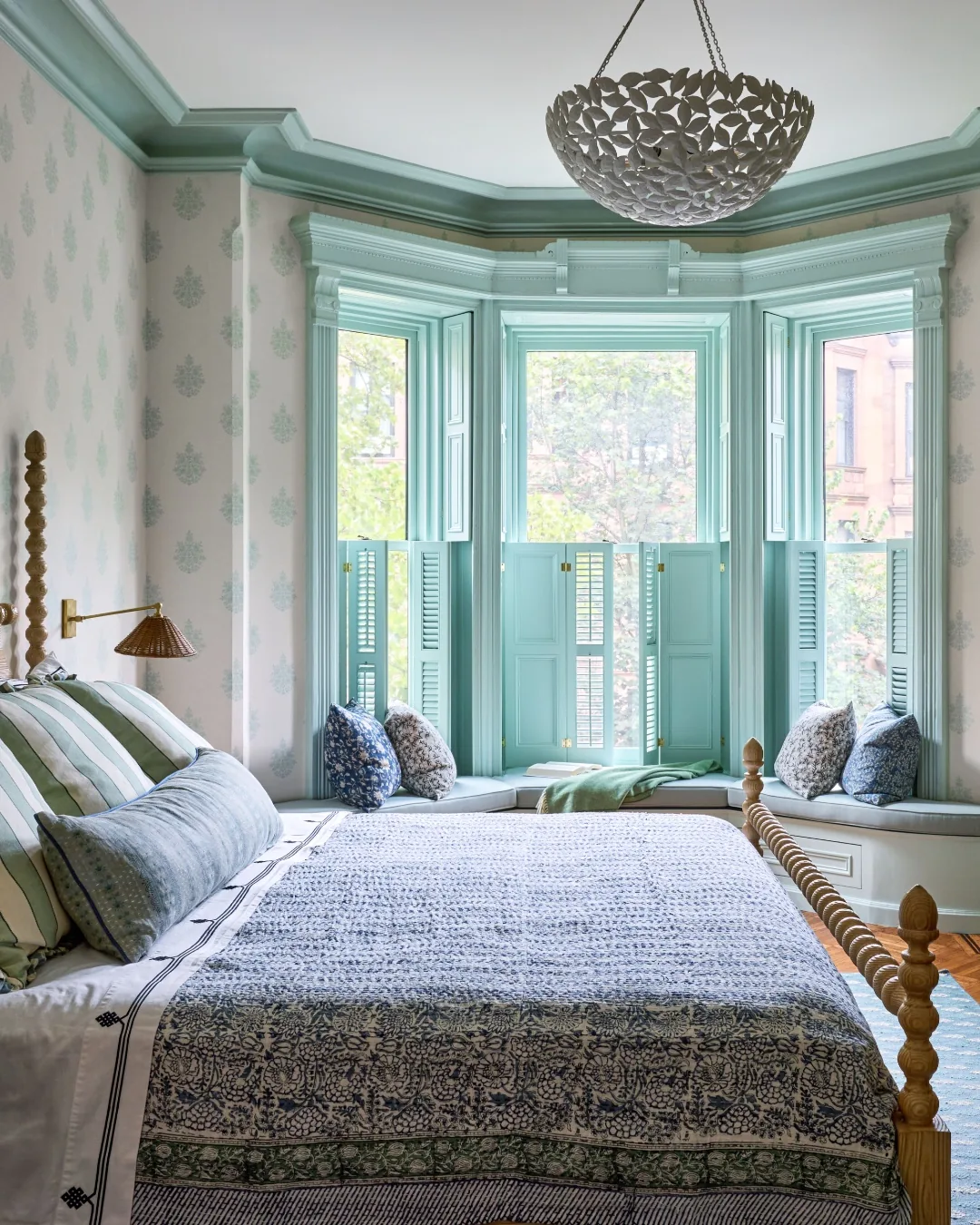
A low wooden spindle bed with patterned blue-and-white bedding sits in the foreground, and directly behind it a three-pane bay window with mint-green trim and open shutters, greenery outside, a built-in window seat with blue and grey pillows, a green throw and an open book. The bed is low, and the entire bay — windows, seat, view — is fully visible above and behind it. Nothing is blocked, and the angle the bay was built for is the angle you see from the pillow.
Every bay has one best angle — the pane the view sits behind, the corner where the light comes in, the seat where the sun lands — and the bed’s job is to stay out of its way. A tall headboard in front of that pane, a pile of pillows stacked against it, a bed pushed too high against the glass: any of these takes the bay’s best angle and hides it behind the bed. Keep the bed low and the pillows flat against the mattress, not stacked up the glass, and the bay stays the thing you look at when you wake up. It is the simplest rule on this list and the easiest to break, because every bedroom accumulates pillows.
The practical point: keep the bed low and the pillows flat — the moment the pillows stack up the glass, the bay’s best angle disappears behind them.
A Rug That Anchors the Bed to the Window
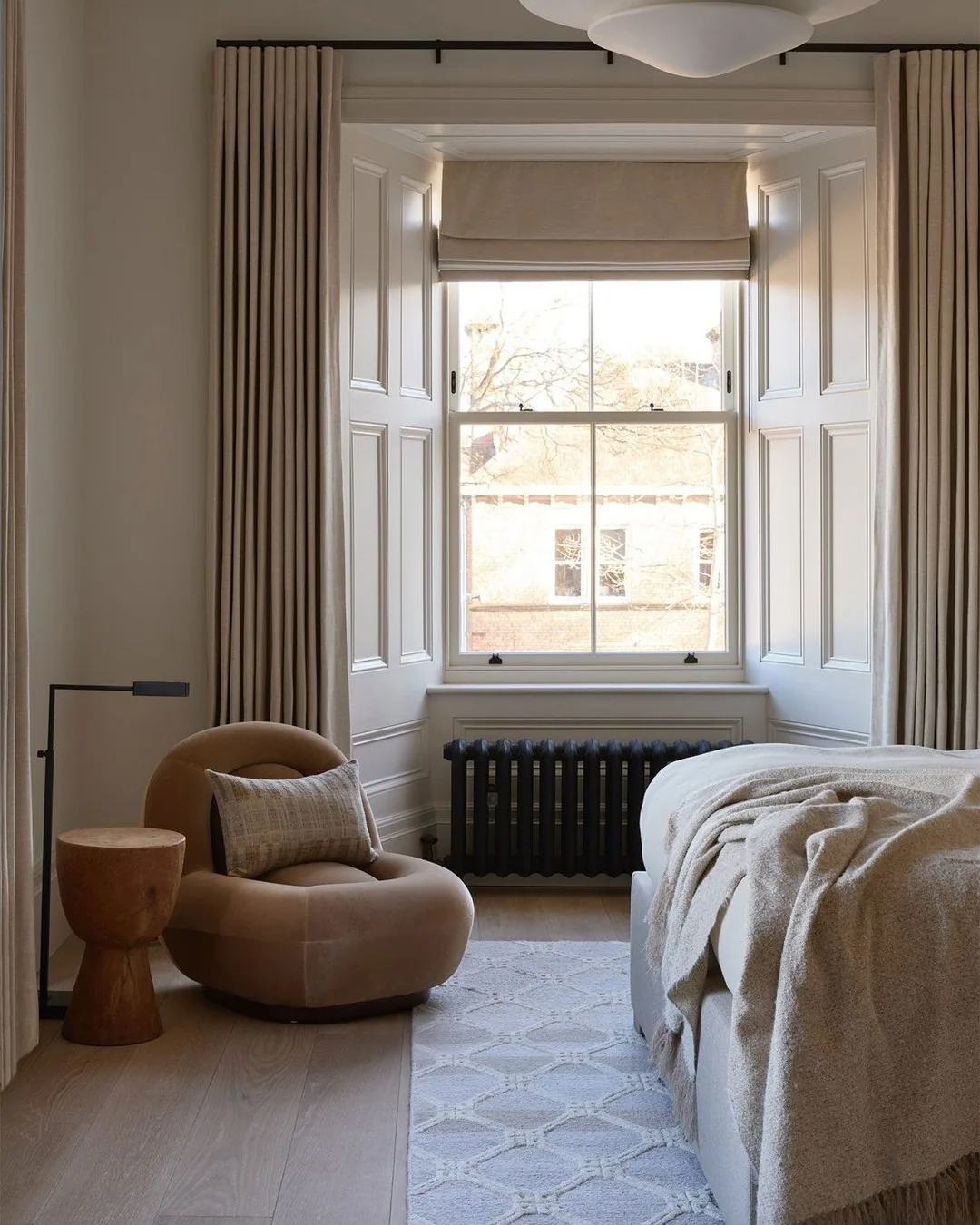
A light patterned area rug runs from the bed toward the bay window — the rug literally connects the two. The bed with white linens and a textured throw sits in the right foreground, the bay window at the back with a Roman blind, bare trees and brick buildings outside, a tan rounded armchair with a plaid pillow, a wooden side table, a black floor lamp. The bed is side-on to the bay, not head-on, and the rug is what ties them together.
Without it, a bed in front of a bay can feel like two separate things that happen to share a room — the bed here, the window there, nothing between them. A rug running from one to the other joins them into a single arrangement, and it does it without moving a single piece of furniture. Size it so it reaches from under the bed to the bay’s edge, not just a small mat beside the bed, and keep the pattern quiet — the rug is a bridge, not a feature, and a loud rug competes with the window for attention.
The practical point: run the rug from under the bed all the way to the bay — a rug that stops halfway joins nothing, and the bed and the window stay strangers.
Wake Up to the View, Not to a Wall
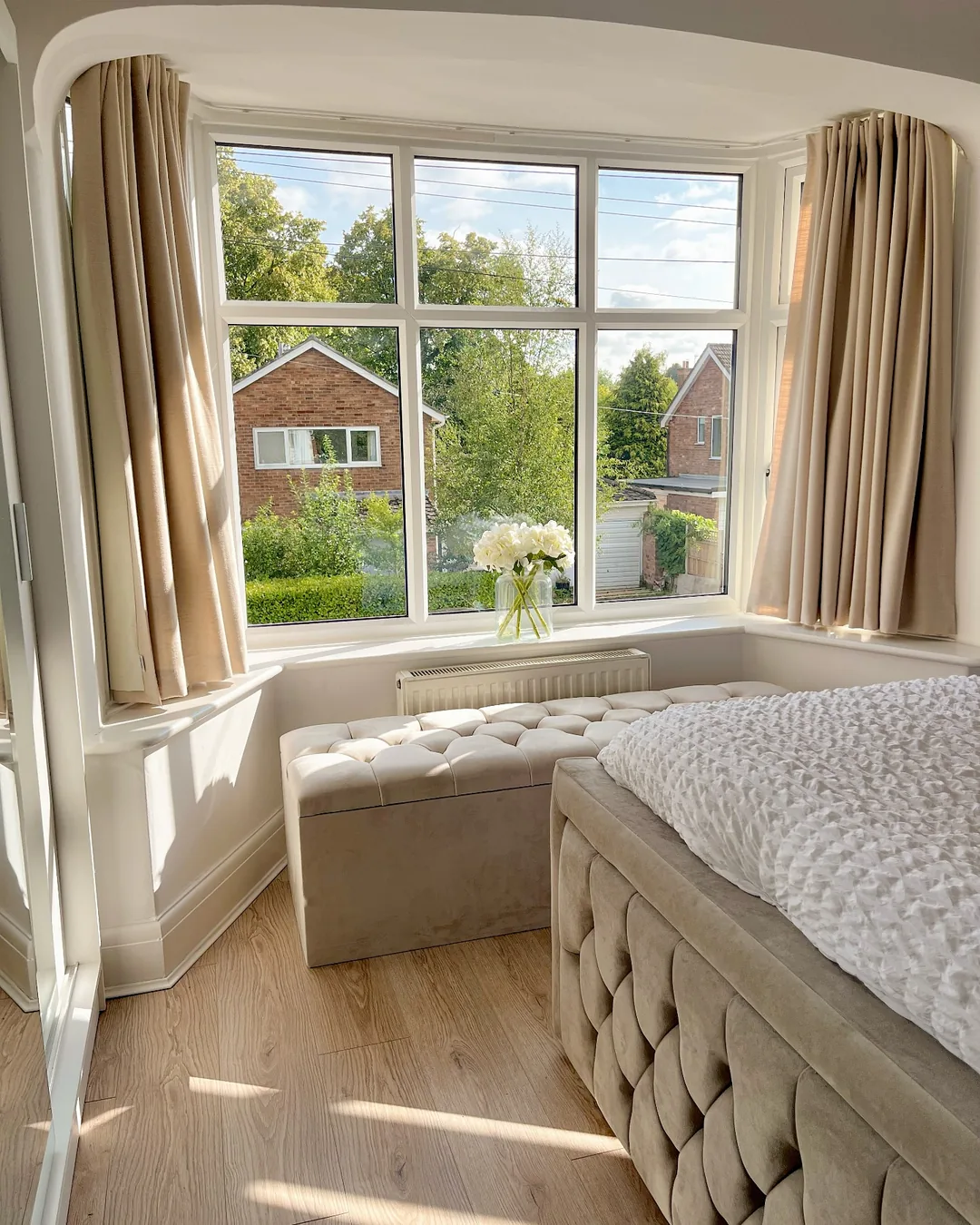
Golden-hour light fills a large white-framed bay window, green trees and red-brick houses outside, blue sky above them, beige pleated curtains drawn aside — and in the right foreground, a tufted beige bed with a white textured duvet, a matching tufted ottoman beneath the window, a glass vase of white hydrangeas on the sill. The view is the first thing you see when you open your eyes, and it is a better first thing than any wall.
This is the idea the whole article has been building toward: a bed in front of a bay is not a compromise, it is a choice to wake up to something worth looking at. It works best where the view is genuinely good — trees, rooftops, a garden, a stretch of sky — and it asks for almost nothing in return: pale bedding, curtains drawn aside, a sill kept clear enough that the glass stays the star. Keep the view uncluttered and the bedding calm, and the bay does the decorating every morning without you lifting a finger.
The practical point: keep the sill clear and the curtains drawn aside — a view hidden behind clutter is no view at all, and the bay only works when you can actually see through it.
The View Is the Headboard
That is the whole idea, really: a bay window was never just a window, and a bed in front of one was never a mistake waiting to happen. Give the bed the bay, keep the bedding calm, let the light in and the view do the talking — and the wall behind your bed stops being a wall at all. It becomes the best seat in the house, and you sleep in it every night.