Your first cup of the day should feel like a small ceremony, not a scramble and the difference is rarely the machine — it is where everything lives.
Before the house wakes up, before the emails and the school run, there is that quiet stretch at the counter — the kettle, the grinder, the mug that is yours alone.
These kitchen counter coffee bar ideas are about giving that moment a home: a corner of the counter that is always ready, a tray that keeps the mess in one place, shelves that put your favourite mugs where your hand expects them.
Nothing here needs a renovation. A cart, a tray, a chalkboard — small moves that turn a rushed morning into a routine you actually look forward to.
Here are 11 coffee bar ideas for a better morning routine, and how to set each one up.
Claim One Corner of the Counter
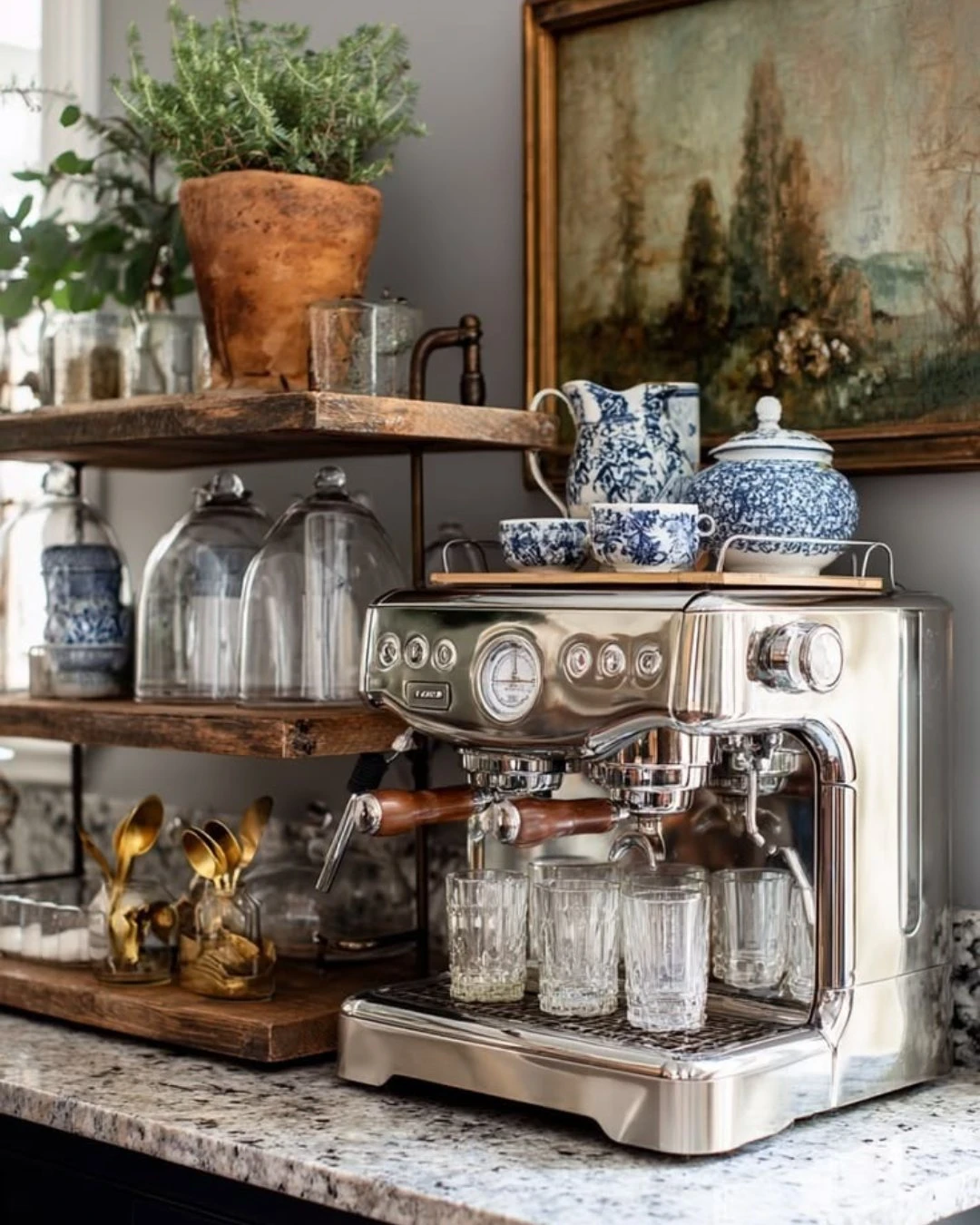
You do not need a whole wall for a coffee bar — one corner is enough. A machine in the corner, shelves above it, and suddenly the coffee has a home instead of living wherever it landed yesterday.
Corners work because they are the least-used stretch of counter in most kitchens. Put the machine where the counters meet, keep the mugs and the beans on the shelves above, and the rest of the counter stays free for cooking. Blue-and-white porcelain on open shelves, like the ones in this photo, turns a working corner into the prettiest spot in the room.
Keep the corner shallow: machine, grinder, one tray of daily things — and nothing else. The moment the corner starts collecting the post, the keys and the fruit bowl, it stops being a coffee bar and goes back to being a dumping ground. For the room around the corner, The Design Details That Define Joanna Gaines Kitchens shows how the best kitchens make room for the rituals that matter.
The practical point: Keep the corner shallow — machine, grinder, one tray of daily things — and nothing else, or it goes back to being a dumping ground.
Why a Cart That Rolls Changes the Morning
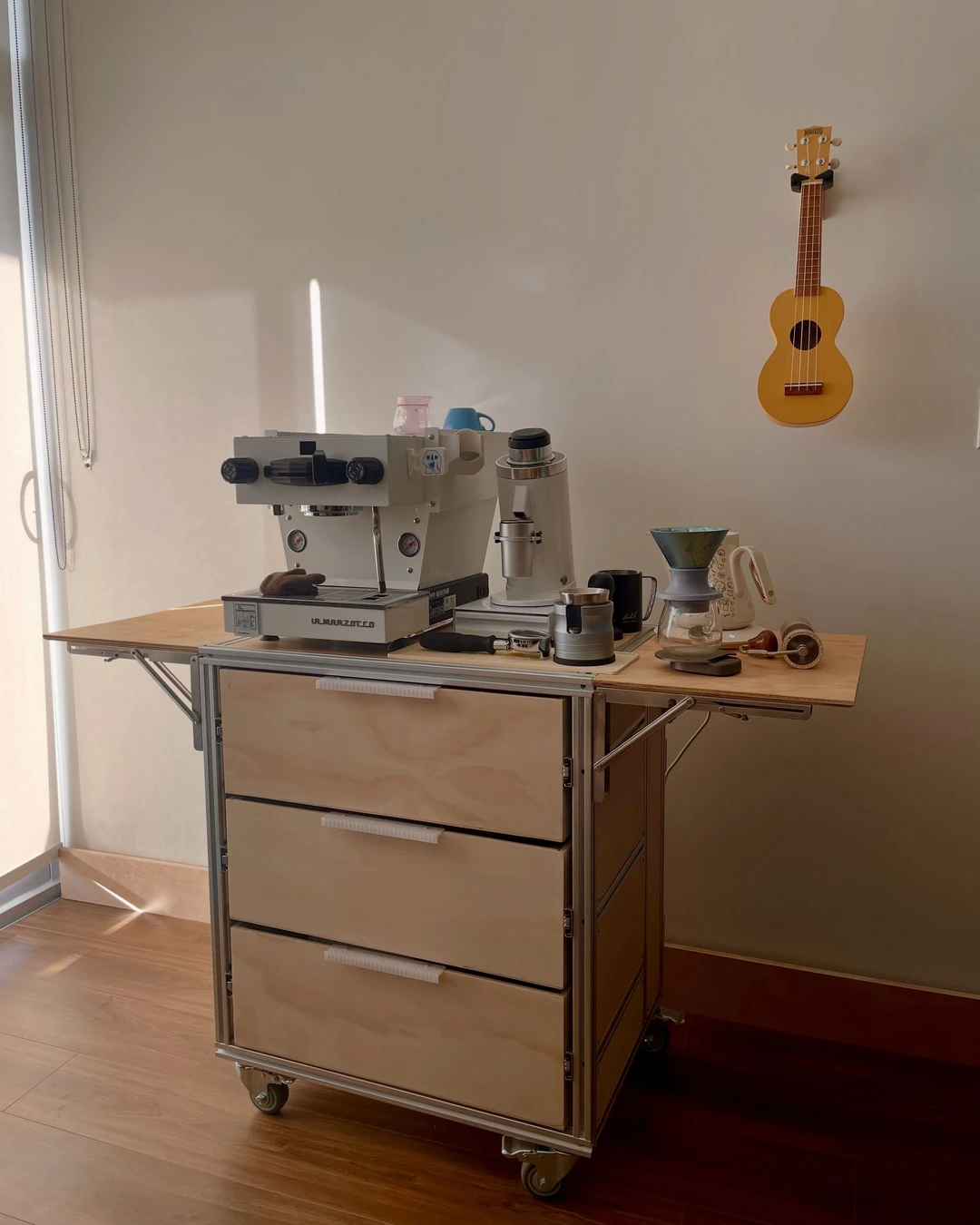
One cart that rolls is the answer for a kitchen with no spare counter. It holds the machine, the grinder and the pour-over kit, and when the morning is over it rolls back against the wall — the counter never belonged to the coffee in the first place.
Casters are the whole point, so check them before you buy: small hard wheels roll fine on tile and wood, but they sink into a rug. Fold-down sides, like this one has, double the workspace while you brew and fold away when you are done. A cart like this one was built at home from light wood, and it shows — nothing about it is precious, which is exactly why it gets used every day.
Keep the cart near an outlet and a water source, or the rolling is a gimmick. A cart that has to be wheeled across the kitchen to plug in will be wheeled exactly once.
The practical point: Keep the cart near an outlet and a water source, or the rolling is a gimmick — a cart that has to cross the kitchen to plug in gets wheeled exactly once.
Open Shelves, Mugs on Show
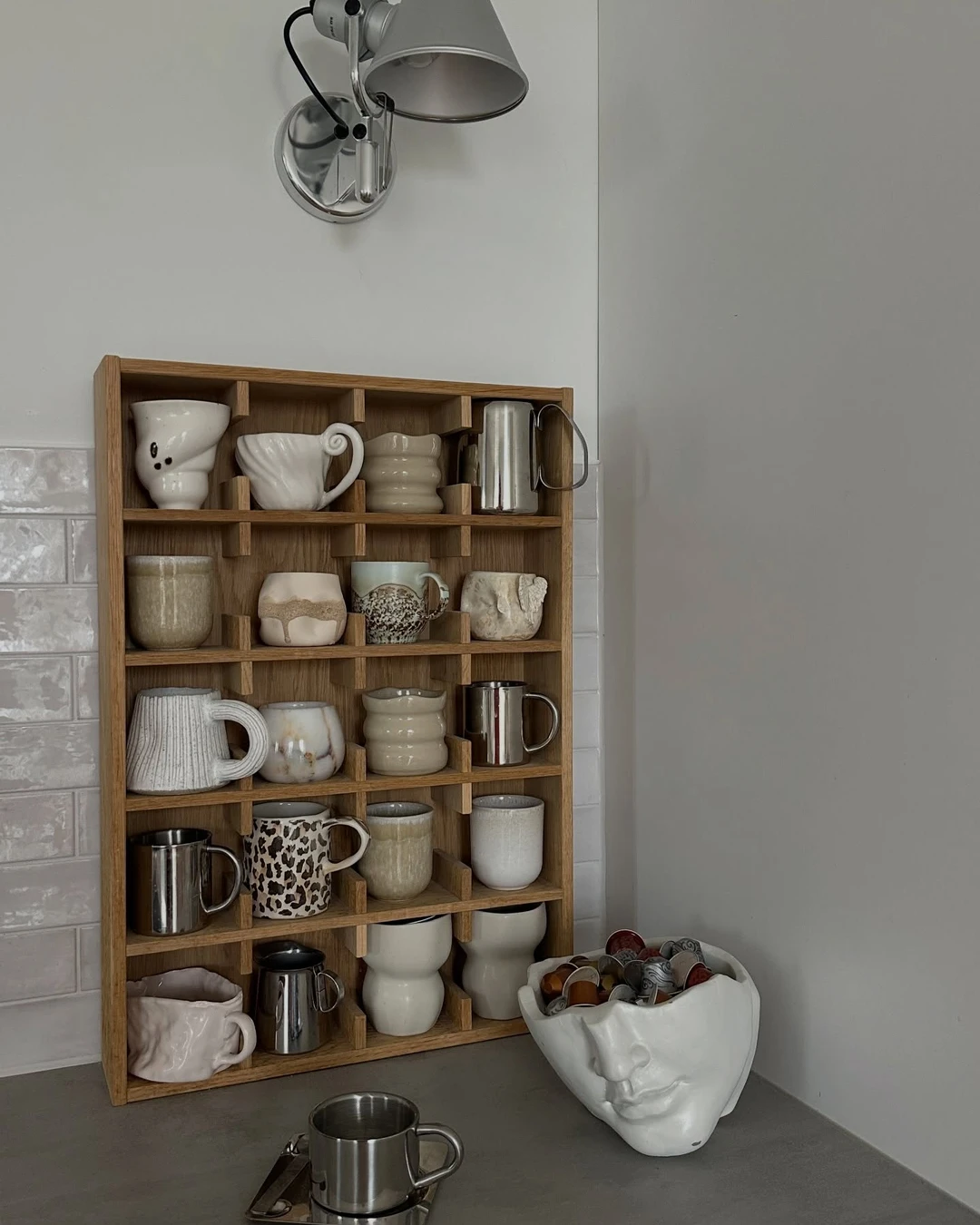
Mugs hidden in a cupboard are mugs you forget you own. Mugs on an open shelf are a collection — and the morning gets a little better when you pick today’s mug the way you pick today’s shirt.
One cubby shelf like this one is the easiest version: small square compartments, each holding a mug or two, all of them visible at a glance. Mixed colours and styles work better than a matching set — a shelf of identical white mugs looks like a shop, while a shelf of different mugs looks like a home that drinks coffee.
Hang the shelf at eye level, not above the cabinets where you need a stool to reach it. And keep the count honest: if a mug has not been used in a month, it is decoration, not a mug — give it away and keep the shelf for the ones you actually drink from.
The practical point: Hang the shelf at eye level, not above the cabinets where you need a stool — and if a mug has not been used in a month, it is decoration, not a mug.
One Tray, No More Mess
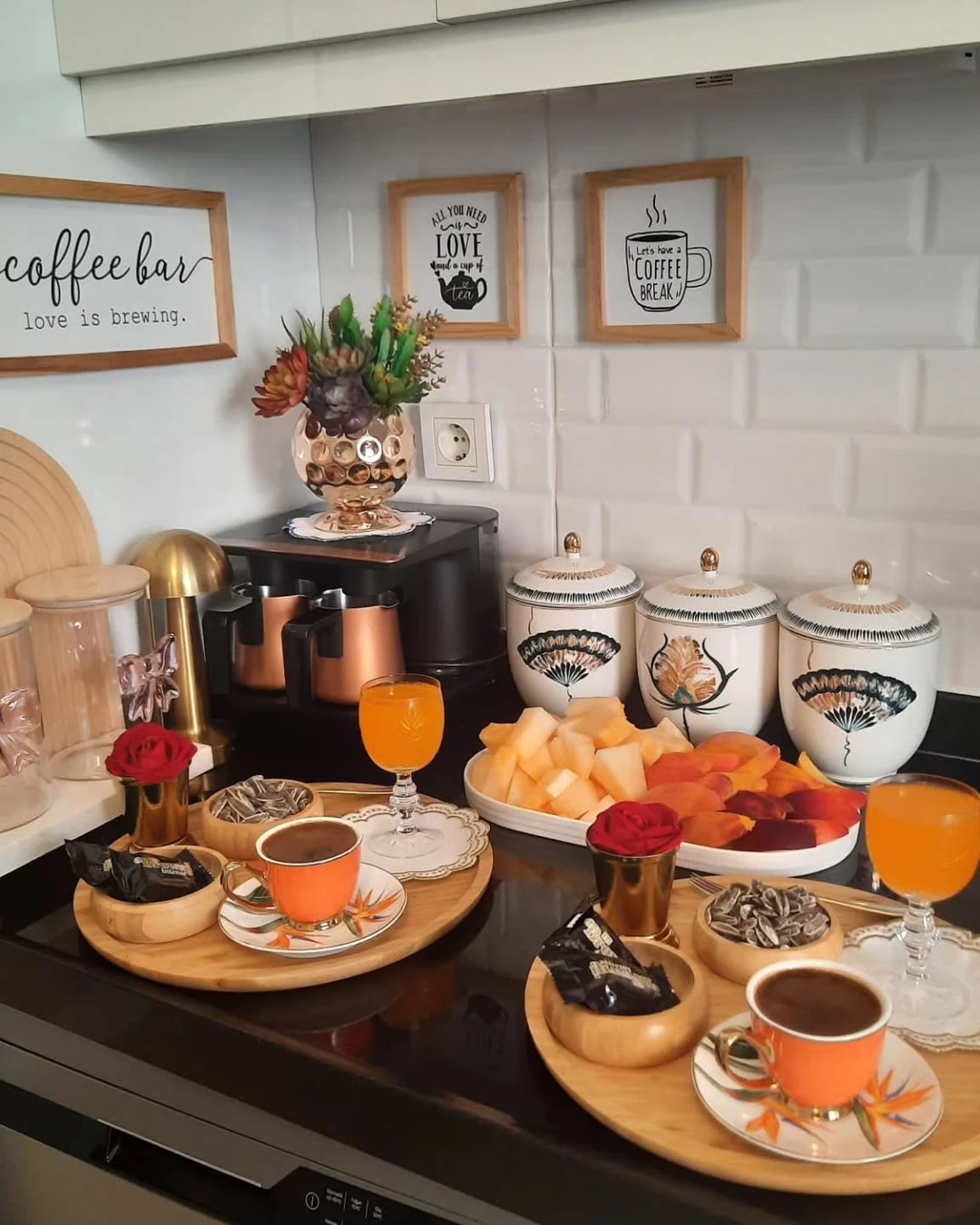
Coffee makes a mess — grounds on the counter, a drip from the machine, a spoon with nowhere to go. One tray fixes all of it. Everything coffee lives on the tray, and the tray lives in one spot, so the mess has a border.
Two round wooden trays, like the ones in this photo, split the job nicely: one for the cups and the small bowls, one for the machine’s extras. The tray catches the drips, holds the spoons, and when guests come over you can lift the whole coffee bar off the counter in one move.
Choose a tray with a rim high enough to catch a spill — a flat board is a serving platter, not a tray. Wood is forgiving and warm; marble looks smarter but shows every coffee ring.
The practical point: Choose a tray with a rim high enough to catch a spill — a flat board is a serving platter, not a tray.
Let the Espresso Machine Take Centre Stage
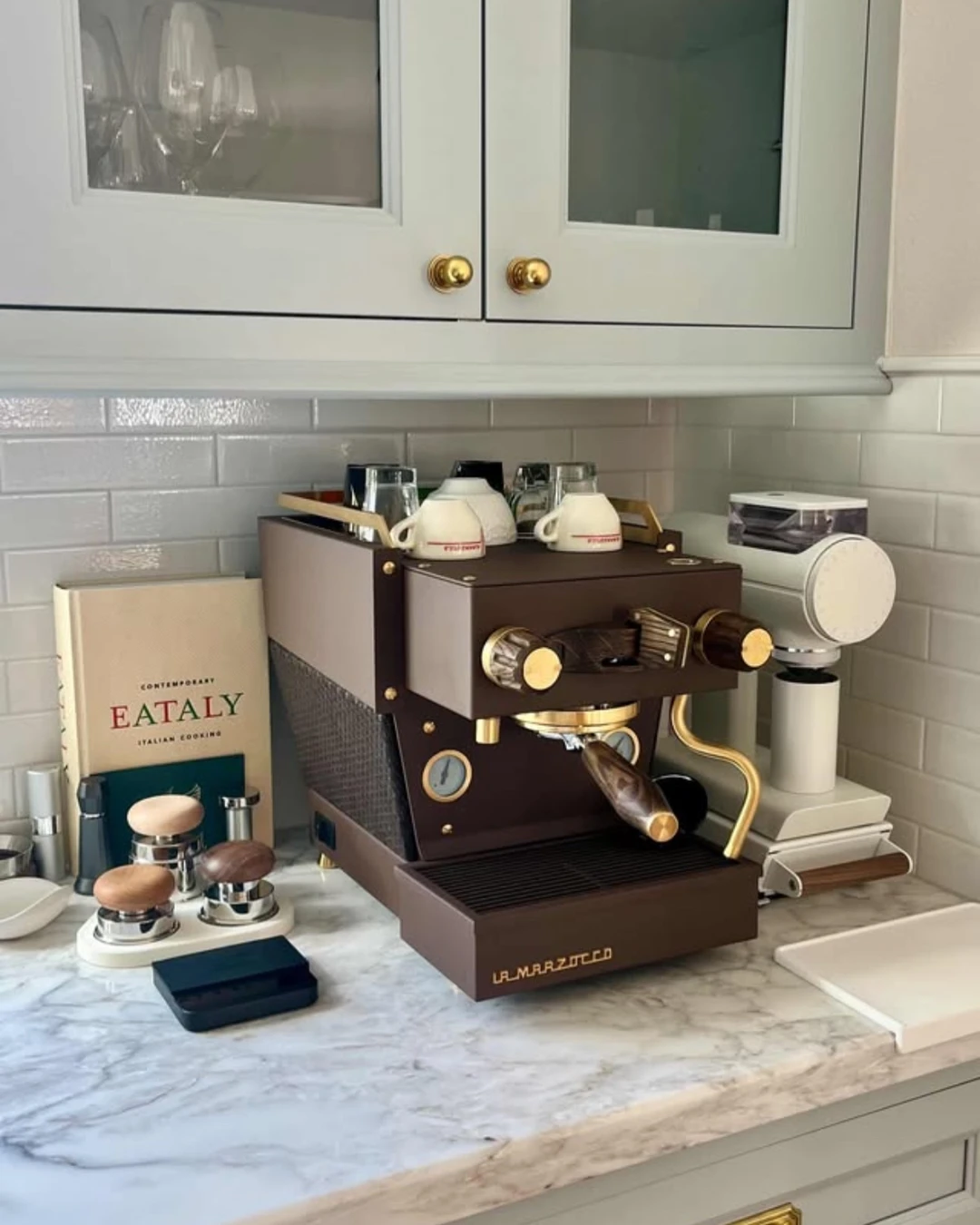
Some machines deserve to be hidden in a cupboard. An espresso machine does not — it is the most beautiful thing most kitchens own, and it earns the centre of the counter.
Give it the middle of the run, with the grinder to one side and the tampers on a small tray to the other, and the whole counter reads as a coffee bar instead of a kitchen that happens to own a machine. Marble counters and white subway tile, like the ones here, are the perfect quiet background — they let the machine be the loudest thing in the room.
Keep a small towel and a knock box within reach, or the centre stage turns into a centre mess. And leave a hand’s width of clear counter on both sides of the machine — you need somewhere to set the cup while the shot pours.
The practical point: Leave a hand’s width of clear counter on both sides of the machine — you need somewhere to set the cup while the shot pours.
How a Pour-Over Corner Slows the Morning Down
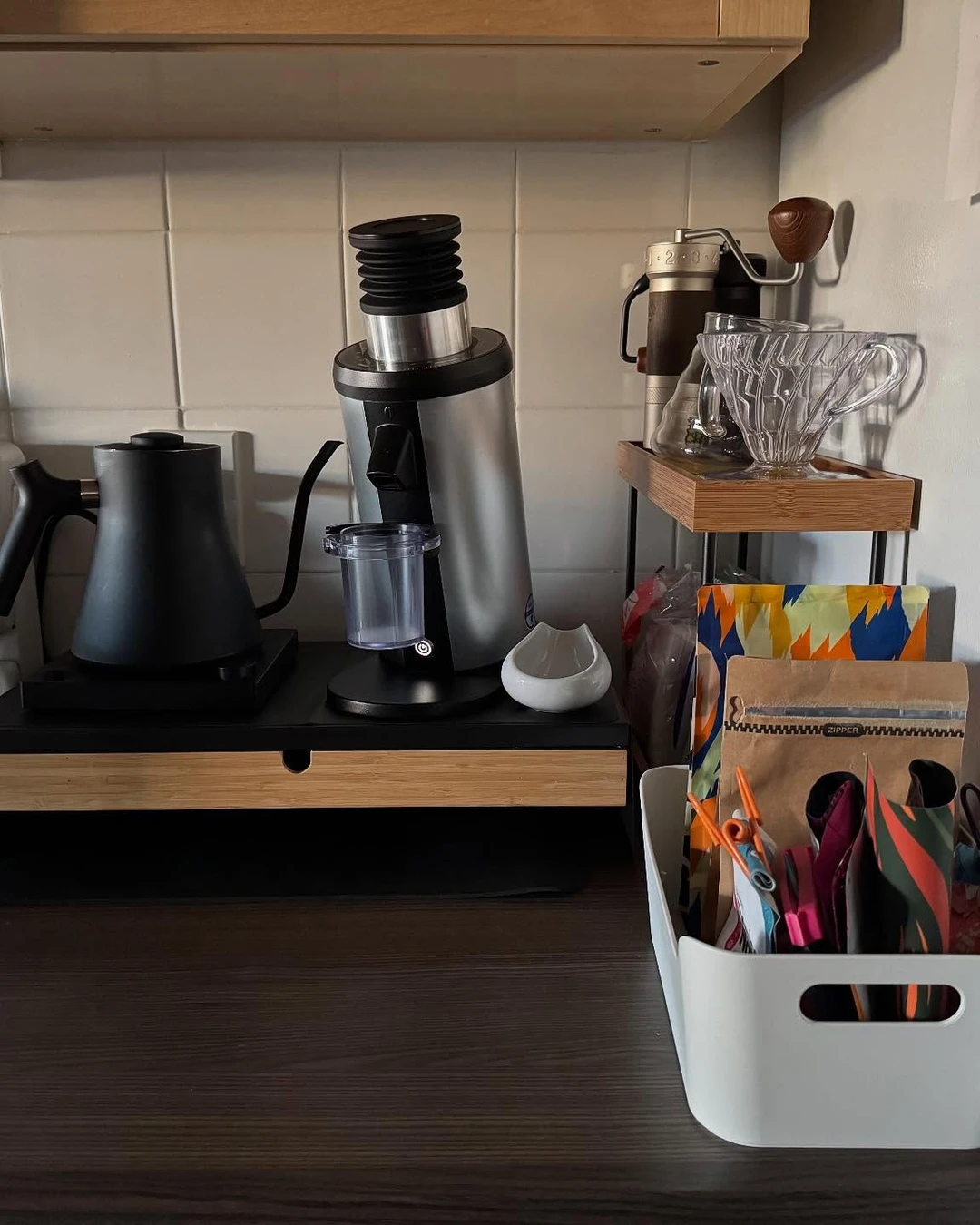
Pour-over is the slowest way to make coffee, and that is the point. Three quiet minutes with a gooseneck kettle, watching the water bloom the grounds — it is the only part of the morning that asks nothing of you.
It needs very little: a kettle, a grinder, a dripper on a small shelf, and a place for the bag of beans. This station has all of it on a black riser under wooden cabinets, with the dripper on its own little wooden shelf like a tool that gets respect. The ritual is the luxury — the gear is simple.
Buy beans whole and grind them the morning you brew, or the ritual is wasted on stale coffee. And keep the dripper where you can see it — a pour-over kit hidden in a cupboard is a pour-over kit you never use.
The practical point: Buy beans whole and grind them the morning you brew, or the ritual is wasted on stale coffee.
Hang the Mugs Under the Shelf
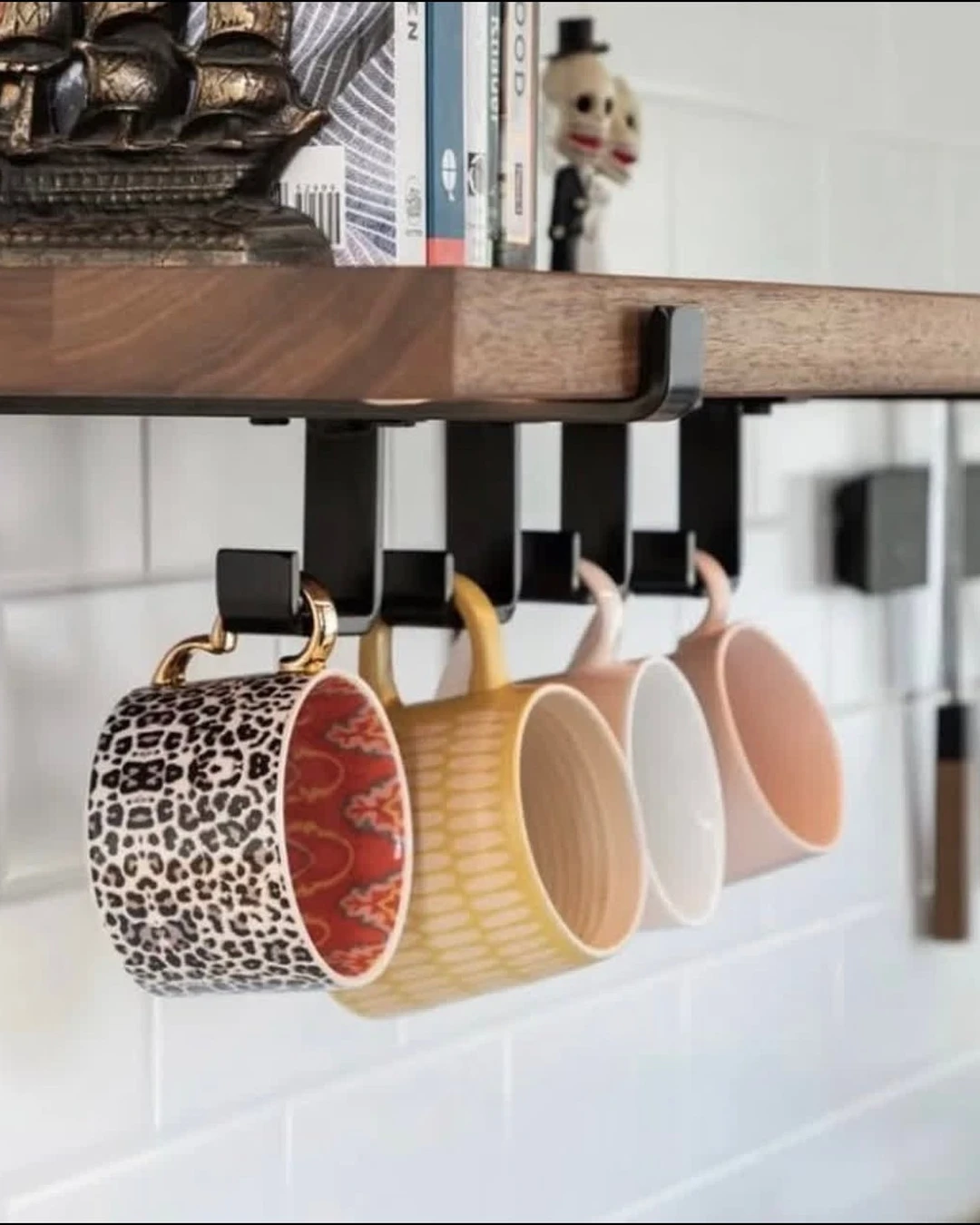
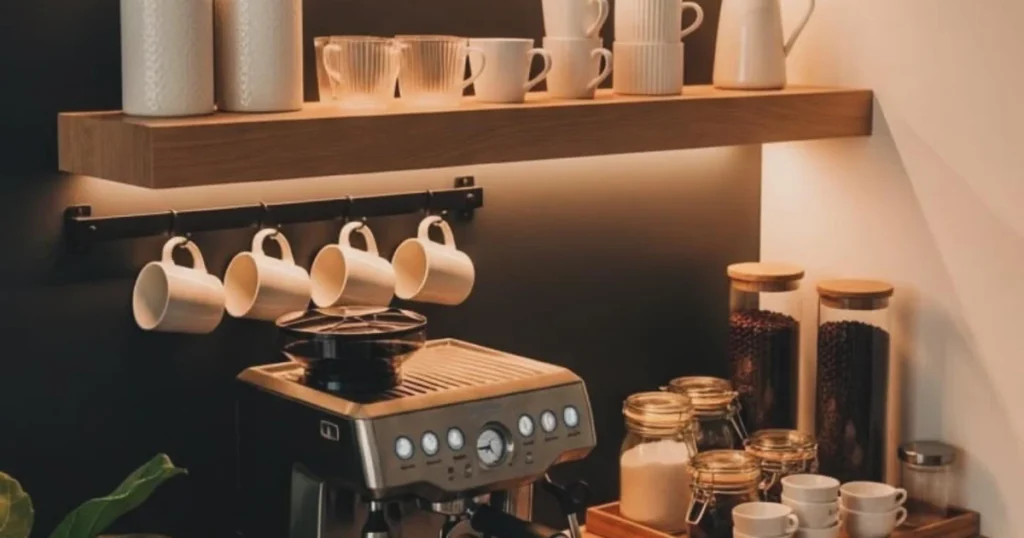
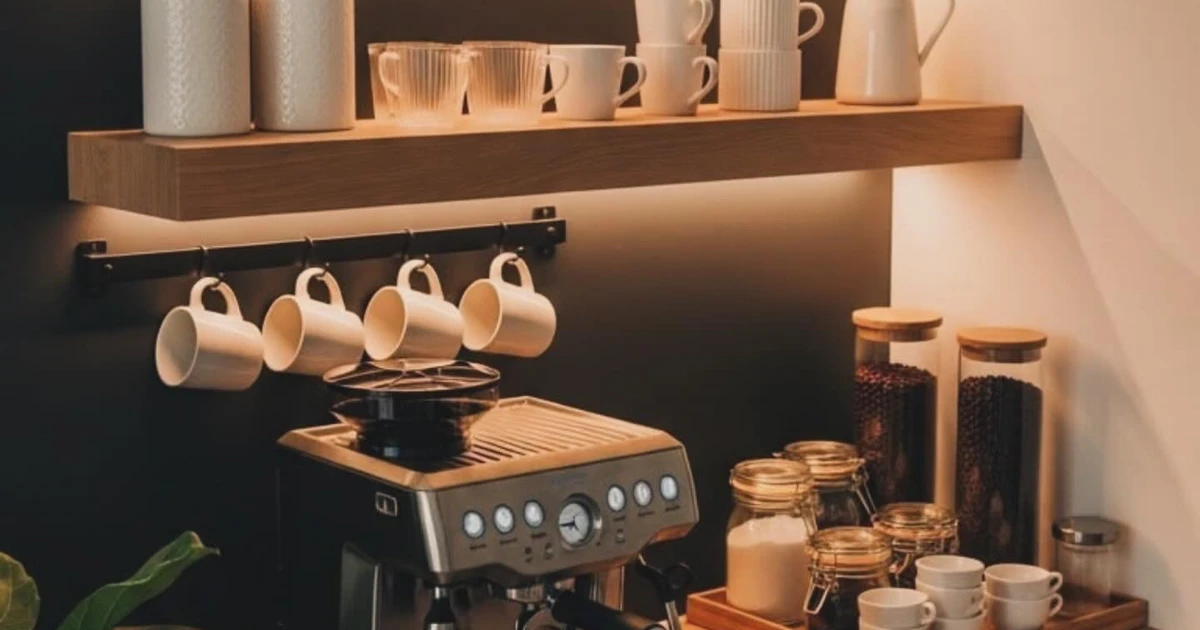
Four mugs on black hooks under a wooden shelf — that is the whole idea, and it takes ten minutes to set up. No shelf to build, no cabinet to organise; the mugs hang where you can see them, and the shelf above still holds whatever it held before.
Hooks work because they use the space nobody else uses: the air under the shelf. A small rail of hooks, screwed into the underside of a wooden shelf, holds four mugs without taking a single inch of counter or shelf. The mugs in this photo are all different — leopard print, mustard yellow, soft pink — and hanging them side by side turns a mixed set into a display. (The little skull figurines in top hats and the bronze ship on the shelf are the owner’s own quirks — the hooks work just as well without them.)
Screw the hooks into solid wood, not into the thin bottom of a cabinet — a mug full of coffee is heavier than it looks, and a hook that pulls out at 6 a.m. ruins the morning. Space the hooks a mug-width apart so the handles do not clink.
The practical point: Hooks under a shelf turn dead space into mug storage — and the mugs become decoration instead of clutter.
Jars of Beans and Sugar, Out in the Open
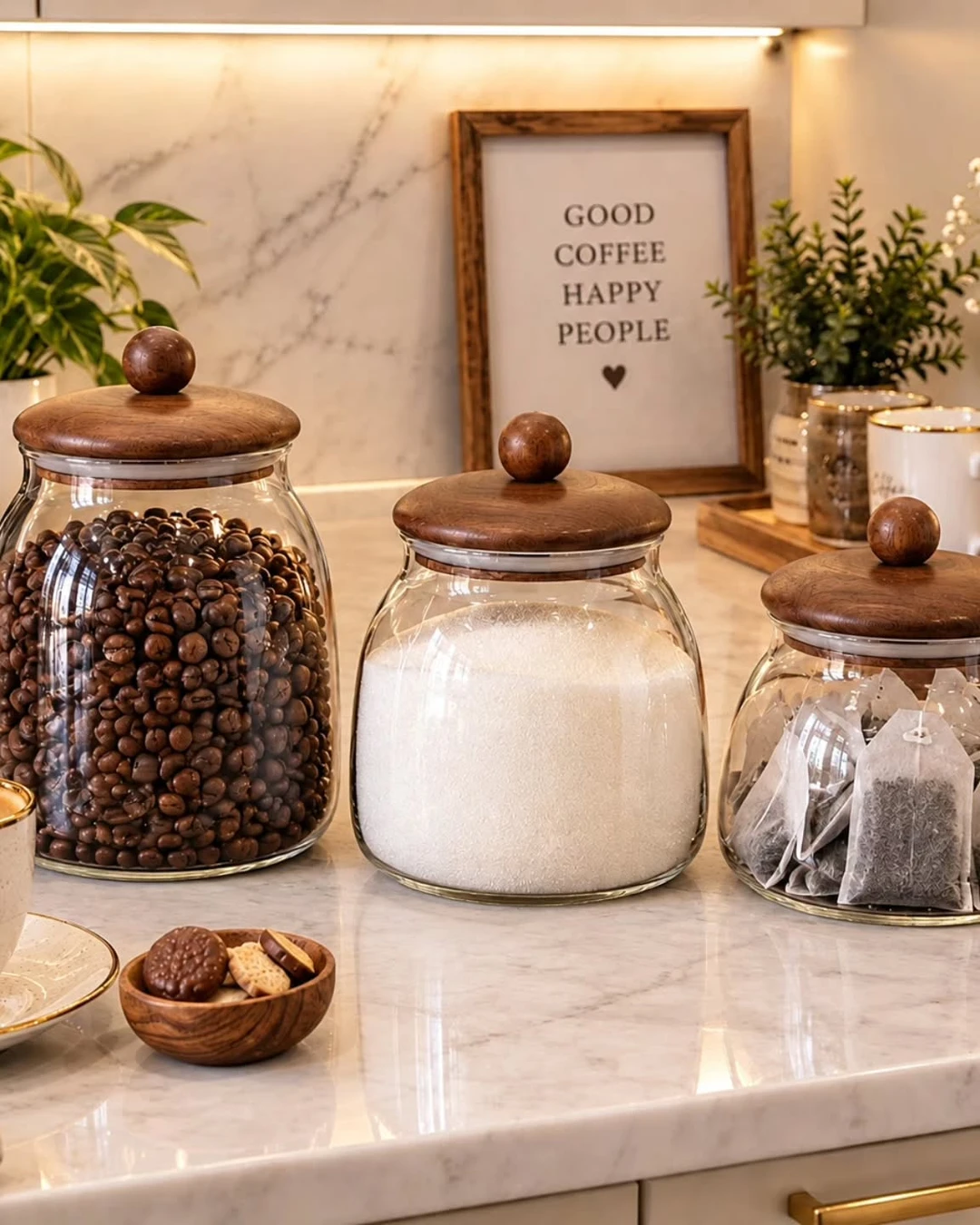
Glass jars of beans and sugar on the counter are the most honest decoration a kitchen has. You can see what is inside, you can see when it is running low, and the coffee bar looks like it belongs to someone who actually makes coffee.
Three jars with wooden lids, like the ones in this photo — roasted beans, white sugar, tea bags — lined up on a marble counter with a cup of latte art beside them. The jars are the photo, and that is the point: no hiding the supplies in a cupboard when they look this good out in the open. A framed print behind them reads a cheerful coffee slogan — the kind of wall decor that costs nothing and makes the corner feel finished.
Keep the beans in an airtight jar away from the window, or the sun steals the flavour before you brew. And decant the sugar into a smaller jar than you think — a half-full jar looks generous, a nearly empty big jar looks neglected.
The practical point: Glass jars show you what is inside — and they show you when you are running low, before the morning you run out.
Coffee by the Window Tastes Different
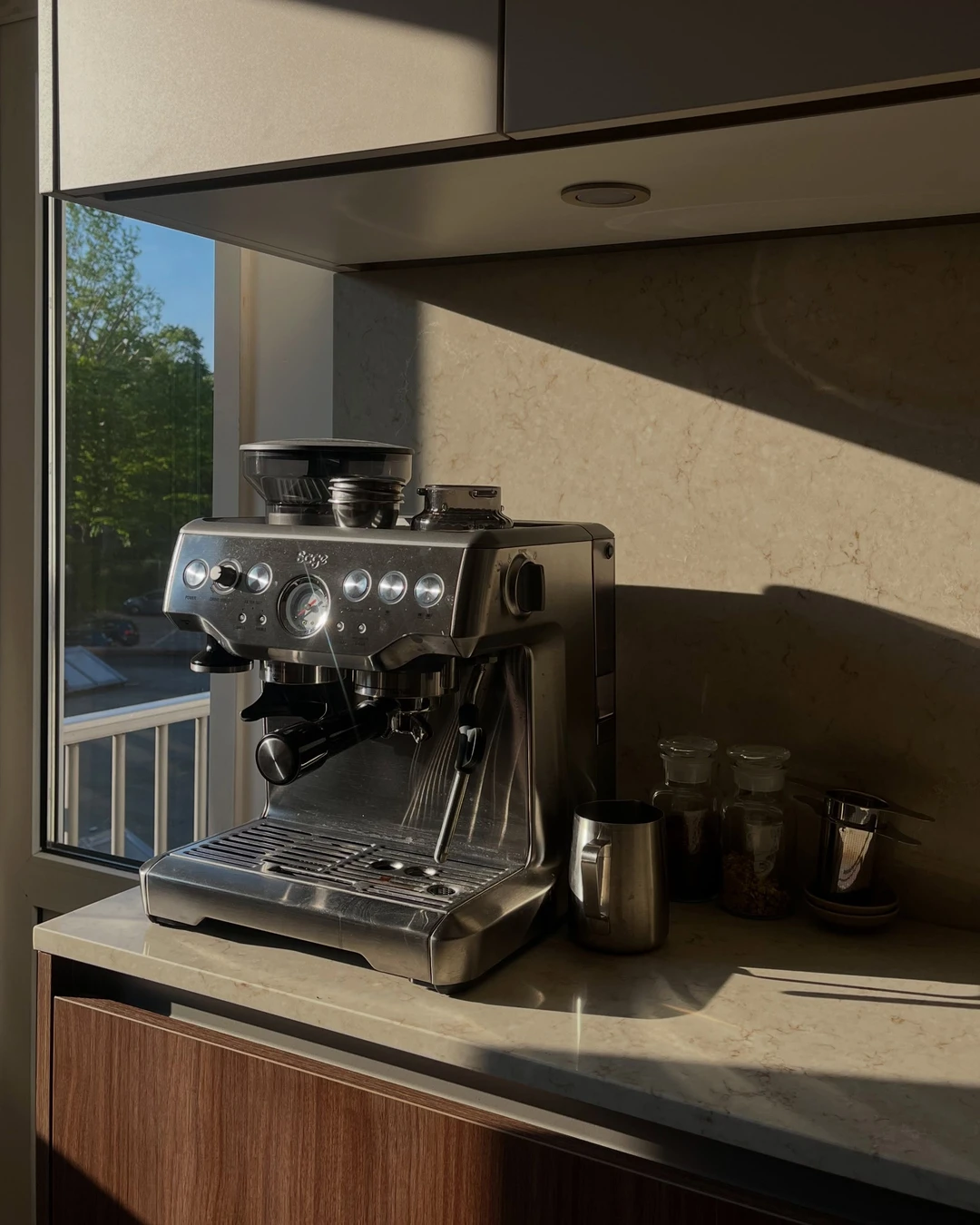
Coffee by the window tastes different, and it is not the coffee — it is the light. Warm morning sun across the counter, greenery outside the glass, the machine catching the light while it warms up — the whole ritual slows down by itself.
Put the machine on the counter beside the window, like this one, and the bar needs almost no decoration at all. The sunlight does the styling: it falls across the stainless steel, it warms the cups, it makes the steam visible in the air. A window with a view of greenery beats any backsplash tile you could buy.
Watch the sun, though — a machine left in direct summer sun all day gets hot enough to warm the beans in the hopper. Morning light is the gift; afternoon sun is the problem. If the window faces west, keep the beans in a shaded spot.
The practical point: Morning light is free — put the machine where the sun lands and the coffee bar needs no decoration at all.
Two Tiers Hold Everything
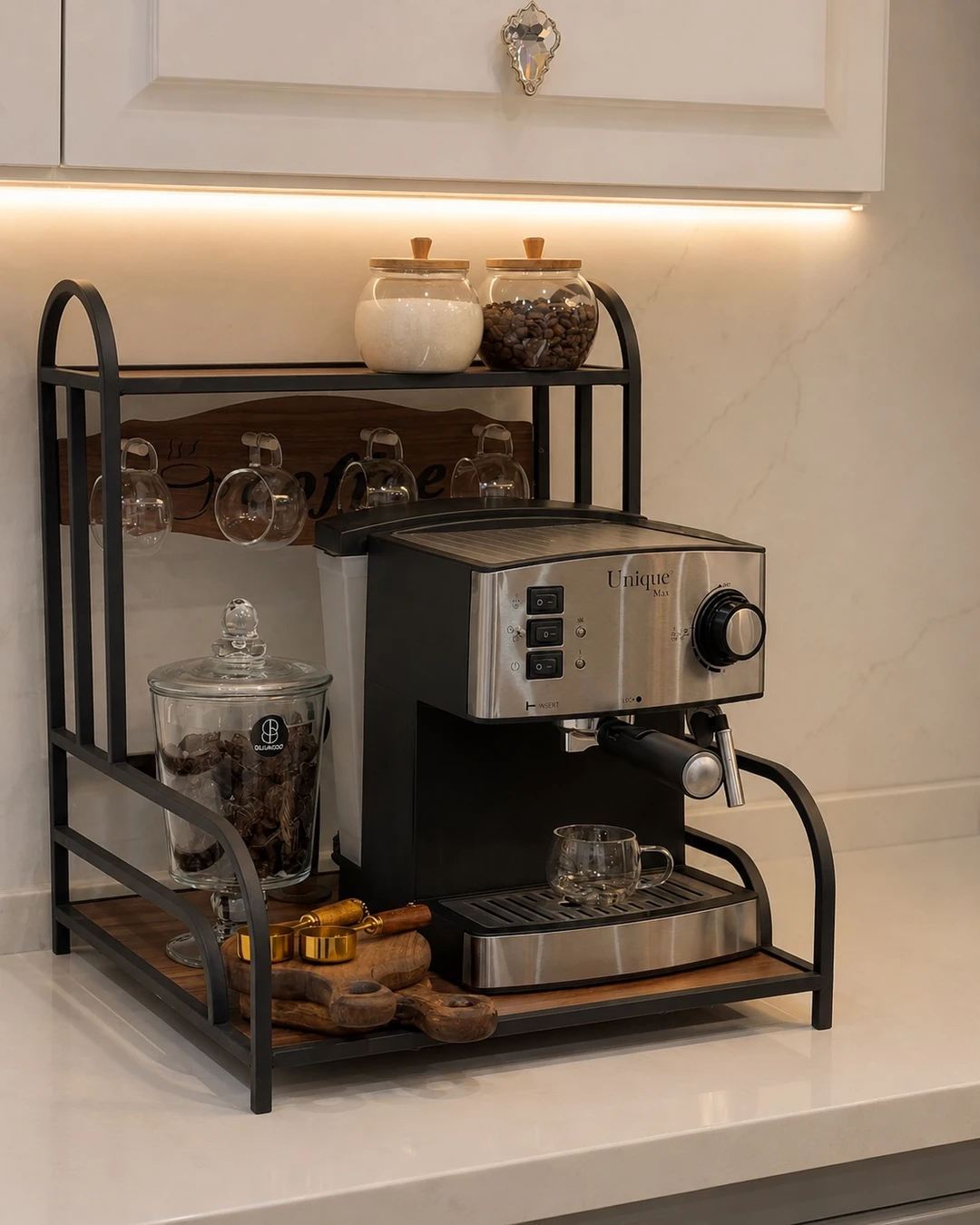
One footprint on the counter, everything stacked above it — that is a two-tier stand, the smallest possible coffee bar. Jars on top, mugs in the middle, machine at the bottom — and the whole morning lives in a square foot of counter.
Look at the stand in the photo: two glass canisters with wooden lids on the top shelf, four glass mugs hanging from hooks underneath, and the espresso machine on the bottom shelf with a small cup waiting. Nothing on the counter around it except the stand itself — that is the whole point of going vertical.
Measure the machine before you buy the stand, or the bottom shelf becomes a very expensive decoration. The stand must clear the machine’s height with room for the cup on top — and the top shelf must clear the cabinet above it.
The practical point: It works when every tier has a job — jars on top, mugs in the middle, machine at the bottom.
What a Chalkboard Menu Does to a Kitchen
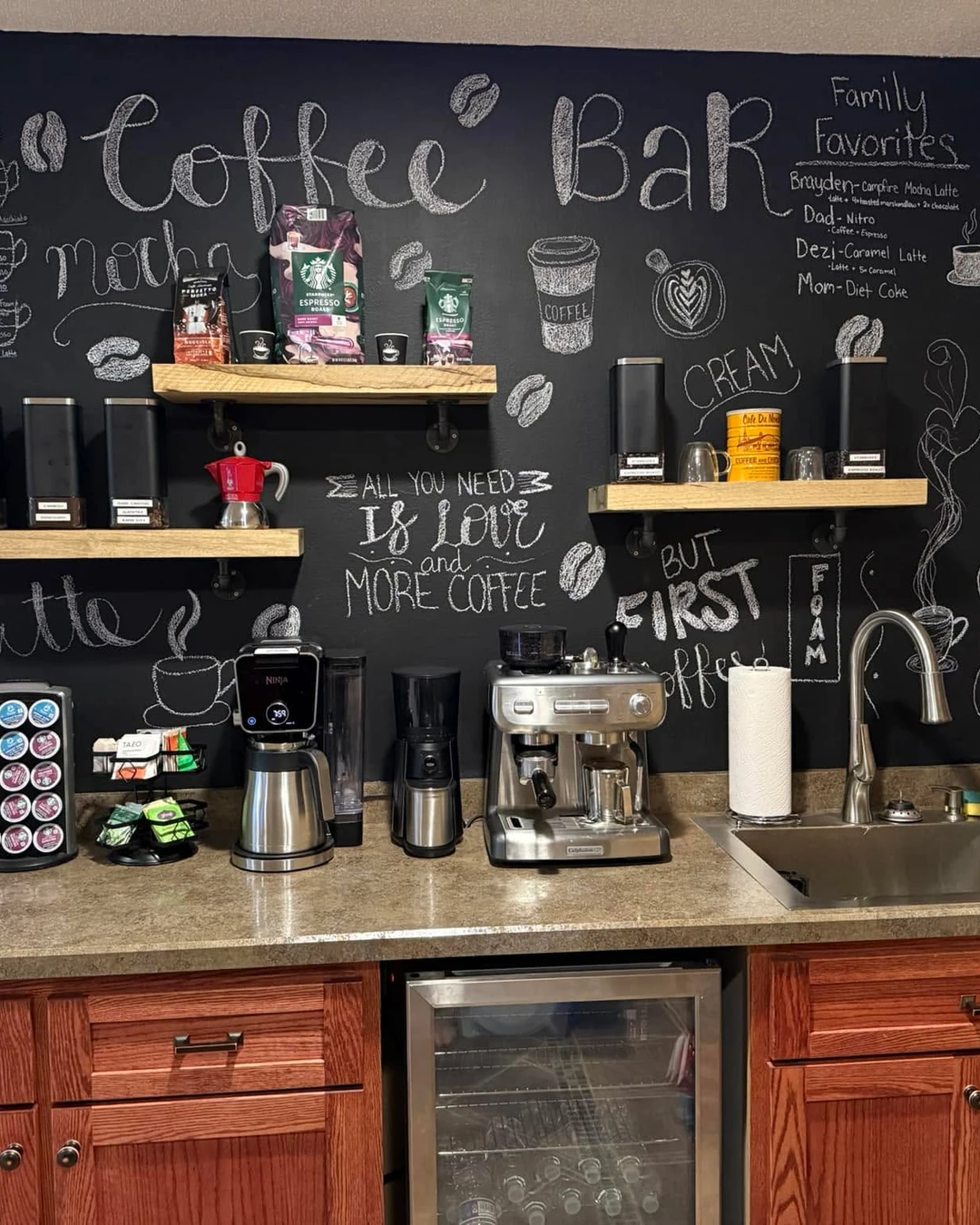
Put a chalkboard menu above the bar and a corner of the kitchen becomes a place. It is not about the drinks list — it is about the feeling that someone runs this coffee bar, and that someone is you.
That wall in the photo is the full version: a black chalkboard headed with a menu and a coffee bar title, a hand-drawn drink list with cup illustrations, wooden shelves below holding coffee bags and canisters, the machine and the sink on the counter. There is even a small corner for family favourites — the drinks each person orders most — which is the detail that makes the whole wall feel personal rather than decorative.
Chalkboard paint on one wall is cheaper than a framed menu and easier to change — new season, new list. And use real chalk, not markers: chalk wipes off with a damp cloth, markers do not, and a menu you cannot change is a menu you will stop looking at.
The practical point: It makes the bar feel like a place, not a pile of equipment — and the family favourites corner is the whole point.
Your Morning, Brewed Better
Your coffee bar is not about the machine — it is about the five minutes before the day starts. Give those minutes a corner, a tray, a shelf, and they start to feel like yours again.
Start with one change — a tray under the machine, or the mugs moved to hooks — and let the rest follow. Mornings do not get better all at once; they get better one small habit at a time. If you love a hot drink station this much, How to Create a Beautiful Hot Cocoa Bar at Home brings the same thinking to winter evenings.