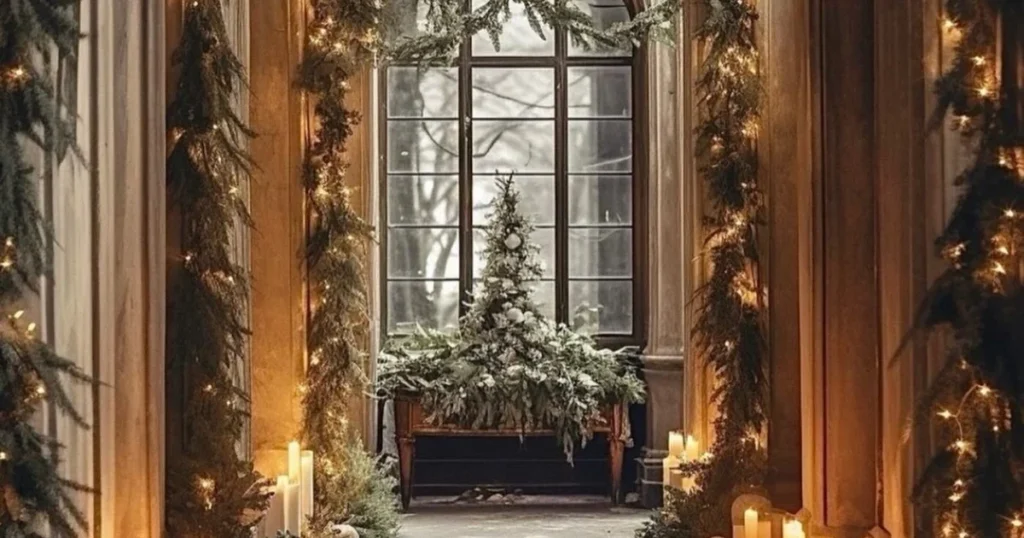
Hallways are the first thing guests see — and the last room anyone decorates. Warm light fixes that in an evening.
Every hallway is a passage, not a destination — which is exactly why a little glow changes how the whole house feels.
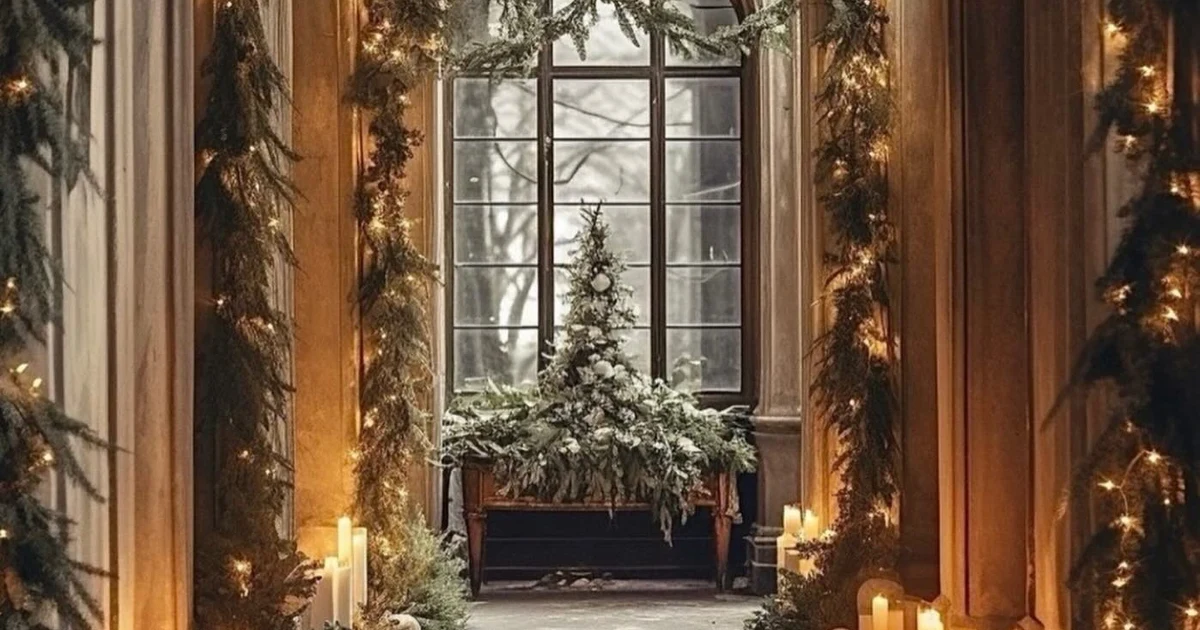
These christmas hallway lighting ideas use the smallest lights you own — fairy lights, lanterns, candles, a single glowing star — and they turn a cold passage into the warmest room in the house. No electrician, no new fixtures, no rewiring.
Fairy lights along a banister, candles in a window, a lit tree at the end of the hall — each one takes minutes, and most of them run on batteries or a single plug. The hallway does the welcoming; the lights do the talking.
Here are 15 christmas hallway lighting ideas for a warmer winter welcome — pick the one that fits your hall, and let the glow do the rest.
Fairy Lights Along the Banister
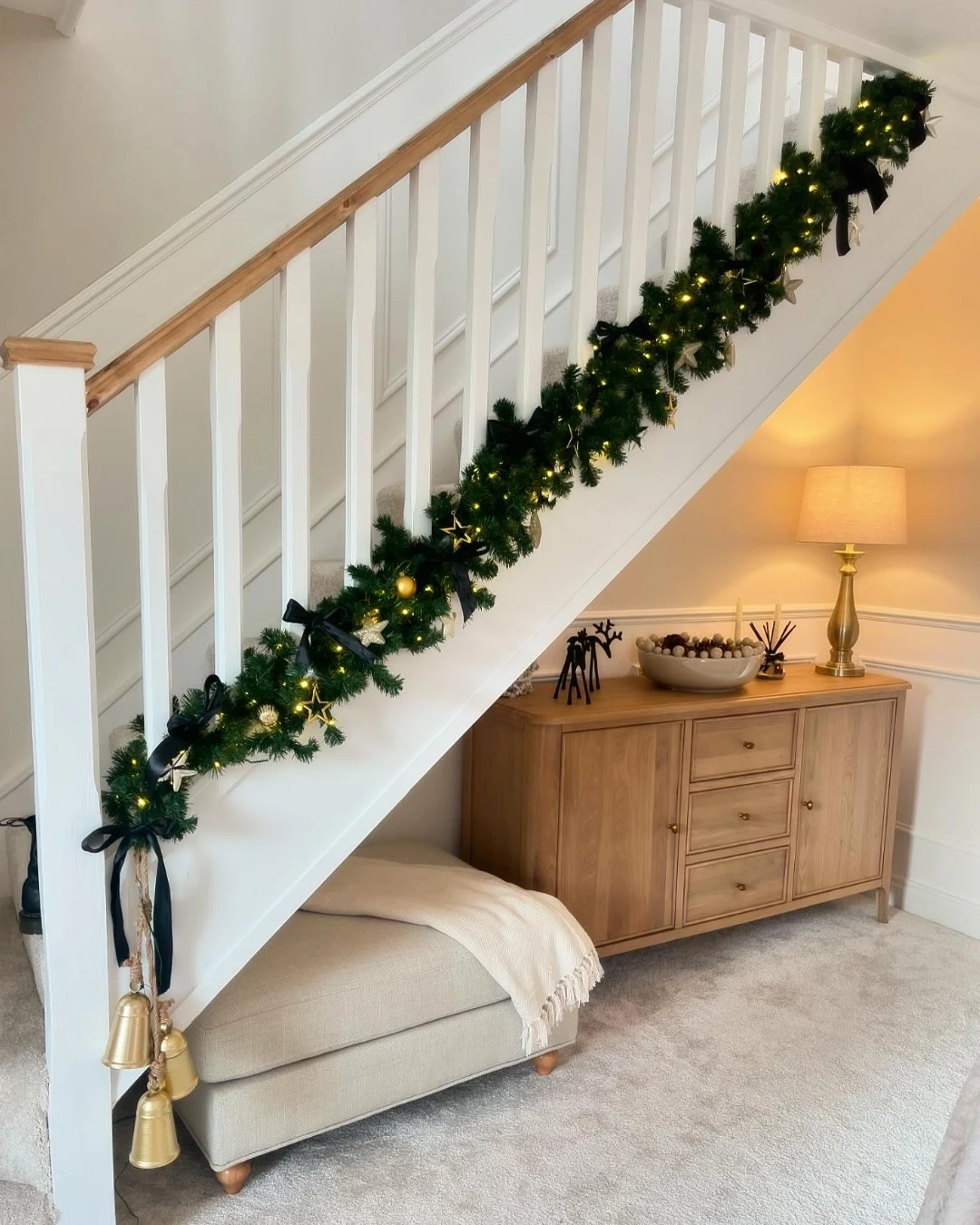
Banisters are the longest line in any hallway, so fairy lights wrapped along one light the whole passage. A white banister carries a lush garland threaded with warm lights here, finished with black velvet bows and gold bells that catch the glow.
Wrap the lights through the garland before you hang it, not after — the wire disappears into the greenery, and the bulbs sit evenly along the rail instead of bunching at one end. Battery fairy lights are the easy choice here, since the banister is rarely near a socket, and a timer means they switch themselves on at dusk.
Keep the garland on the side of the stairs people do not grip, and leave the handrail itself clear. Lights look beautiful on a banister; a handrail wrapped in wire does not feel beautiful at 2 a.m. The bells and bows are the finishing touch — two or three along the whole run is plenty.
The practical point: Lights threaded through the garland first, battery pack with a timer, and the handrail left clear for hands.
Lanterns on the Console Table
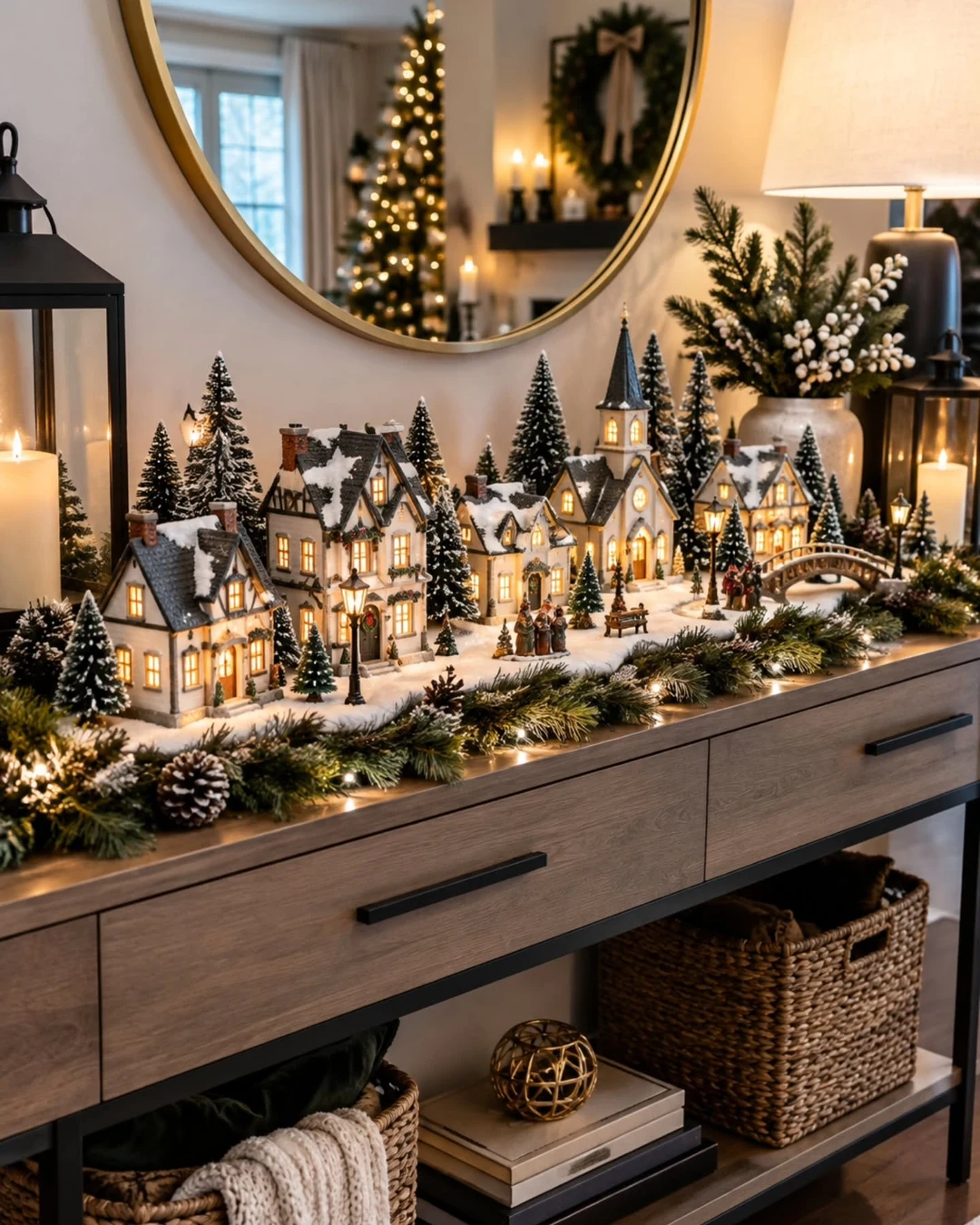
Console tables sit against the hall wall with nothing to do, and two lanterns give them a job. A wooden table carries a lit Christmas village here, with a black lantern holding a lit candle at each end, garland along the front edge and a round mirror above reflecting a lit tree.
Two lanterns beat one on a console table. One lantern looks like something you forgot to put away; a pair, one at each end, frames whatever sits between them and turns the whole table into a display. Keep the lanterns the same size and the same colour, or the symmetry falls apart.
Real candles in lanterns are lovely, but a hallway lantern gets knocked, brushed past and left burning — flameless LED candles inside the glass give the same flicker with none of the worry. The village between the lanterns is optional; the lanterns themselves are the decoration.
The practical point: A matched pair, one at each end, with flameless candles inside — the console table goes from empty wall to the warmest spot in the hall.
Candles in the Window
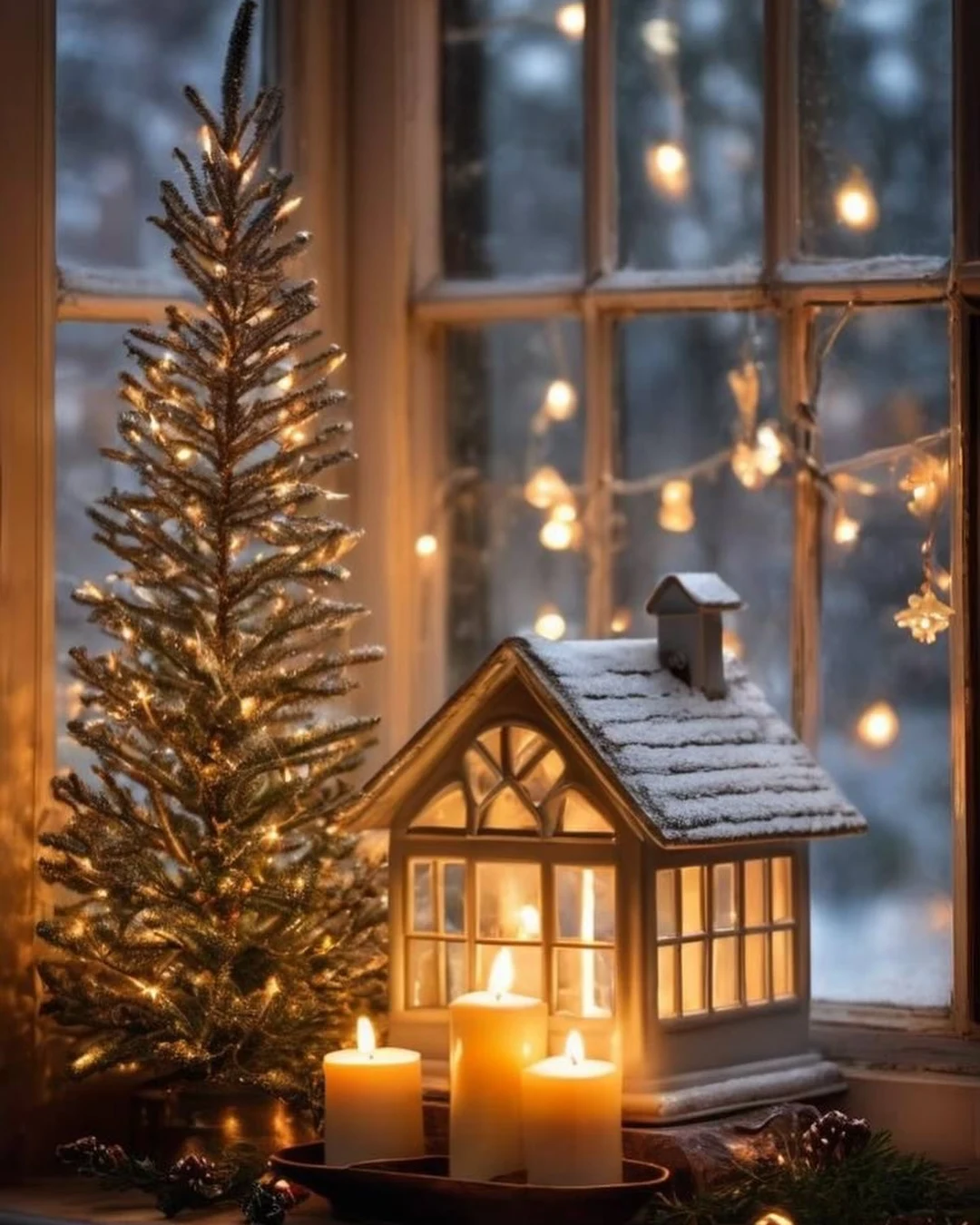
Window candles are the oldest Christmas lighting tradition there is, and they still work. A windowsill at dusk holds a small lit tree, a house-shaped candle lantern glowing from within, and three lit pillar candles on a dark tray, with fairy lights strung across the window behind.
Group the candles instead of lining them up. Three pillar candles of different heights on one tray read as a single warm glow, while a row of identical candles spaced along the sill looks like a shop display. The house lantern in the middle gives the group a shape to gather around.
Keep real flames away from curtains and never leave them burning in an empty room — or use LED pillar candles and stop worrying altogether. The glow from the window is also the first thing anyone sees from outside, so the candles decorate the street as well as the hall.
The practical point: Three candles of different heights grouped on one tray, flames kept clear of curtains — or LED pillars and no worry at all.
String Lights Across the Ceiling
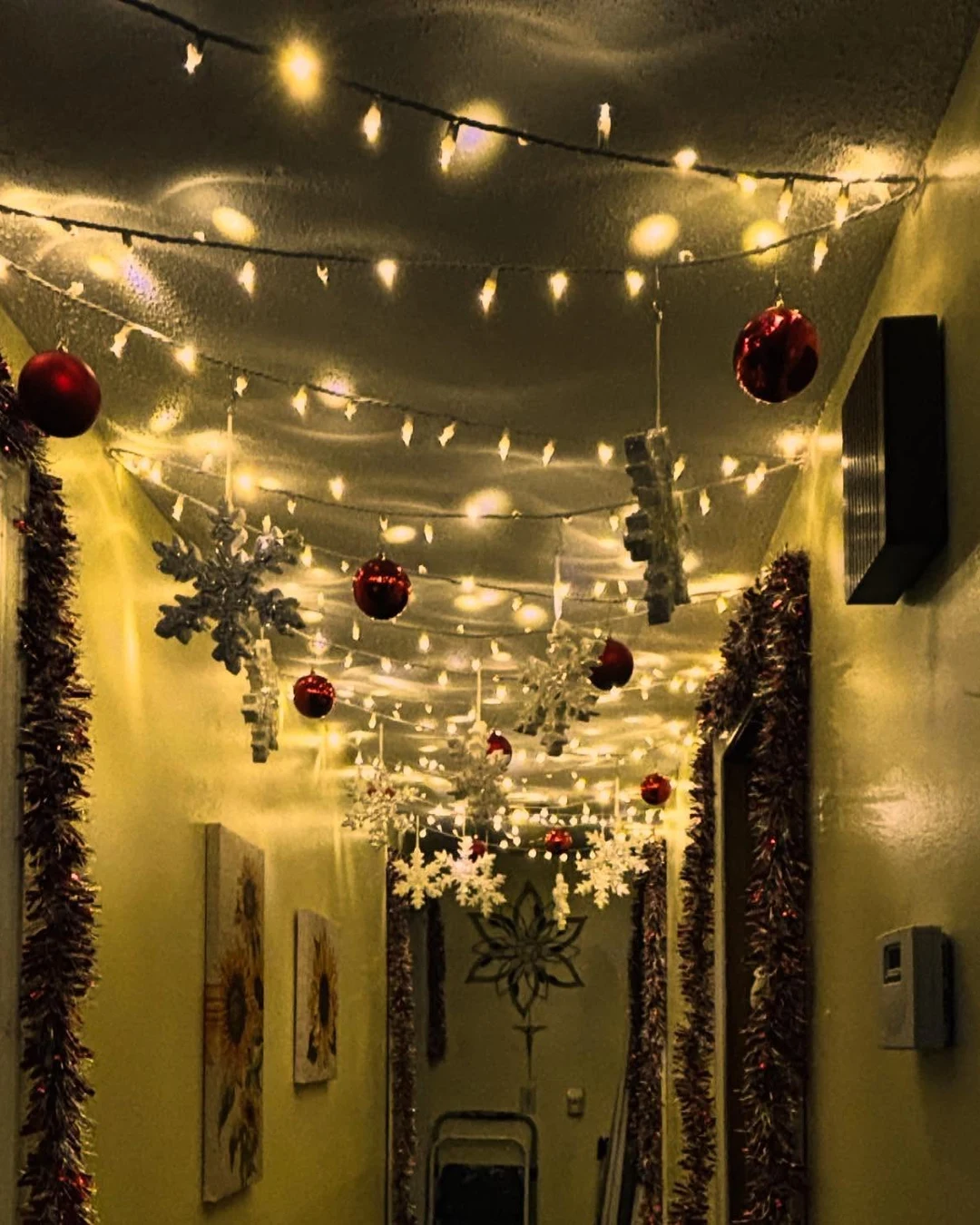
Ceilings are the one surface hallways never use, and rows of string lights turn a plain corridor into a canopy. A narrow hallway ceiling is covered in warm lights here, with red baubles and large snowflakes hanging among them and tinsel garlands framing the doorways on both sides.
Run the lights in straight rows from wall to wall, a foot apart, and let them sag just slightly between the fixings — the gentle dip is what makes a ceiling of lights feel like a canopy instead of a grid. Small adhesive hooks or removable ceiling clips hold the strands without a single hole in the plaster.
Warm white is the only colour temperature that works for this. Cool white turns a hallway into an office, and multicolour turns it into a fairground — warm white with a few red baubles is the combination that reads as Christmas and still feels calm. The snowflakes hanging below the lights catch the glow and throw soft shadows on the walls.
The practical point: Straight rows a foot apart, a slight sag between fixings, warm white only — the ceiling becomes a canopy, not a grid.
Let a Lit Garland Frame the Doorway
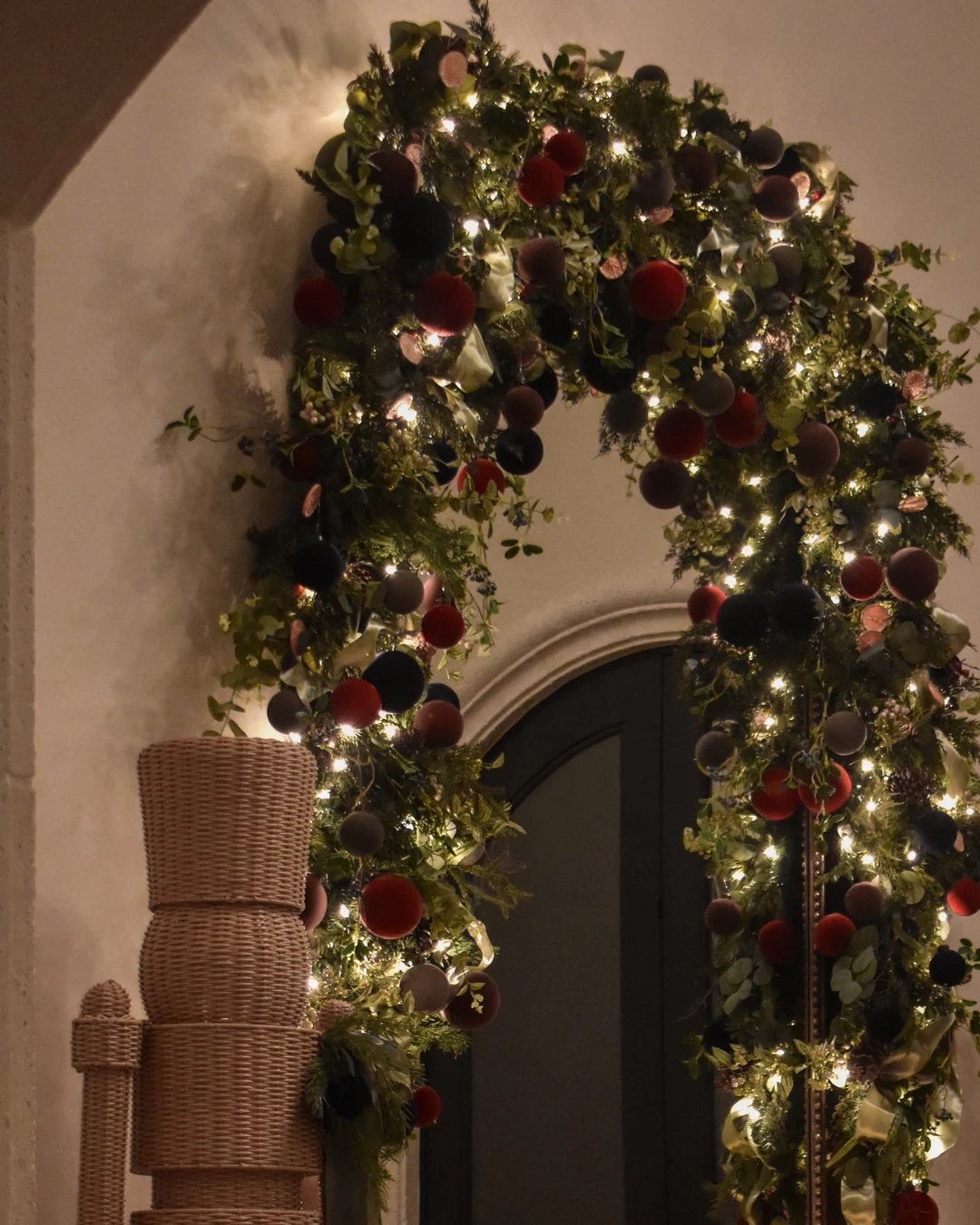
Doorways are the frames of a hallway, and a lit garland turns one into an archway. A lush garland threaded with warm lights and round red ornaments frames a dark arched doorway here, with a tall wicker nutcracker standing guard in the foreground.
Hang the garland from the top of the frame and let it fall down both sides, rather than draping it across the top only — the full arch is what makes a doorway feel like an entrance. A tension rod across the top of the frame holds the garland without nails, and the same trick works for a tension rod garland anywhere else in the house.
Keep the garland clear of the door’s swing. A garland that catches the door every time it opens ends up on the floor by the second day — fix it to the frame, not the door, and leave a finger’s width of clearance on the hinge side. The ornaments should sit on the outside face of the garland, where the hallway sees them.
The practical point: Full arch down both sides, fixed to the frame with clearance for the door — a doorway becomes an entrance.
Wall Sconces With Flameless Candles
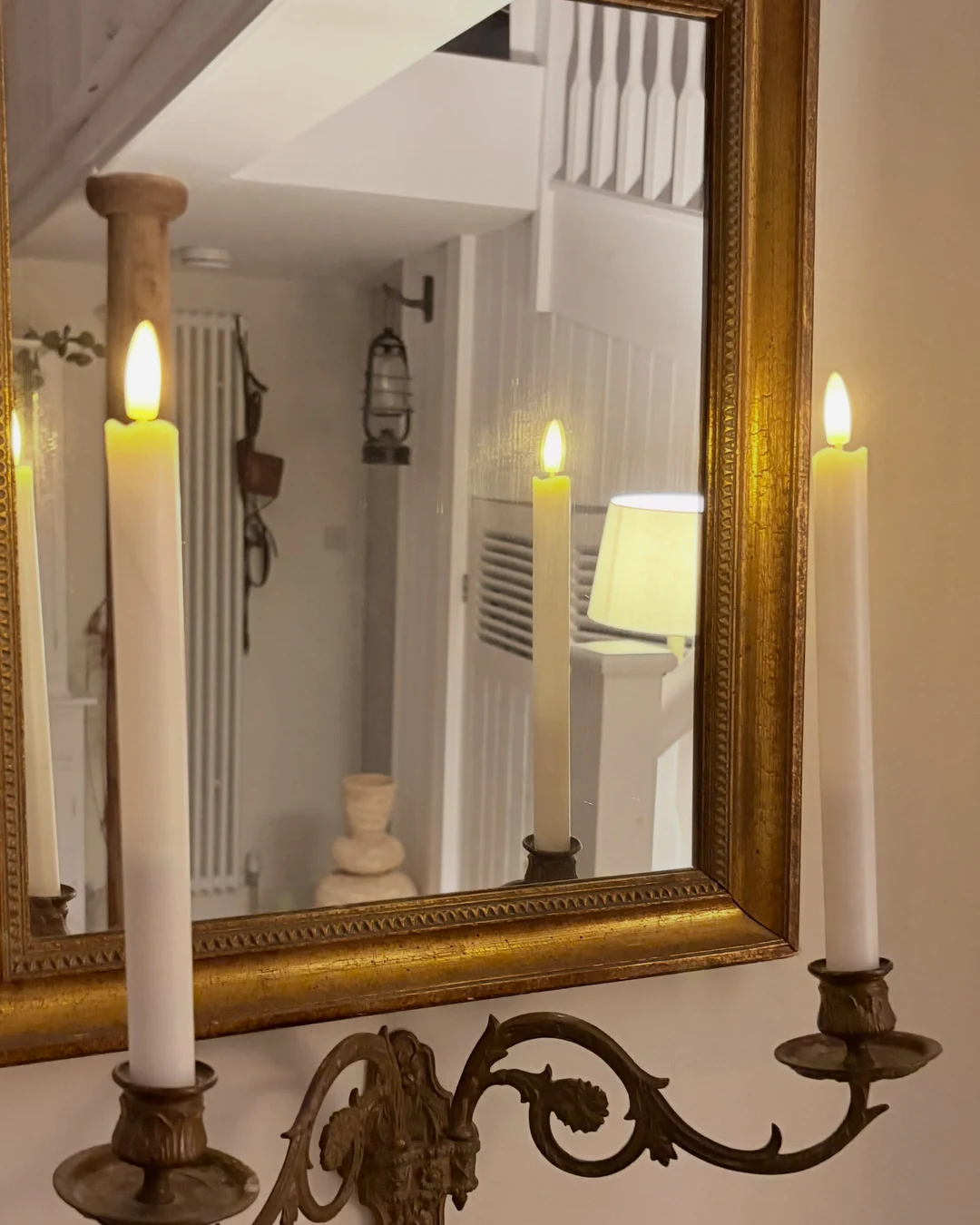
Hallway walls are usually bare, and a sconce with flameless candles fills one in a single move. A dark metal two-arm sconce holds two tall LED candles below a gold-framed mirror here, and the mirror doubles the glow by reflecting the hallway back at itself.
Flameless is the whole point in a hallway. A real candle in a wall sconce sits at shoulder height where coats, scarves and sleeves brush past it — an LED candle with a flickering flame gives the same light and never needs watching. Battery sconces stick to the wall with adhesive strips, so there is no wiring and no holes.
Hang the sconce below a mirror and the light multiplies. The mirror catches the candle glow and throws it back down the hall, so one sconce lights twice as much wall as it would on its own. Two sconces, one on each side of the mirror, is the grand version — one is enough for a narrow hall.
The practical point: LED candles in a battery sconce below a mirror — the same flicker, no flame at shoulder height, and the mirror doubles the light.
A Light-Up Wreath on the Hall Mirror
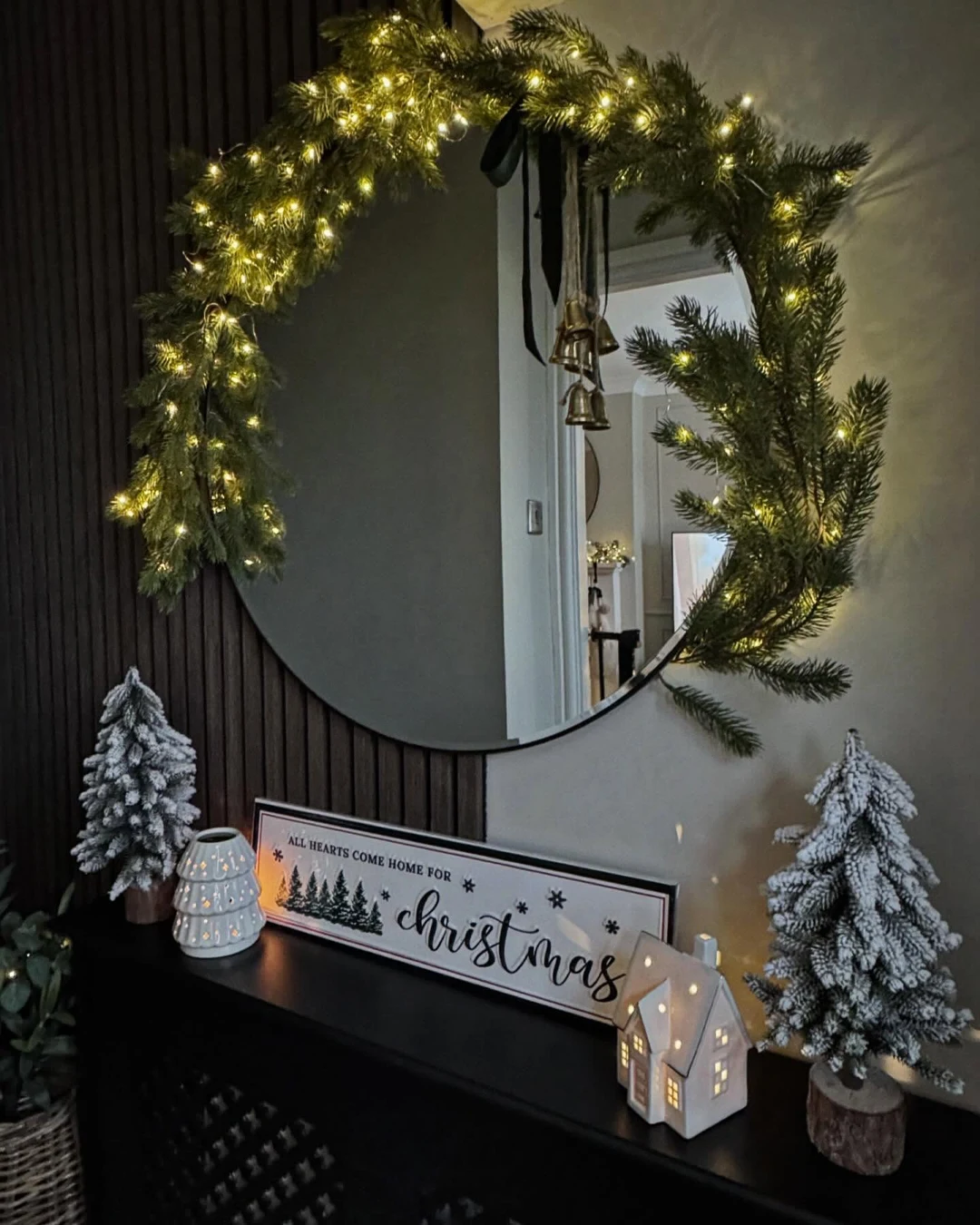
Hall mirrors are already there to bounce light around, so a wreath wrapped in fairy lights on one is the most efficient decoration in this list. A round mirror is framed by a pine wreath threaded with warm lights here, with black ribbons and small gold bells, and a console table below with flocked trees and a lit ceramic house.
Hang the wreath on the mirror itself, not on the wall around it — a suction hook on the glass holds a light wreath, and the mirror behind it makes the lights look twice as many. Battery fairy lights are the right choice, since the mirror is rarely near a socket and a trailing wire ruins the effect.
Keep the wreath a little smaller than the mirror, so the glass shows around the edges. A wreath that covers the whole mirror stops being a mirror — a ring of greenery and light around the rim frames your reflection instead of hiding it. The bells are the detail that makes it feel finished. If the wreath idea grows on you, the same treatment works in the kitchen — these christmas cabinet wreaths bring the same glow to cabinet doors.
The practical point: A wreath slightly smaller than the mirror, battery lights, suction hook on the glass — the mirror doubles every bulb.
Fairy Lights in a Glass Vase
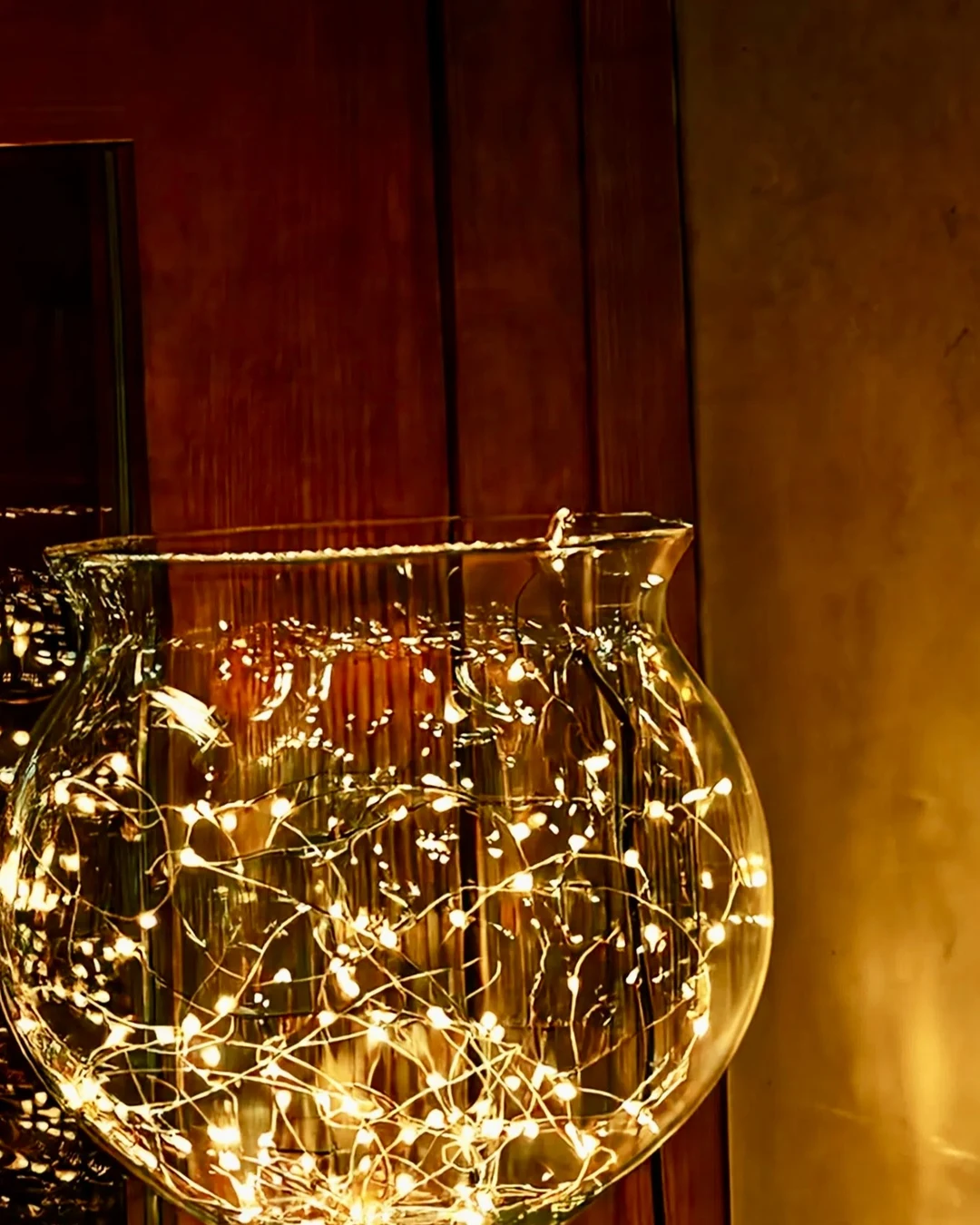
A vase full of fairy lights is the simplest idea here, and one of the prettiest. A large clear glass vase holds a tangle of warm-white lights here, glowing bright in a dark room with its reflection in a mirror beside it — no flowers, no branches, just light in glass.
Fill the vase loosely, not tightly. A string of lights stuffed into a vase looks like a knot; the same string draped in loose loops fills the glass with glow and leaves space between the bulbs. A tall, straight-sided vase works best, because the light shows through the whole height instead of pooling at the bottom.
Set the vase where the hallway turns dark — on a console table, a shelf, the floor by the stairs. The glass throws the light in every direction, so one vase lights a corner that a wall light would miss. A mirror behind it doubles the glow, the same way it does for a wreath.
The practical point: Loose loops in a tall straight vase, set where the hall turns dark — light in glass, nothing else needed.
A Lit Christmas Tree at the End of the Hall
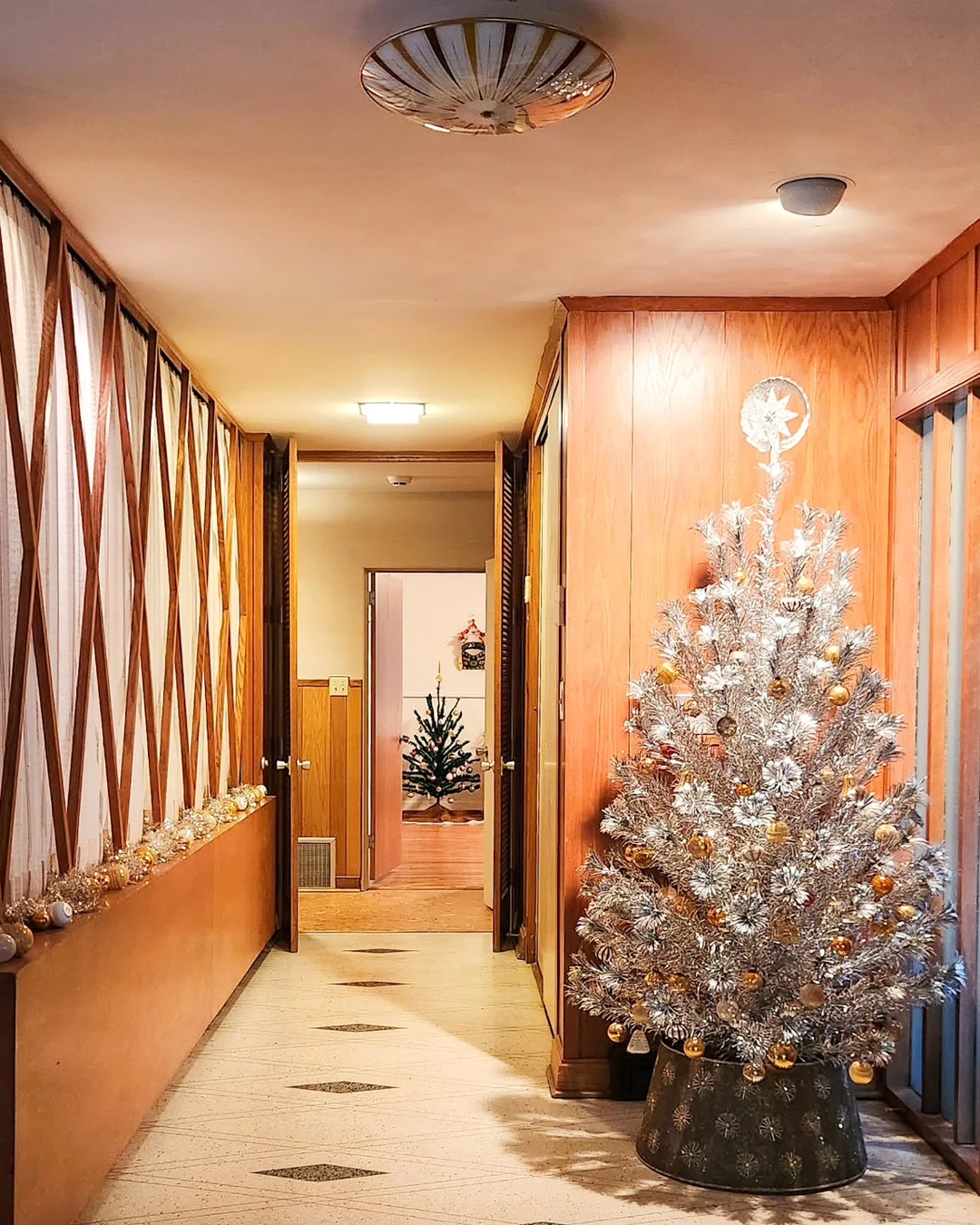
Every hallway has a far end, and a lit tree standing there turns the whole passage into a view. A silver tinsel tree with lights stands at the end of a long wood-panelled hallway here, with a second small lit tree visible through a doorway at the far end.
Small is right for a hallway tree. A four-to-five-foot tree fits the end of a hall without blocking the doorway, and a slim or pencil tree fits a narrow passage where a full tree would not. Tinsel reads beautifully in a hallway because it catches the light from every angle, and it needs no ornaments to look finished.
Keep the tree off the floor on a small stand or in a basket, and leave the walkway clear around it. The tree is the view at the end of the hall, not an obstacle in it — a foot of clear floor on each side is enough for the hallway to stay a hallway. Warm white lights only; the silver tinsel does the sparkle.
The practical point: Four to five feet, slim or pencil shape, a foot of clear floor each side — the tree is the view, not the obstacle.
A Paper Star Lantern in the Window
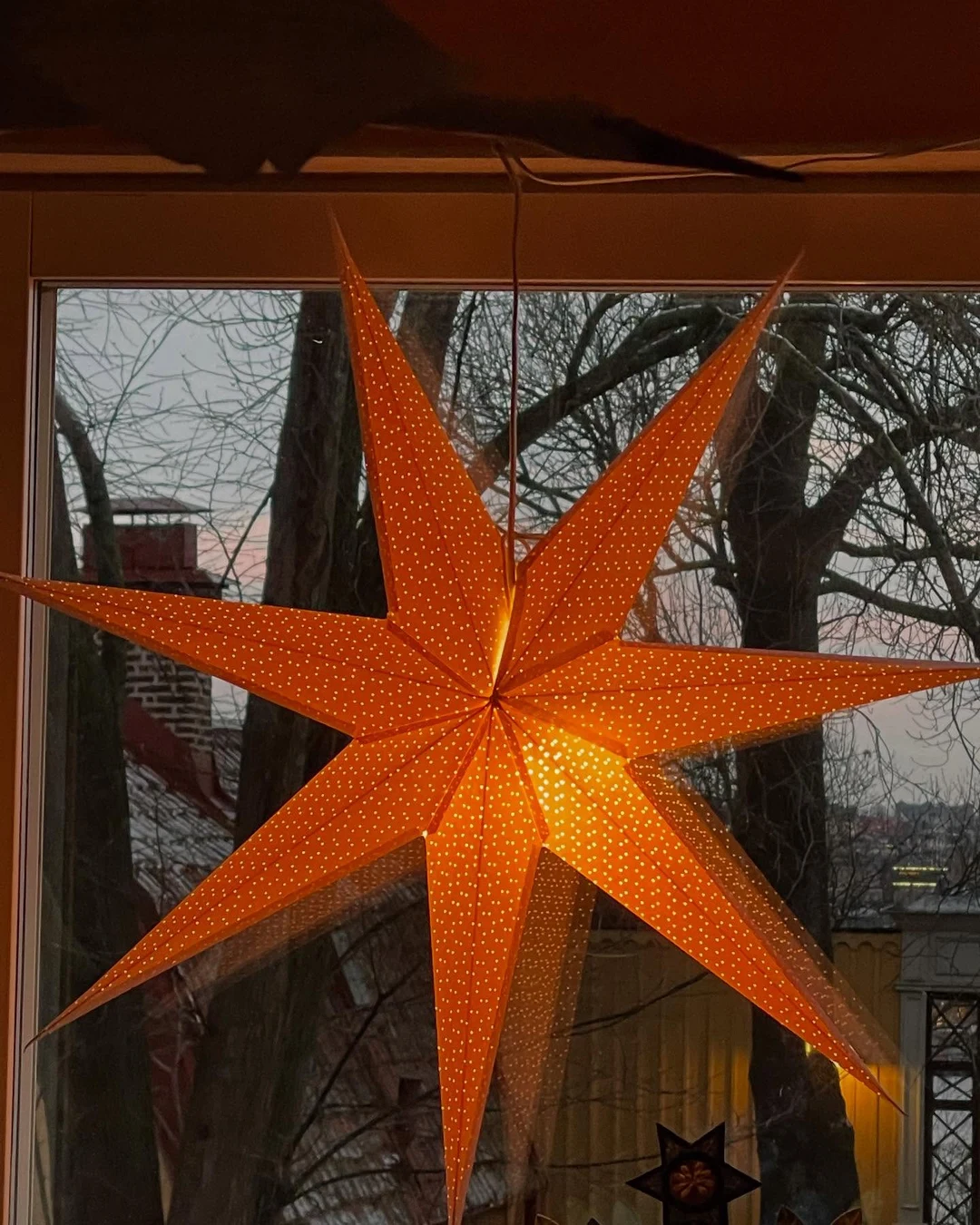
Paper star lanterns are the quietest light in this list, and the one that looks most like winter. A large orange seven-pointed star glows in front of a window at twilight here, its perforated surface letting the light through in a soft pattern, with bare trees and a dusky sky outside.
Hang the star from a suction hook on the glass or a small hook in the window frame, so it floats in front of the window instead of sitting on the sill. The star needs to hang free — a star resting on the sill looks like storage, while a star floating in the glass looks like it belongs there.
One large star beats several small ones in a hallway window. The window is usually the only light source in the hall, so a single generous star fills it without cluttering the glass — and from outside, the star is the whole house’s Christmas card. Warm white bulbs inside keep the glow amber, never harsh.
The practical point: One large star hung free in the glass, warm white bulb inside — the window becomes the house’s Christmas card.
Lights Along the Banister and Runner
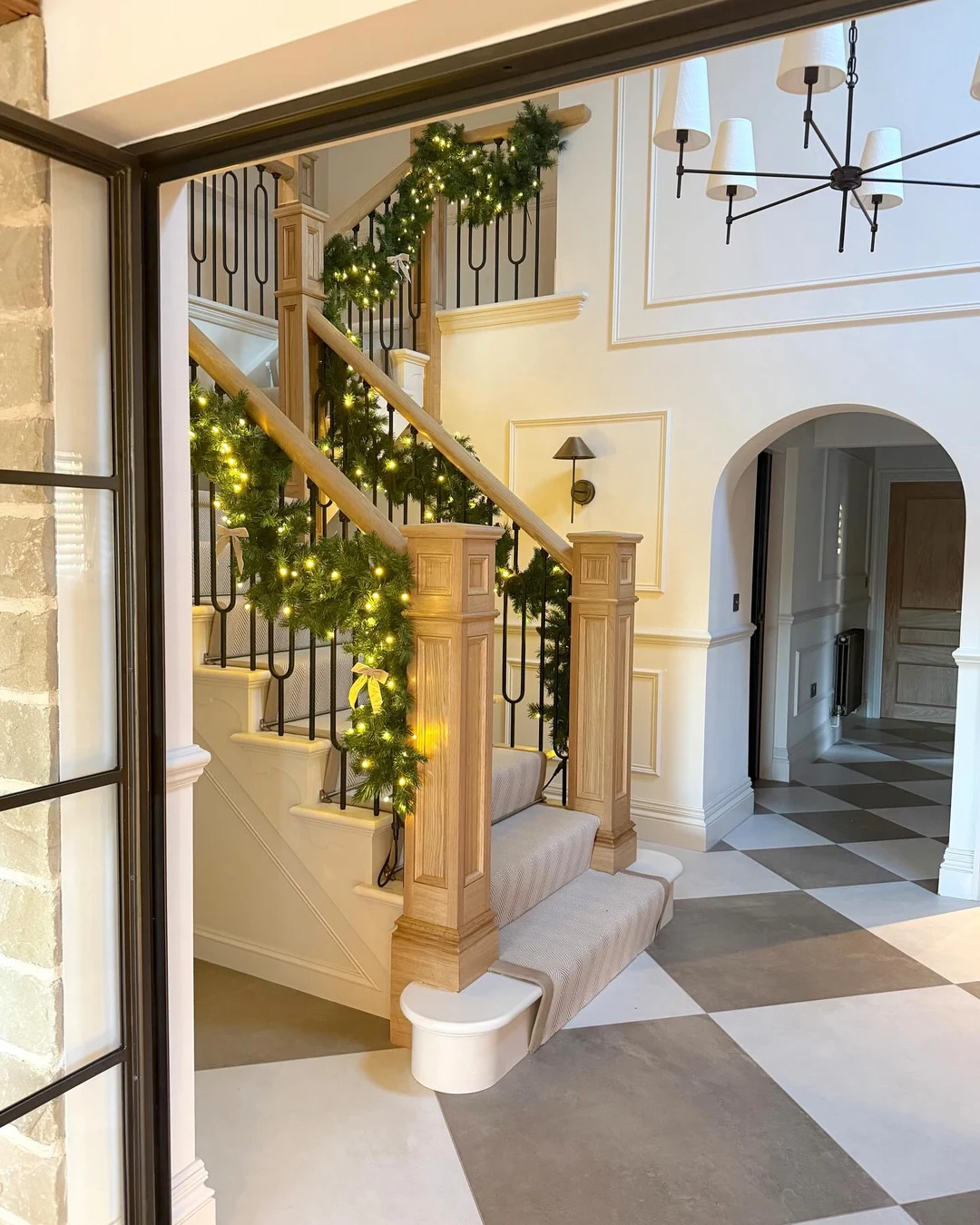
Stair runners and banister lights belong together — the runner softens the stairs, the lights warm the whole flight. A grand entryway at night shows the combination here: a light-wood staircase with a neutral runner, the handrail wrapped in garland strung with warm fairy lights, and a checkered floor below.
Run the lights along the handrail, not on the runner itself. The runner is for feet; the handrail is for light — garland and fairy lights wrapped around the rail light every step without anything underfoot to trip on. The lights follow the full length of the stairs, so the glow runs from the bottom step to the landing.
Keep the runner neutral and the lights warm. A patterned runner with coloured lights is too much happening at once — a plain runner lets the fairy lights be the colour in the stairwell. The checkered floor below catches the glow and throws it back up, so the whole entryway feels lit from every side.
The practical point: Lights on the handrail, runner kept neutral, glow running the full flight — the stairs light themselves.
Battery Candles on the Hallway Shelf
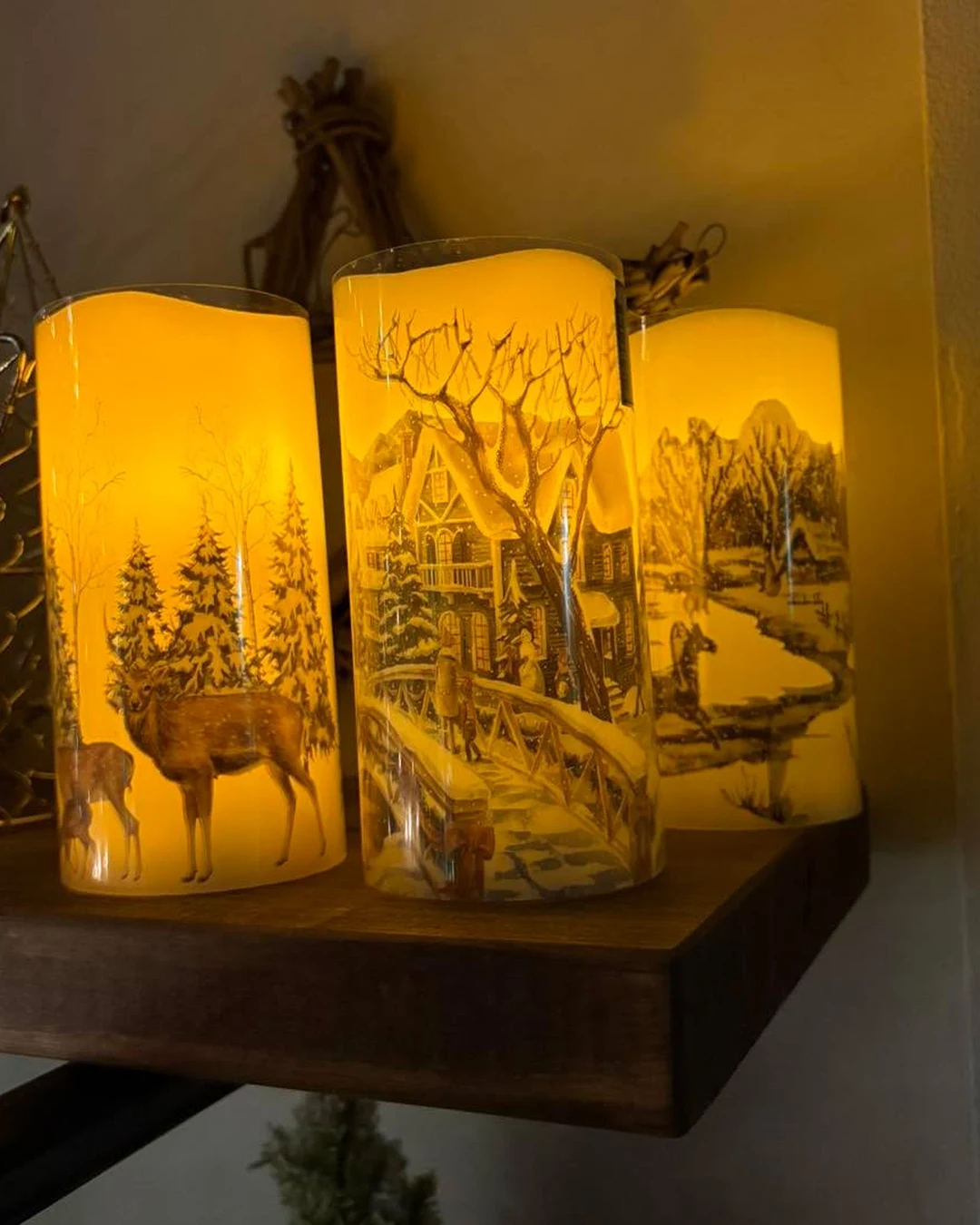
Hallway shelves are too high for a lamp and too narrow for a vase, which is exactly why battery candles suit them. Three LED flameless candles glow on a dark wooden floating shelf here, each printed with a black-and-white winter scene — a deer among pines, a snow-covered house, a bridge.
Group three candles of different heights on one shelf, and the shelf becomes a little winter scene of its own. The printed scenes do the decorating — the deer, the house, the bridge — so the shelf needs nothing else around the candles. A timer means they light themselves at dusk and switch off at bedtime.
Keep the shelf clear of anything that could fall on the candles. A floating shelf in a hallway gets brushed by coats and bags, so the candles should sit flat and steady, with nothing leaning over them. The glow from three candles is enough to light a whole stretch of wall.
The practical point: Three candles of different heights, timer set for dusk, shelf kept clear around them — the smallest light in the hall, and the warmest.
A Projector Light on the Wall
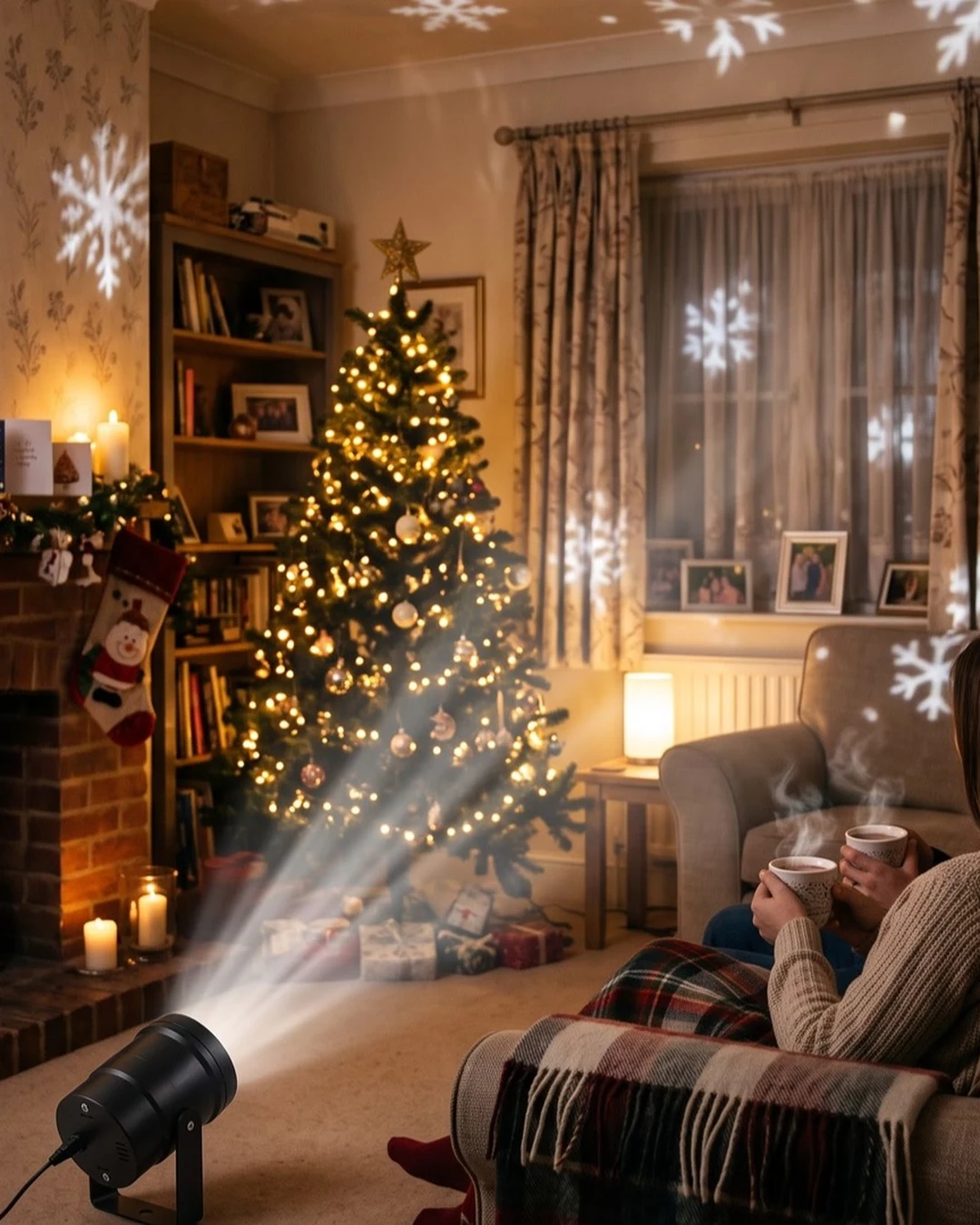
Projector lights are the one idea here that needs no hanging, no hooks and no ladder — just a plug and a wall. A small black projector sits on the carpet in a living room here, casting bright snowflake patterns across the walls, the ceiling and the curtains, with a lit tree and a fireplace nearby.
Point the projector at the biggest blank wall you have, and let the pattern do the decorating. Snowflakes are the calmest choice — they drift across the wall without shouting, and they suit a hallway or a living room equally. The projector itself sits on the floor out of the way, so there is nothing to hang and nothing to take down.
Keep the room dark enough for the pattern to show. A projector in a bright room is invisible; the same projector in a dim hall throws snowflakes across the whole wall. The effect costs less than a string of lights, takes thirty seconds to set up, and comes down in one move after Christmas.
The practical point: Biggest blank wall, room kept dim, snowflake pattern — thirty seconds to set up, nothing to hang, nothing to take down.
Lit Branches in a Tall Vase
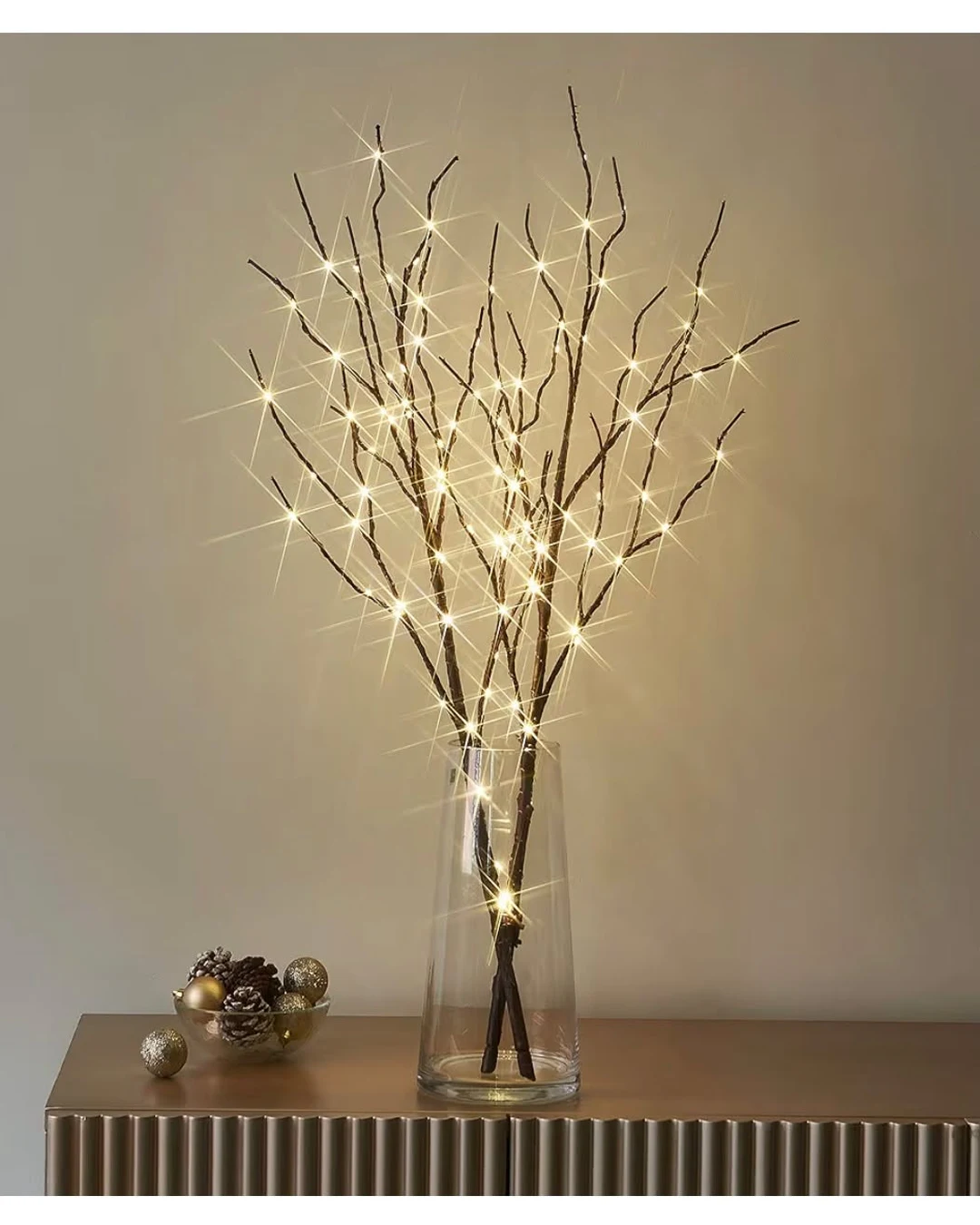
Bare branches wrapped in fairy lights are the closest thing to a tree a hallway can hold without a tree. A tall clear vase holds several bare branches here, each wrapped with small warm-white lights, glowing like stars on a ribbed cabinet with a bowl of pinecones beside it.
Use real branches, not fake ones. Real twigs bend in slightly different directions, so the lights sit at different depths and the whole arrangement looks alive — fake branches are too even, and the lights sit in a flat row. Cut the branches to different lengths, so the tallest reaches a foot above the vase and the shortest barely clears the rim.
Keep the vase tall and the branches bare. A short vase with leafy branches reads as a plant; a tall clear vase with bare, lit branches reads as winter. The fairy lights should wrap the branches, not the vase — the glass stays clear so the stems show through.
The practical point: Real branches at different lengths, lights wrapped on the branches not the vase, tall clear glass — winter in a vase.
Warm Bulbs in the Hallway Pendant
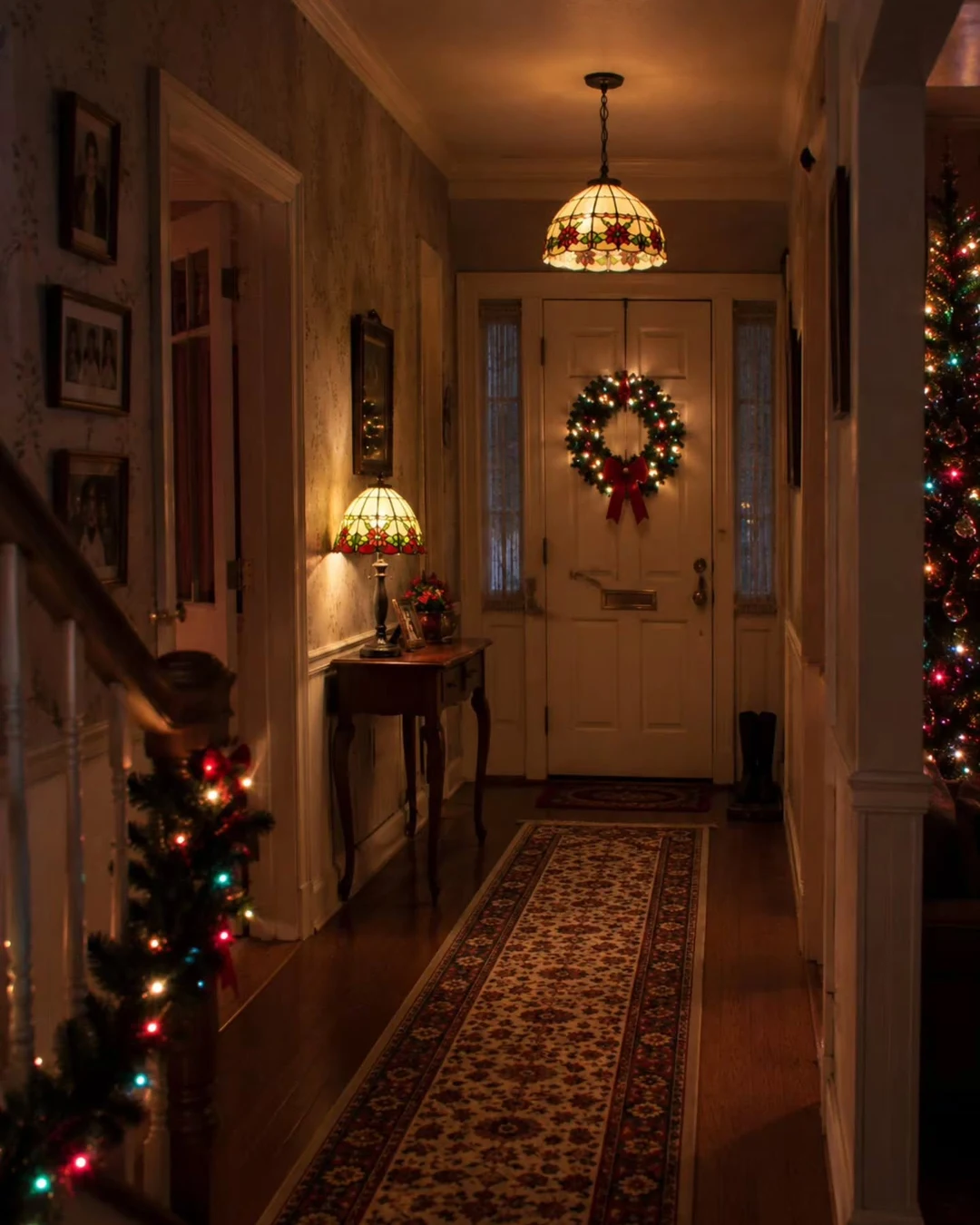
Hallway pendants are the light the house already has, and a warm bulb is all they need for Christmas. A stained-glass pendant glows amber over a patterned runner here, with a lit wreath on the front door at the far end, a matching table lamp and garland on the stair banister.
Swap the bulb, not the fitting. A warm white bulb at 2700K turns a cold hallway amber in the time it takes to change a bulb, and a dimmer lets you drop the light to a glow in the evening. The pendant is already the centrepiece of the hall — the warm bulb just lets it do its job for Christmas.
Keep the pendant clean and the glass clear. Dust on a stained-glass pendant dulls the amber, and a clean pendant throws coloured light across the walls and the runner. The wreath on the front door and the garland on the banister do the decorating; the pendant does the glowing.
The practical point: A 2700K warm bulb, dimmer set low in the evening, glass kept clean — the light the hall already has, turned amber.
The Hallway That Welcomes You Home
A hallway does not need a chandelier to feel warm. It needs one small light in the place you pass most — and hallways are everywhere you pass.
Start with the light nearest the front door. Switch it on tonight, and see how the house feels when you come home. Chances are, the rest of the hallway will follow by the weekend.