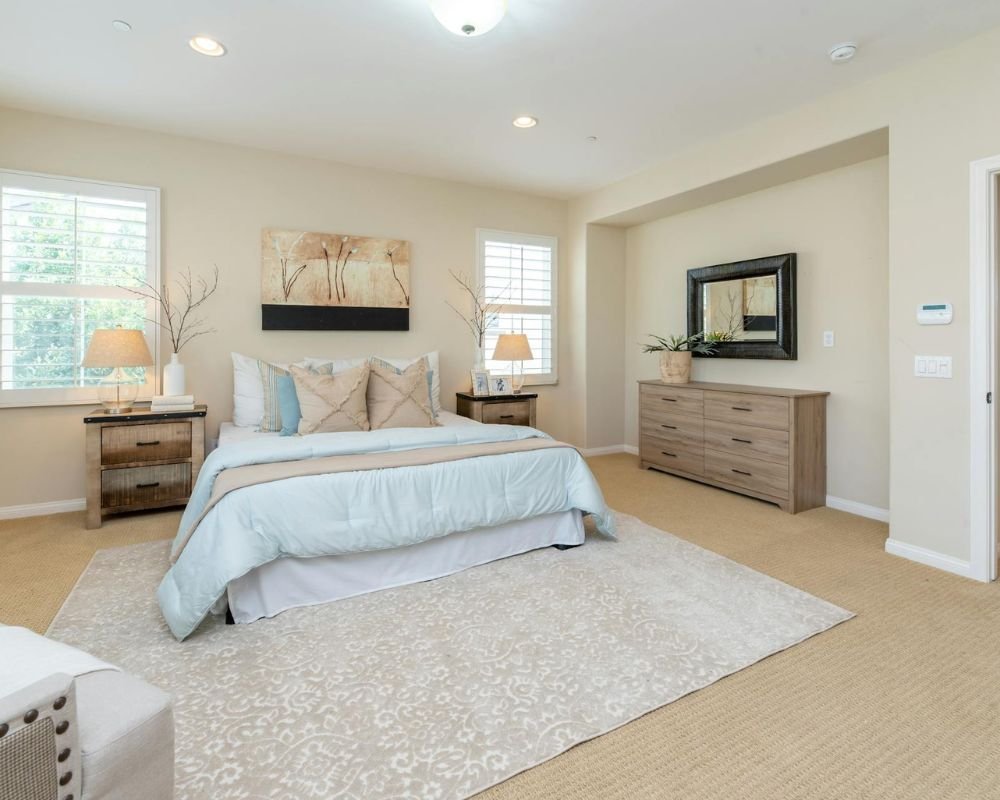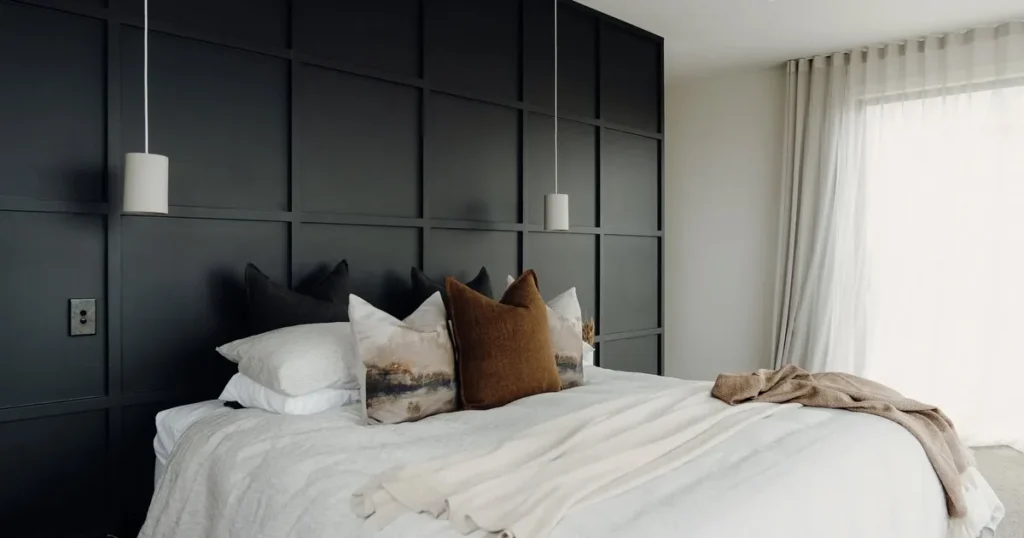
The headboard is the most overrated piece of furniture in the bedroom. People buy one out of habit, not need — a big upholstered panel that costs more than the mattress, collects dust behind the pillows, and makes the room feel smaller than it is. Meanwhile the wall behind the bed sits there doing nothing, when it could be doing the whole job for a fraction of the price and none of the bulk.
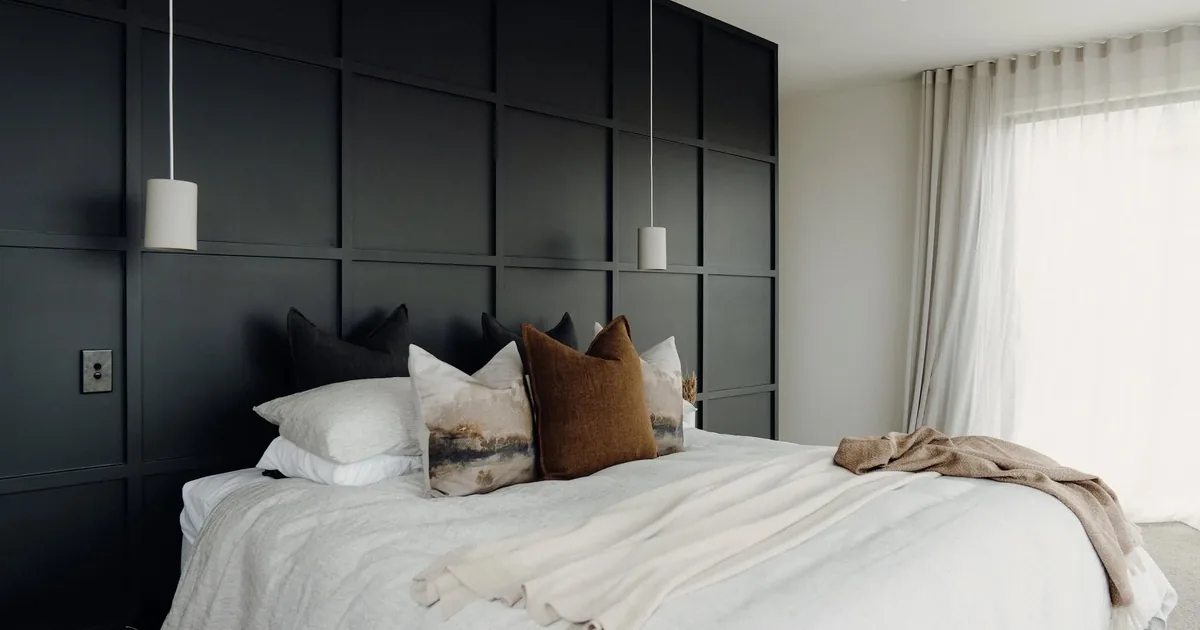
Without a headboard, the bed stops being a piece of furniture with a frame around it and starts being part of the room itself. Pillows rest against paint, or wood, or a mirror, or a wall of art, and suddenly the wall is the thing you look at — not a slab of fabric you paid too much for. It feels lighter, the room reads bigger, and you can change the whole look with a pot of paint instead of a delivery van.
These 15 no headboard bed ideas cover every way a wall can take over from a headboard — arches and murals, gallery walls and shelves, mirrors and slats — and every one of them starts with the same move: stop shopping for a headboard and look at the wall you already have.
Paint the Wall Behind the Bed a Colour Worth Waking Up To
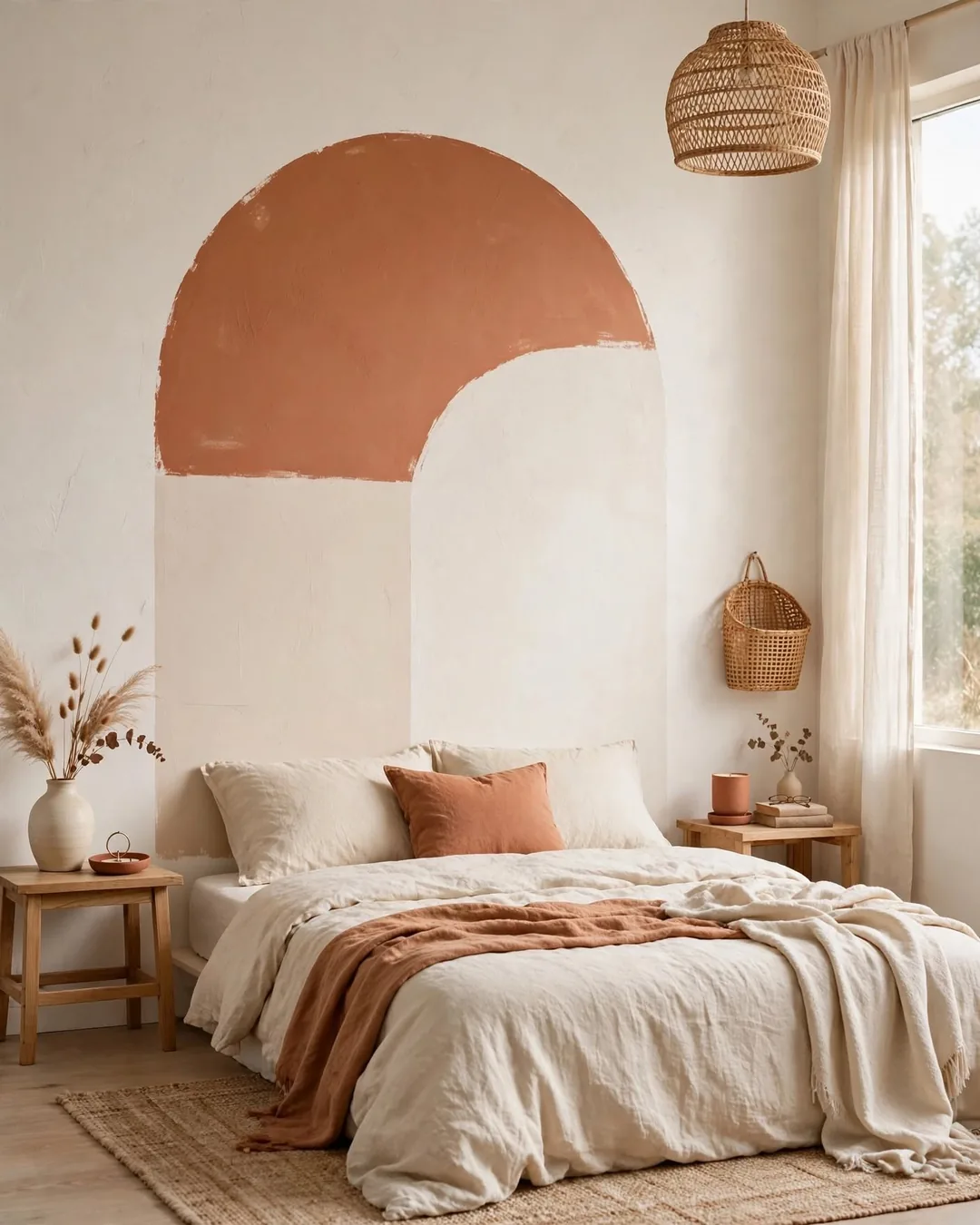
In the photo, a terracotta arch is painted straight onto a white wall behind a bed dressed in neutral linens — the arch rises above the pillows like a sunrise, a terracotta cushion echoing it on the bed, wooden nightstands and dried flowers at the sides. No headboard anywhere. The painted arch does the whole job: it gives the bed a shape, a colour and a focal point, and it cost a pot of paint.
Paint works because it is the cheapest way to make a wall behave like furniture. A bold arch, a wide colour band, a full wall in a deep shade — any of these tells the eye where the bed begins and ends, which is exactly what a headboard does. Keep the rest of the wall pale and the bedding quiet, and the painted shape reads as deliberate, not like a wall you ran out of paint for.
The practical point: paint the arch about as wide as the bed — around 60 inches for a queen — and use a brush, not a roller, for the edge; a slightly uneven hand-painted line looks intentional, while a perfect machine edge looks like a sticker.
Why a Gallery Wall Works Better Than a Headboard
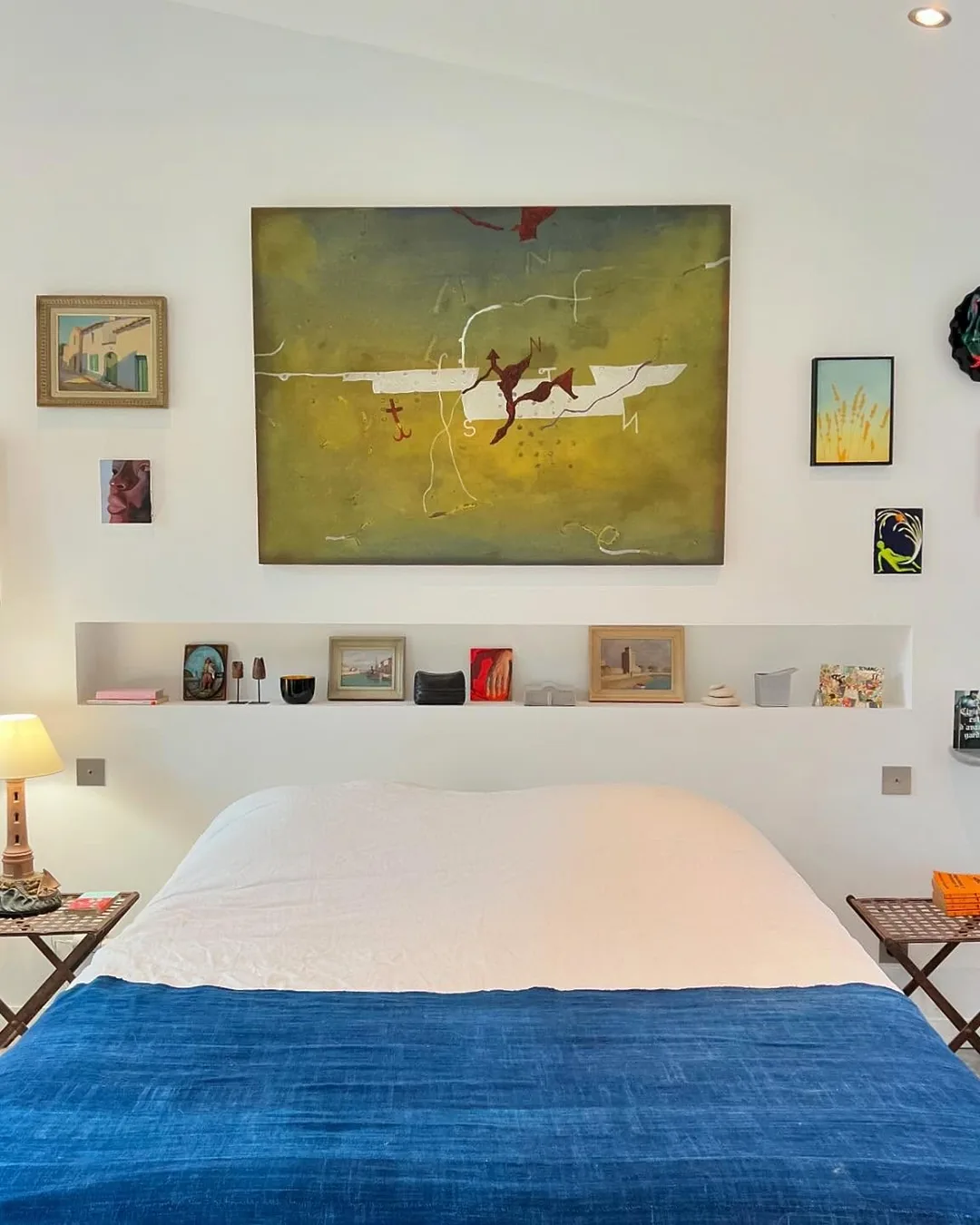
Above this bed, a large green abstract painting hangs beside smaller framed pieces, with a recessed ledge below them holding tiny artworks, books and objects — white linens and a blue throw on the bed, no headboard at all. Gallery walls work better than headboards because they give you something to look at that changes with you: swap a print, move a frame, and the whole bed feels new without buying anything.
With a headboard, one decision is frozen forever. A gallery wall is a dozen small decisions you can keep making. Start with one large piece centred over the bed, then build around it with smaller frames at different heights — the mix of sizes is what makes it feel collected rather than hung in a hurry. Keep the frames close together, two to three inches apart, so the group reads as one thing instead of scattered pictures.
The practical point: centre the largest piece above the bed with its middle at about 58 to 60 inches from the floor, and keep every frame within the bed’s width — art that spreads wider than the bed makes the bed look small.
Hang a Textile Where the Headboard Would Go
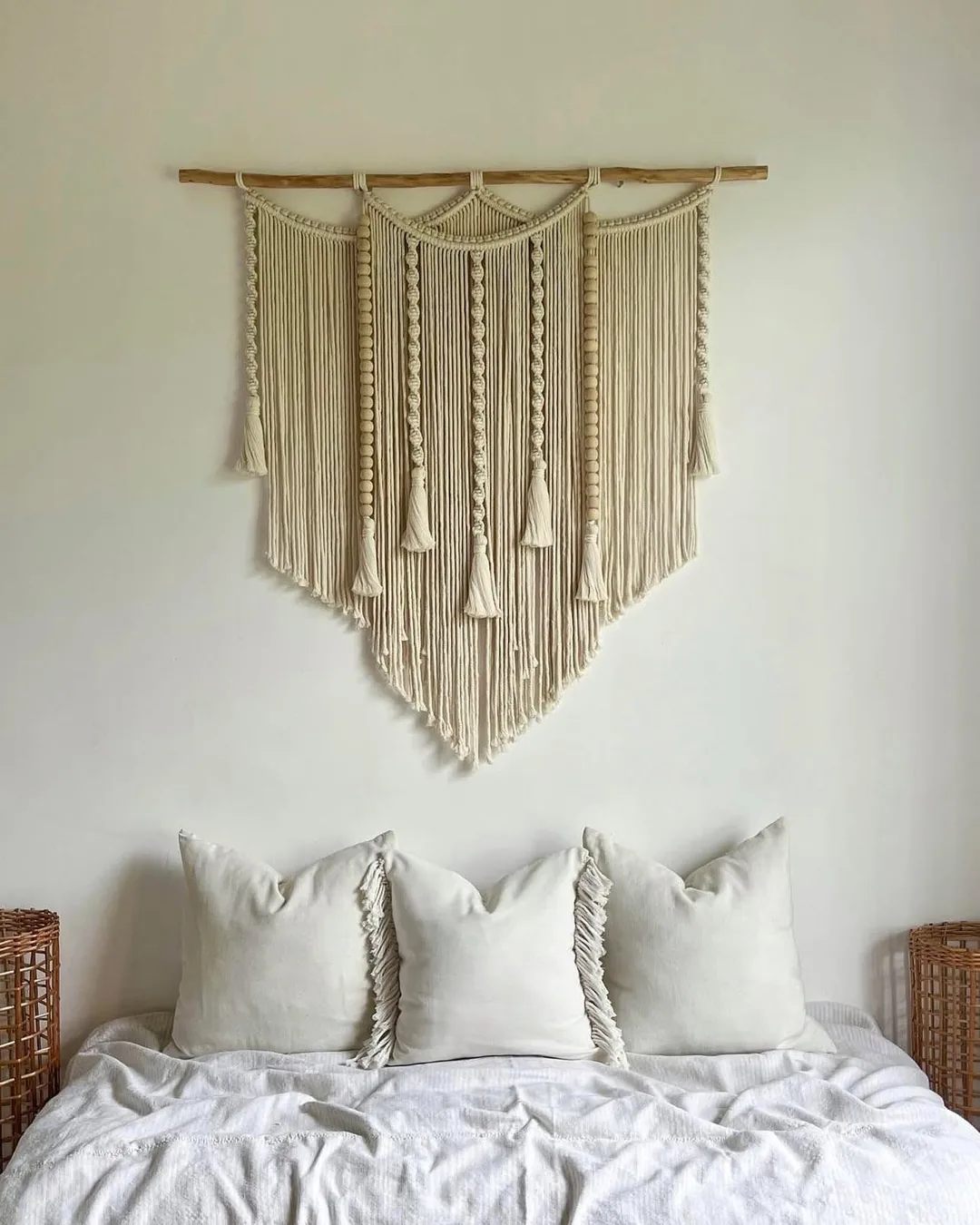
A large cream macramé hangs from a wooden dowel above a bed with rumpled white bedding and three white fringed pillows, wicker baskets at the floor edges. Softness is the whole point here: where a headboard would be hard and flat, the textile is soft and textured, and it does something a headboard never does — it moves slightly when the window is open, and it catches light through its knots all day.
Textiles suit bedrooms that feel too hard — too much wood, too much white, too many straight lines. A tapestry, a woven wall hanging or a length of beautiful fabric on a dowel adds warmth without adding weight, and it is the easiest idea on this list to change: take it down, wash it, hang something else. Hang the dowel a little wider than the bed so the textile frames the pillows instead of sitting on top of them.
The practical point: let the bottom of the textile hang just above the pillows, not behind them — fabric trapped behind pillows creases, collects dust and disappears.
Let a Shelf Do the Job of a Headboard
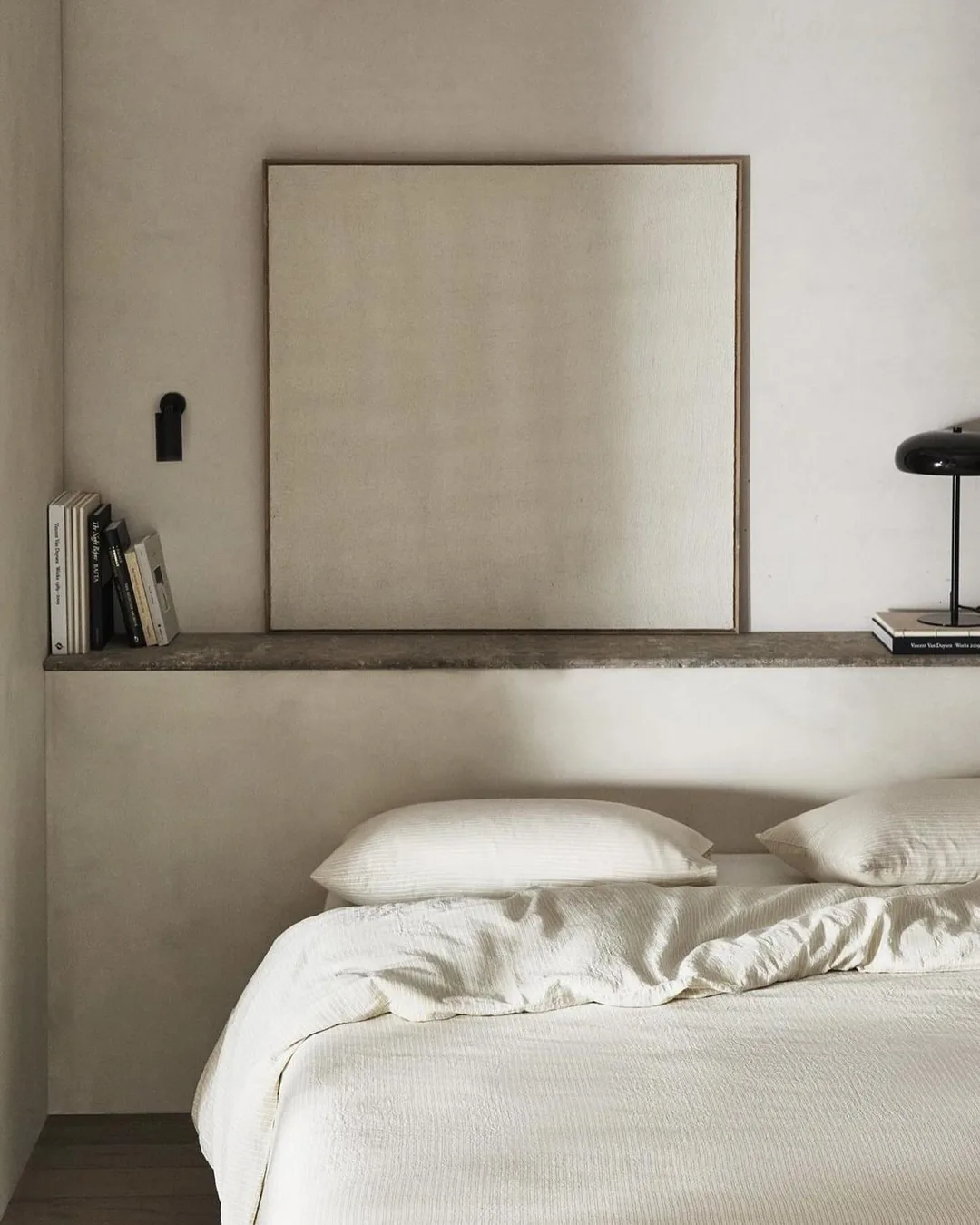
No headboard here at all — just a built-in ledge running across the wall directly above it, holding a small stack of books on one side and a modern black lamp on the other, with a large blank framed canvas above. It works because the ledge gives the wall a horizontal line at exactly the height a headboard would sit, and then it earns its place by holding the things you actually reach for at night.
A ledge beats a shelf here because it is shallow — four to six inches deep is enough for books and a lamp, and nothing on it can fall on your head while you sleep. Keep it light: a few books, one lamp, nothing heavy and nothing breakable directly above the pillows. The blank canvas above it is doing quiet work too, giving the eye somewhere calm to rest.
The practical point: mount the ledge eight to twelve inches above the pillows and keep it shallow — anything deeper turns into a shelf you bump into, and anything heavier than books does not belong above a sleeping head.
What Happens When the Bed Meets a Window?
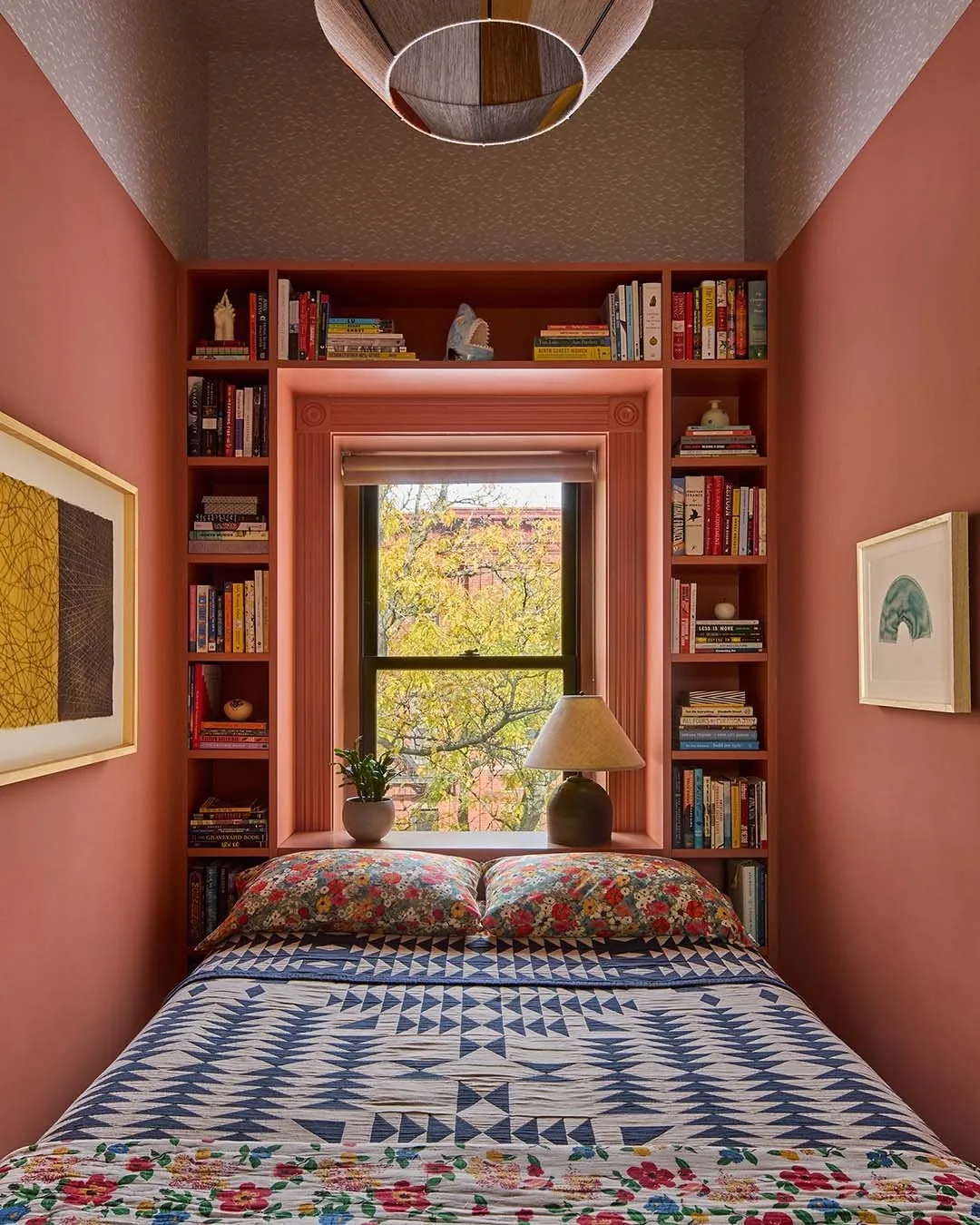
Push the bed right up against a central window and something unexpected happens: the window becomes the headboard. In the photo, a bed with a blue-and-white geometric quilt sits against a window framed by coral built-in bookshelves, autumn leaves outside, a lamp and a potted plant on the sill. Pillows rest against the window wall, and the whole room suddenly has a view from the bed instead of a wall.
It only works if the window is treated like a headboard, not an accident. Keep the sill clear of clutter, skip heavy curtains that bunch behind the pillows, and put a blind on the window itself — a blackout blind if you sleep late, a sheer one if you like waking with the light. Cold is the real objection, and it is a fair one: in winter, a window behind the bed can feel draughty, so a thick quilt and a draught excluder on the sill matter more than they would anywhere else.
The practical point: a blind fitted to the window beats curtains here every time — curtains behind pillows get crushed, gather dust and block the light the window is there for.
Frame the Bed with Two Sconces and Nothing Else
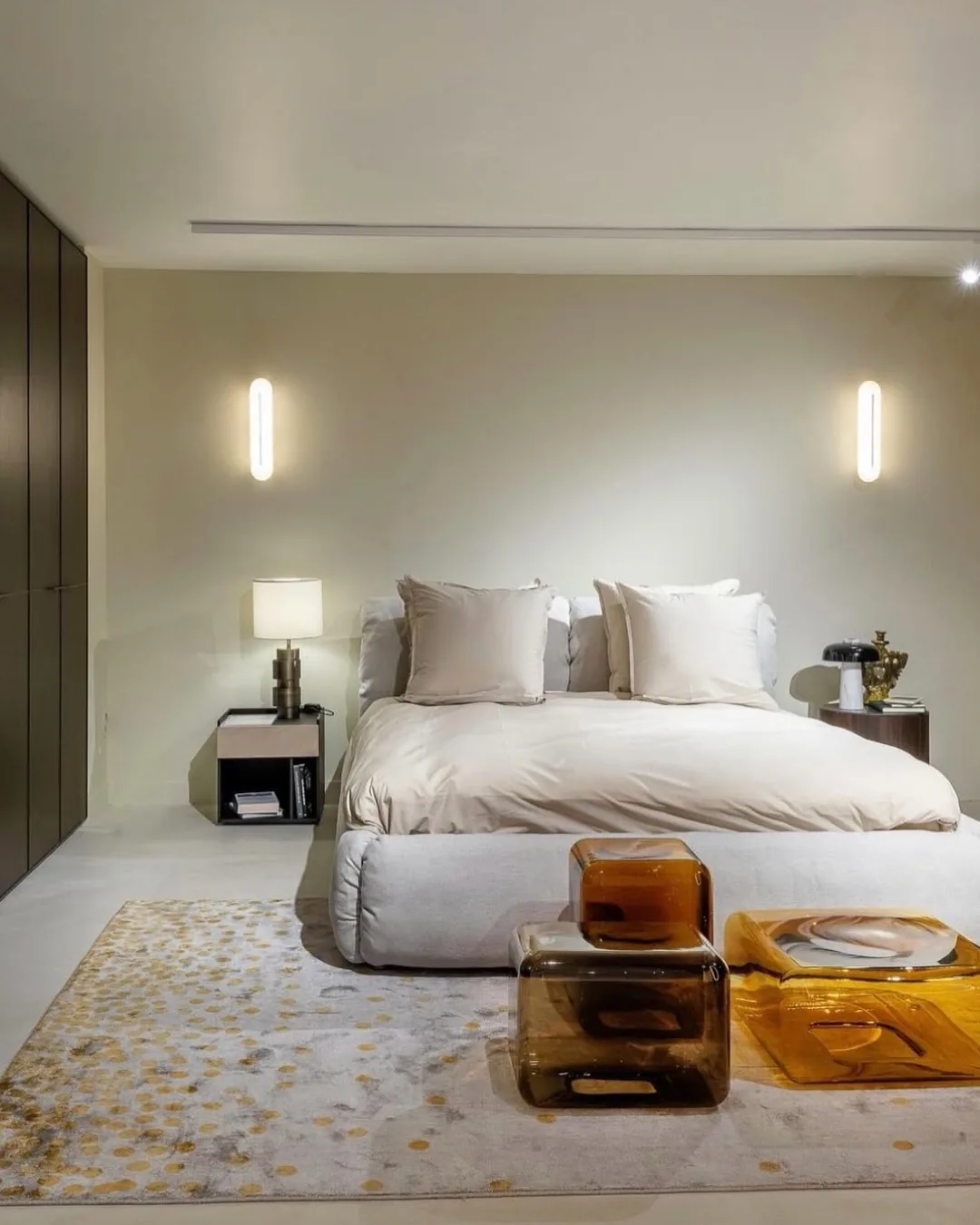
Two slim vertical sconces glow on a plain light wall, one on each side of a low bed with white linens — matching nightstands below them, nothing else on the wall. It is the sparest idea on this list, and it works precisely because of that: the two points of light frame the bed the way a headboard’s edges would, and at night the wall glows instead of looming.
Sconces are the right choice when the room is small or the wall is beautiful on its own. They take up no floor space, they replace the bedside lamps, and they give the bed a shape after dark that no headboard can match. Mount them at the same height, the same distance from the bed’s centre, and put them on a dimmer — bright for reading, low for sleeping, and the wall does the rest.
The practical point: mount each sconce 30 to 36 inches above the mattress and level with each other — one sconce higher than the other is the first thing anyone notices, and it never stops looking wrong.
Turn the Wall into a Mural Behind the Bed
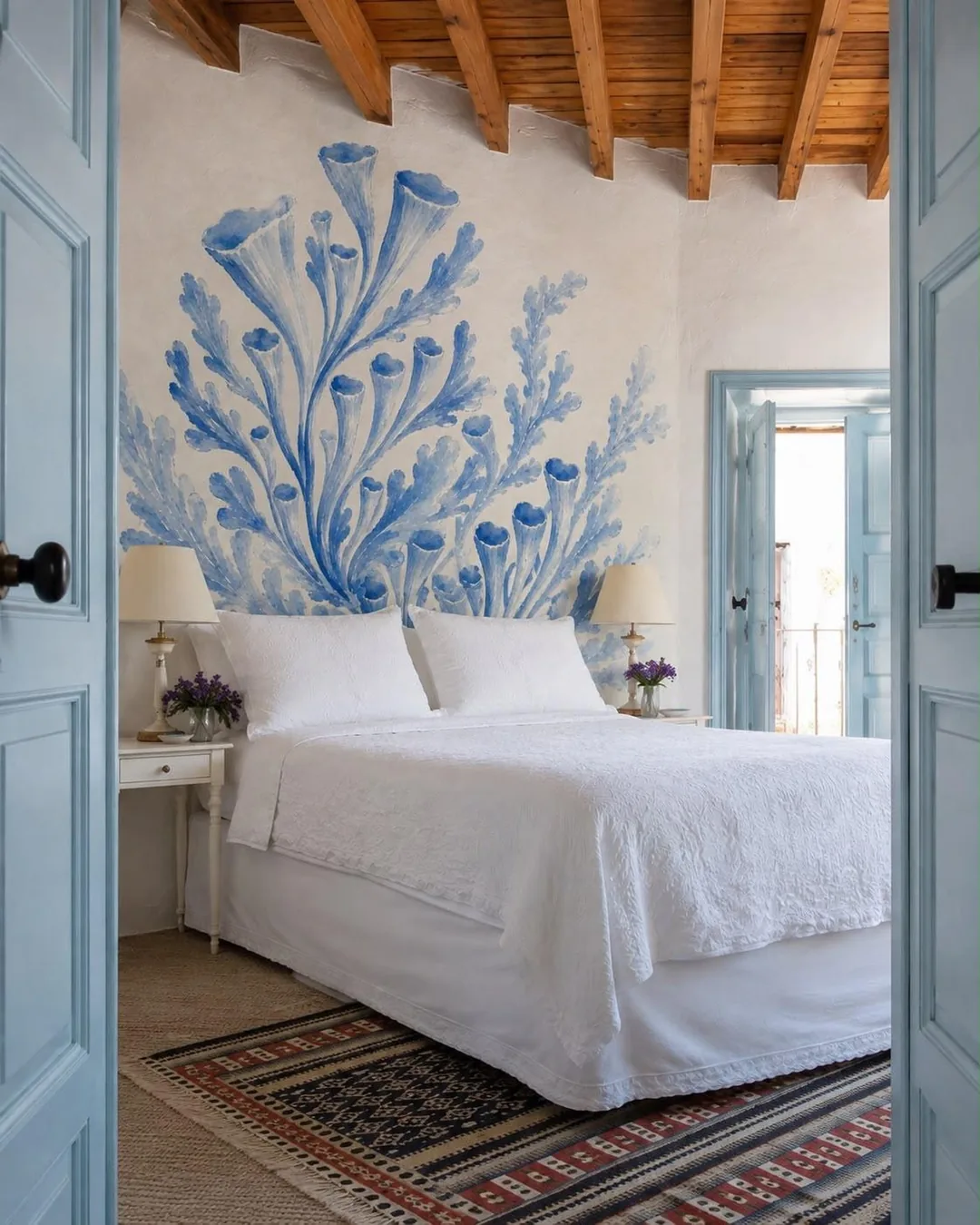
A hand-painted mural of blue coral and sea flora rises behind a white bed, pale-blue doors framing the shot at the edges, wooden beams above. It is not a painted wall — it is a picture the size of a wall, and the bed sits inside it. Murals work where paint alone feels flat: they give the wall a subject, a story, something the eye can wander over while you are lying there awake.
You do not need to paint it yourself. A local artist, a peel-and-stick mural, even a large-scale wallpaper panel can do the same thing, and the rule is the same either way: keep the bedding plain. White or pale linens let the mural be the star; patterned bedding next to a mural is two loud voices talking over each other. One wall is enough — murals on every wall turn a bedroom into a theme park.
The practical point: keep the mural to the one wall behind the bed and the bedding plain white — the mural is the decoration, the bed is the calm in front of it.
How Low Can the Bed Go Without a Headboard?
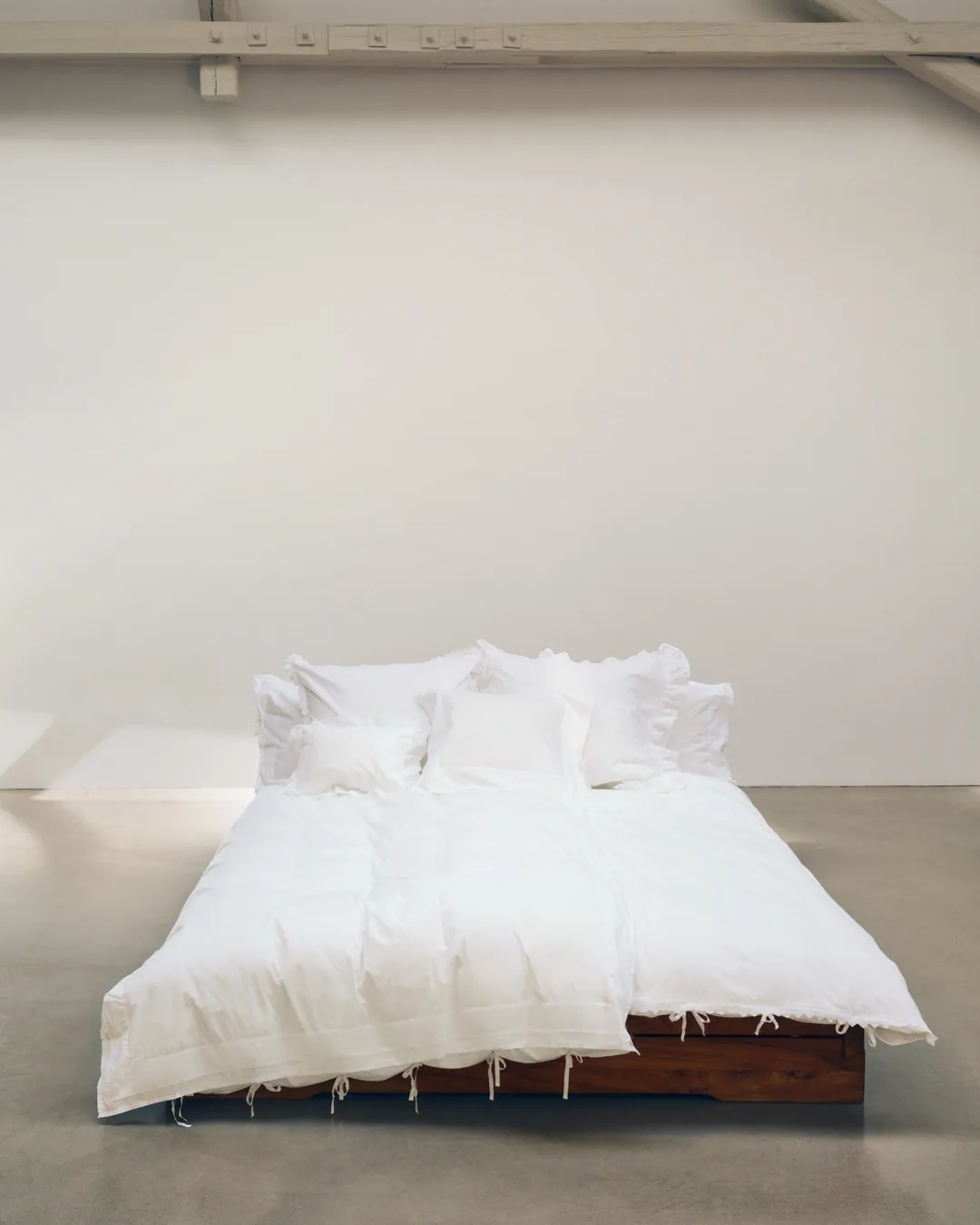
Very low. In the photo, a wooden platform bed sits directly on a smooth concrete floor — white bedding, plain off-white wall behind it, exposed beams above, and a lot of empty wall. The bed takes up only the bottom of the frame, and that emptiness is the point: without a headboard pulling the eye up, a low bed makes the wall feel taller and the room feel bigger than it is.
Low beds suit small rooms for exactly that reason, and they suit the no-headboard idea because there is nothing to hide behind — the bed is just a mattress on a platform, honest about what it is. Do not put the mattress straight on the floor, though: a slatted base underneath lets air move and stops damp building up. And check the ceiling — a low bed in a low room feels like a tent, while a low bed in a tall room feels like a retreat. If you want the same thinking applied room by room, Ways to Make a Small Bedroom Look Bigger Than Its Square Footage covers how light, order and clear surfaces do more than square footage does.
The practical point: keep the mattress on a slatted platform a few inches off the floor, not on the floor itself — air underneath matters more than the last two inches of lowness.
Layer Pillows Like a Headboard That Isn’t There

Close up, this bed is all pillows: two cream Euro shams at the back, grey sleeping pillows, three cream squares with bold black geometric patterns, a long lumbar pillow in front — the whole stack standing against a dark blue-grey striped wall, exactly where a headboard would be. It is the oldest trick in the book, and it works because pillows are soft where headboards are hard: you can lean on them, rearrange them, and take them off the bed entirely when you want the wall back.
The trick is height. One row of pillows looks like a bed that is missing something; three layers — sleeping pillows at the back, Euros in the middle, accents in front — build a stack 24 inches or more above the mattress, and that reads as a headboard from across the room. Fluff them daily or the stack slumps by the second night, and keep the back layer firm — soft shams fold forward and the whole thing collapses.
The practical point: build three layers — sleeping, Euro, accent — with the back layer reaching at least 24 inches above the mattress, or the stack reads as clutter instead of a headboard.
Put the Art Where Your Head Rests
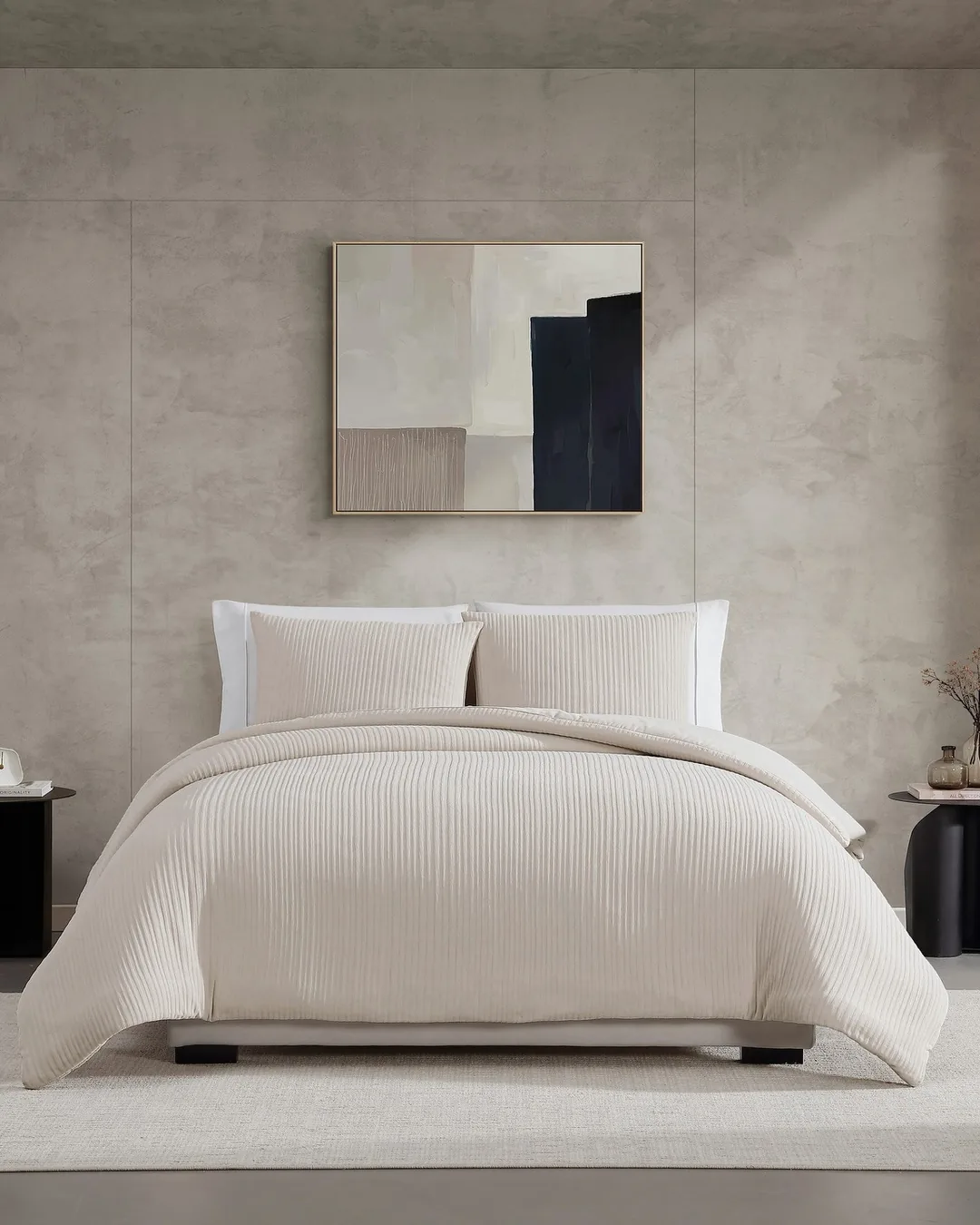
One large framed abstract painting — muted beige, white and dark-navy blocks — hangs centred on a textured grey wall directly above the pillows, a bed with a beige ribbed comforter below it. No headboard, no gallery, no shelf: just one piece of art, hung where your head rests. It is the calmest idea on this list, and it suits rooms that already have enough going on.
One piece works when it is big enough. A small print above a bed looks lost, like a headboard that shrank; a painting about two-thirds the width of the bed fills the space a headboard would fill, and the eye accepts it as the bed’s backdrop. Hang it low — the bottom edge six to eight inches above the pillows — so the art and the bed read as one arrangement instead of two separate things on a wall.
The practical point: size the art to about two-thirds of the bed’s width and hang it six to eight inches above the pillows — too small or too high, and it floats away from the bed entirely.
Can a Canopy Frame a Bed Without a Headboard?

Yes — and the canopy does the framing better than a headboard ever could. In the photo, cream fabric drapes from a ceiling-mounted rod and falls in soft folds behind a white bed, a black lamp on the nightstand, a wardrobe at the edge of the frame. No headboard, no posts, no frame around the bed at all: just fabric falling from the ceiling, giving the bed a shape and a softness that a wooden panel never manages.
Rooms with height to spare suit a ceiling canopy, because the fabric needs room to fall. Anchor the rod into a ceiling joist, not just plaster — fabric pulls, and a rod that comes down at two in the morning is nobody’s idea of romance. Choose washable fabric, because canopy fabric collects dust exactly where you breathe, and let it fall just behind the pillows rather than pooling on the bed.
The practical point: anchor the rod into a ceiling joist and let the fabric fall behind the pillows, not onto them — a canopy should frame the bed, not bury it.
Wood Slats on the Wall, Bed Below
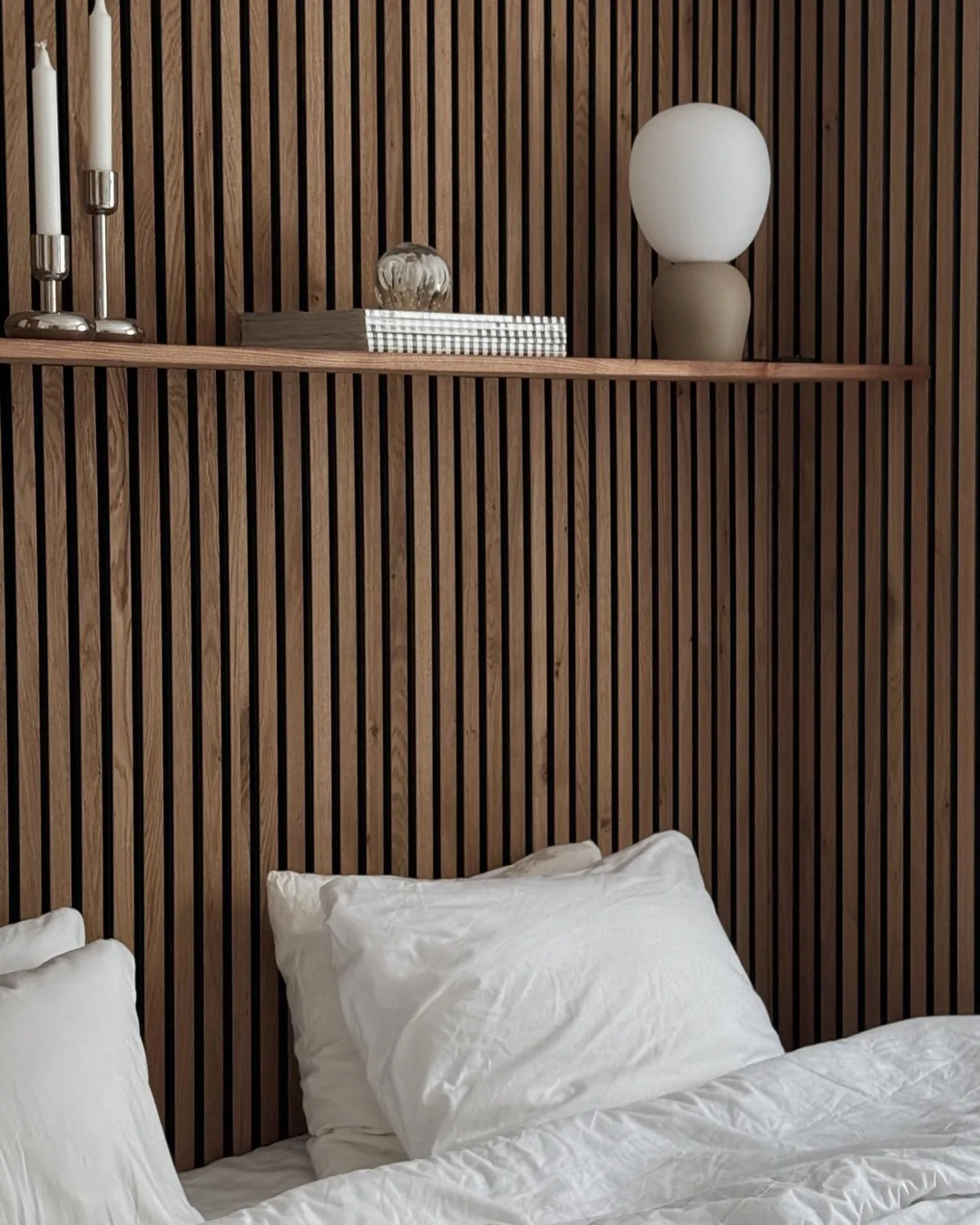
A full dark-wood slat wall runs behind this bed, a floating shelf across it holding candlesticks, a glass orb, stacked books and a white globe lamp — white pillows resting directly against the slats, no headboard in sight. Wood slats are the warmest idea on this list: they add texture, rhythm and a natural material to a room that might otherwise be all plaster and paint, and the vertical lines make the wall feel taller.
Slats work because they are not flat. The gaps between them catch light and shadow all day, so the wall changes as the sun moves — a flat painted wall never does that. Run them vertically, keep the gaps even at one to two inches, and let the pillows sit against them: washable pillow covers matter here, because bare wood can mark pale fabric over time. The same love of wood, taken all the way up to the ceiling, is what makes Wood Cathedral Ceiling Ideas for a More Inviting Interior work — natural grain warming a tall room instead of fighting it.
The practical point: keep the slat gaps even at one to two inches and use washable pillow covers — uneven gaps look like a mistake, and wood marks pale fabric faster than you expect.
Keep the Wall Plain and Let the Bedding Speak
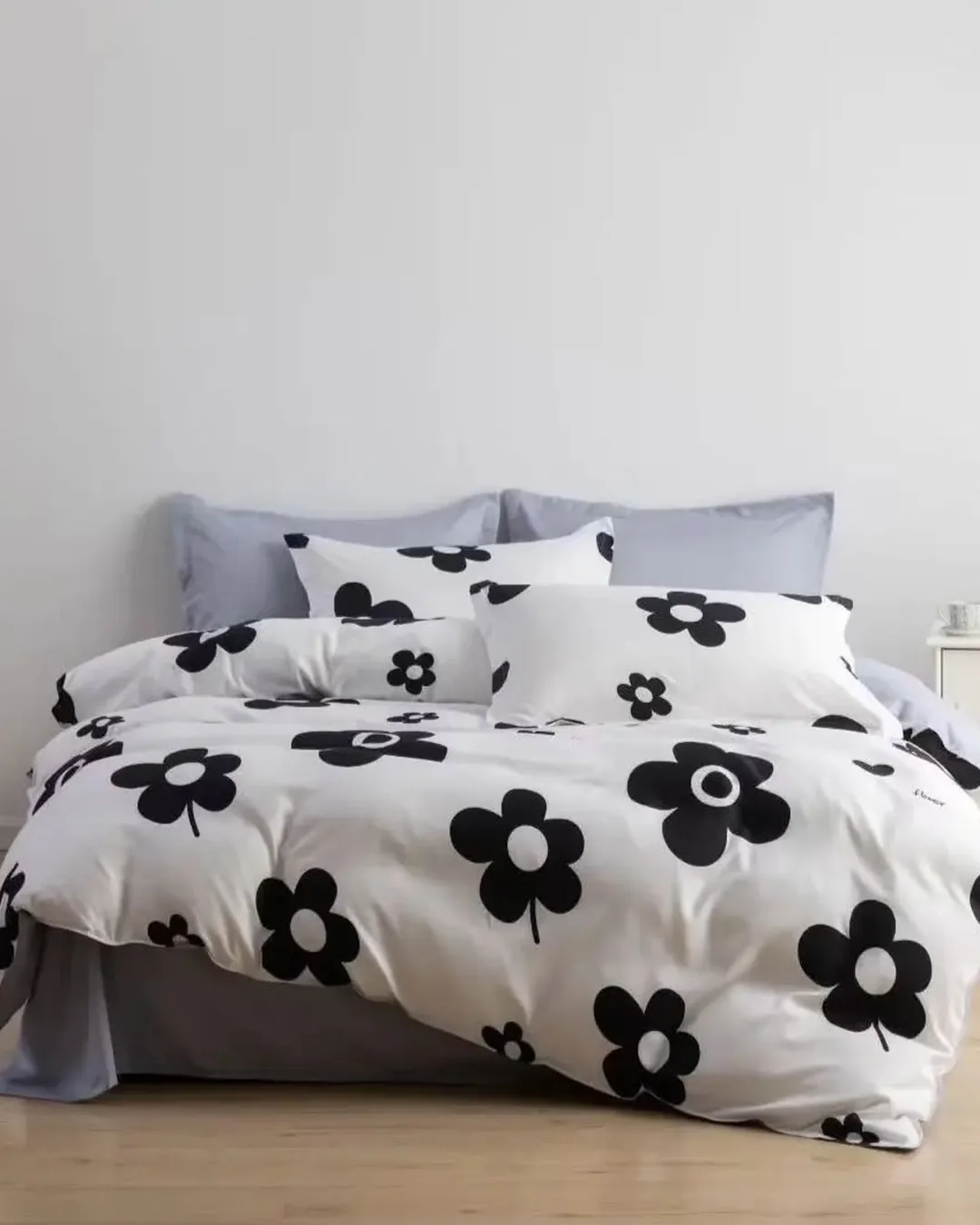
Picture a low bed against a plain white wall, dressed in a bold black-and-white floral duvet with matching pillowcases and pale grey sheets — no headboard, no art, no shelf, nothing on the wall at all. The bedding is unmistakably the star, and that is the whole idea: when the wall says nothing, the bed can say everything.
It is the easiest idea on this list to live with and the easiest to get wrong. It works when the bedding is genuinely bold — a large-scale print, high contrast, a pattern you can see from the door. It fails when the bedding is merely busy: small prints and muddy colours on a plain wall just look like a bed that is missing its headboard. Keep everything else in the room quiet — plain walls, plain floor, one colour repeated in the cushions — and let the duvet do the talking.
The practical point: go big and high-contrast with the print, and keep the rest of the room quiet — a timid pattern on a plain wall reads as a missing headboard, not a decision.
Carve a Niche in the Wall Instead of a Headboard
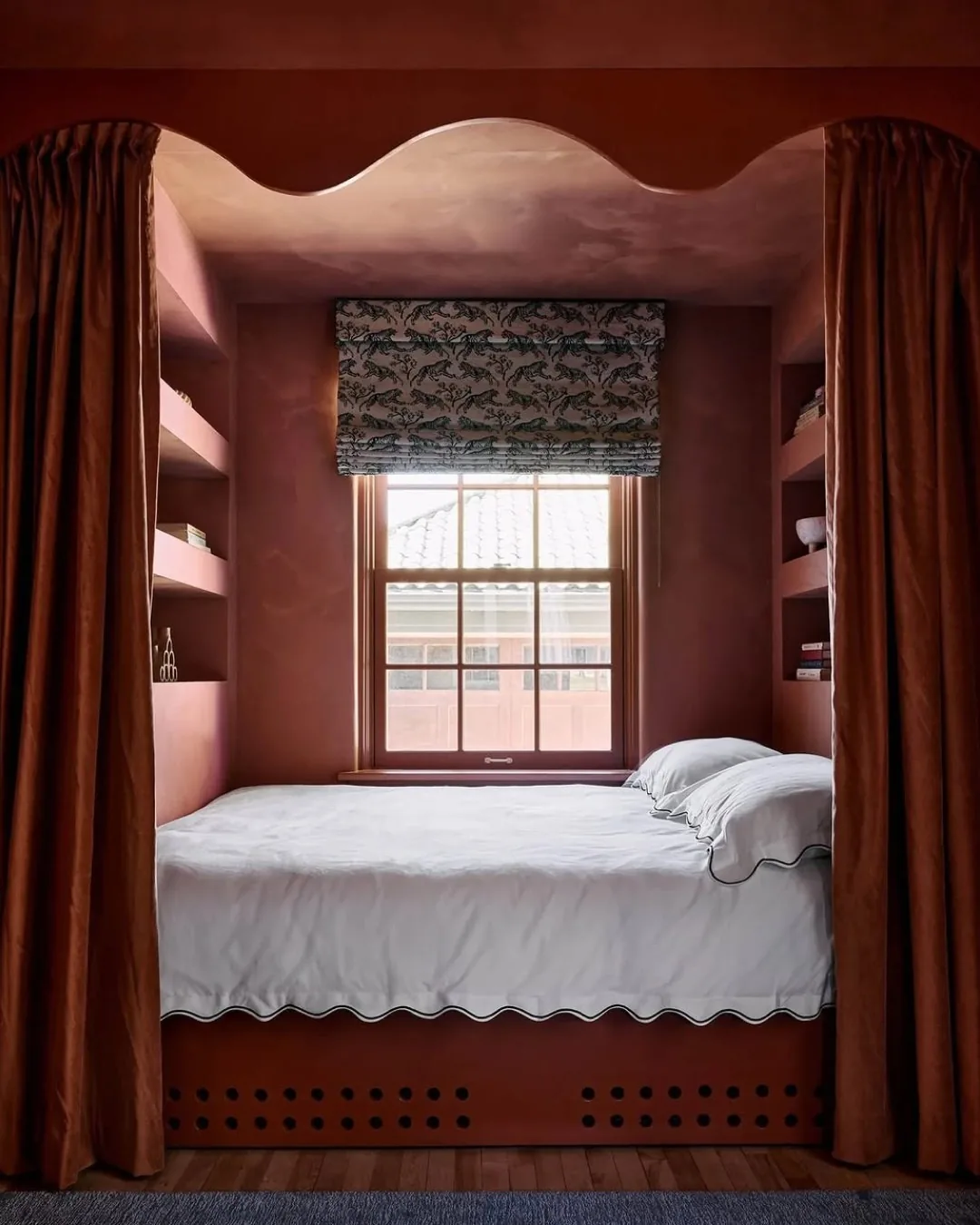
Built into a terracotta alcove, this bed has a window at the back, rust curtains drawn to the sides, small shelves cut into the alcove walls, white bedding. No headboard, because the room itself holds the bed: the alcove wraps around it on three sides, and the bed feels tucked in rather than placed in the room. It is the cosiest idea on this list, and the one that feels most like a room within a room.
A niche only works if it has light. An alcove with a window at the back, like this one, feels like a retreat; an alcove with no light feels like a cupboard, and nobody sleeps well in a cupboard. If there is no window, put a small light inside the niche — a sconce on the alcove wall, a strip of warm light along the top — and hang curtains on the opening so you can close the little room off at night.
The practical point: a niche needs its own light — a window at the back or a warm light inside it — or the cosy alcove reads as a dark cupboard.
Hang a Mirror Behind the Bed and Double the Room
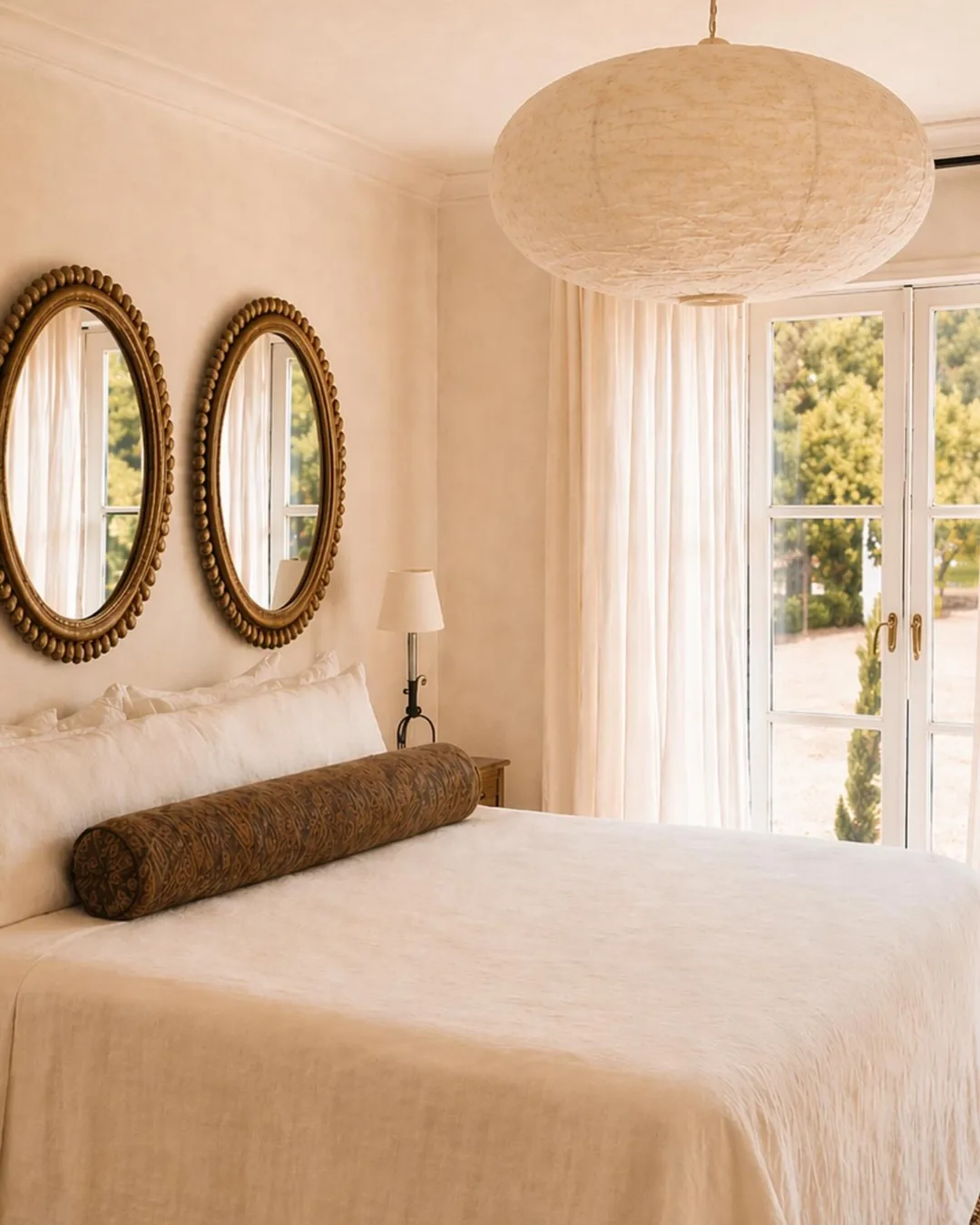
Two oval mirrors with ornate gold beaded frames hang on the wall directly above a bed with white linens and a brown bolster, a table lamp on the nightstand, French doors with sheer curtains at the side. The mirrors catch the window light and throw it back into the room, and the wall behind the bed suddenly has depth — you see the garden in the glass, and the room feels twice as wide.
Mirrors work behind a bed for the same reason they work in a small hallway: they borrow light and space from somewhere else. Hang them so they reflect the window, not the bed itself — nobody wants to watch themselves sleep — and hang both at the same height, their centres lined up with the bed’s width, or the pair looks like it was hung in a hurry. Keep the frames simple if the room is busy, or ornate like these if the room is plain: the mirror is the decoration here, so let it be one.
The practical point: hang the mirrors to reflect the window and its light, at the same height with their centres aligned to the bed — a mirror that reflects the bed is a mirror nobody enjoys.
Your Wall, Your Headboard
That is the whole idea, really: the wall behind your bed was always the headboard, waiting for someone to notice. Paint it, hang something on it, lean pillows against it, mirror it or build into it — any of these beats a panel you bought because the shop told you a bed needs one. Start with the wall you already have, and let it do the work.