Look at the corner of your bedroom. You know the one — the angle where the bed never quite sits right, where a single twin looks lost and two twins look impossible, so it ends up holding a laundry basket and a pile of good intentions.
Most corners fail because we treat them like a problem to hide. But a corner is the one place in a bedroom where two beds can actually belong together — pushed into the angle, sharing a nightstand, a rug, a lamp, and suddenly the awkward spot is the cosiest corner in the house. Nothing about the room needs to change except the way the beds meet the walls.
Here are 15 corner twin bed ideas that turn that empty angle into a proper retreat, from beds that meet in an L-shape to the small desk tucked by the corner window.
Two Beds, One Corner
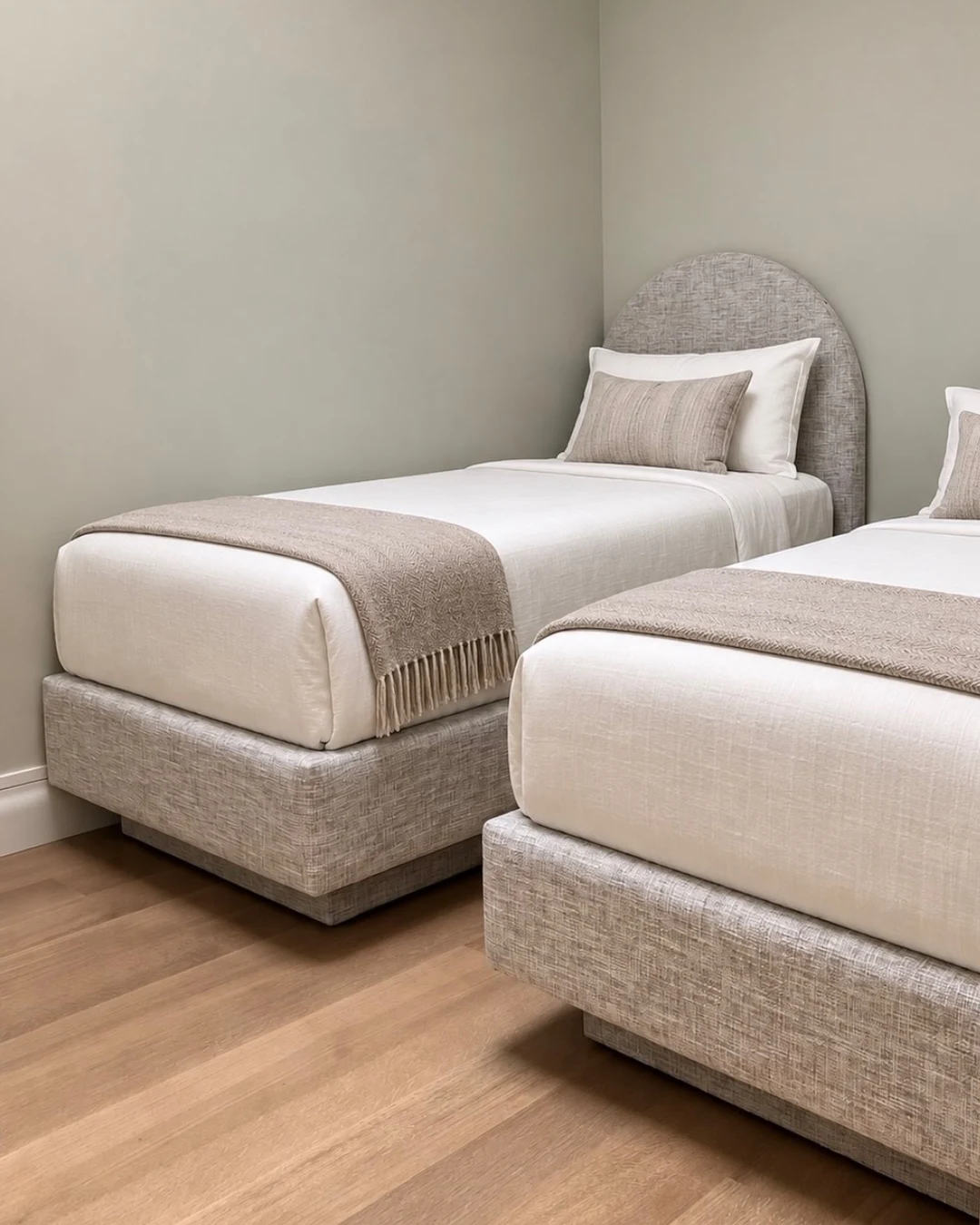
The simplest corner layout is also the strongest: two twin beds pushed into the corner at a right angle, heads meeting where the walls meet. Sage-green walls, light-gray upholstered headboards, white linens and beige fringe throws — the room in the photo is calm because the beds aren’t fighting the corner, they’re using it. Each bed gets its own wall, and the corner itself becomes the headboard.
An L-shape changes how the room feels to sleep in, too. Nobody is staring straight at a wall from the foot of their bed; each sleeper gets a long view across the room, and the gap between the beds stays open for a nightstand or a small plant. Keep the bedding matched — same duvets, same throws — and the two beds read as one design instead of two singles that happen to share a room.
The practical point: measure both walls before you push anything. Each twin is 38 inches wide and 75 inches long, so the L-shape needs about 75 inches of clear wall on each side, plus 24 inches of walkway around the foot of each bed.
Headboard That Wraps the Corner
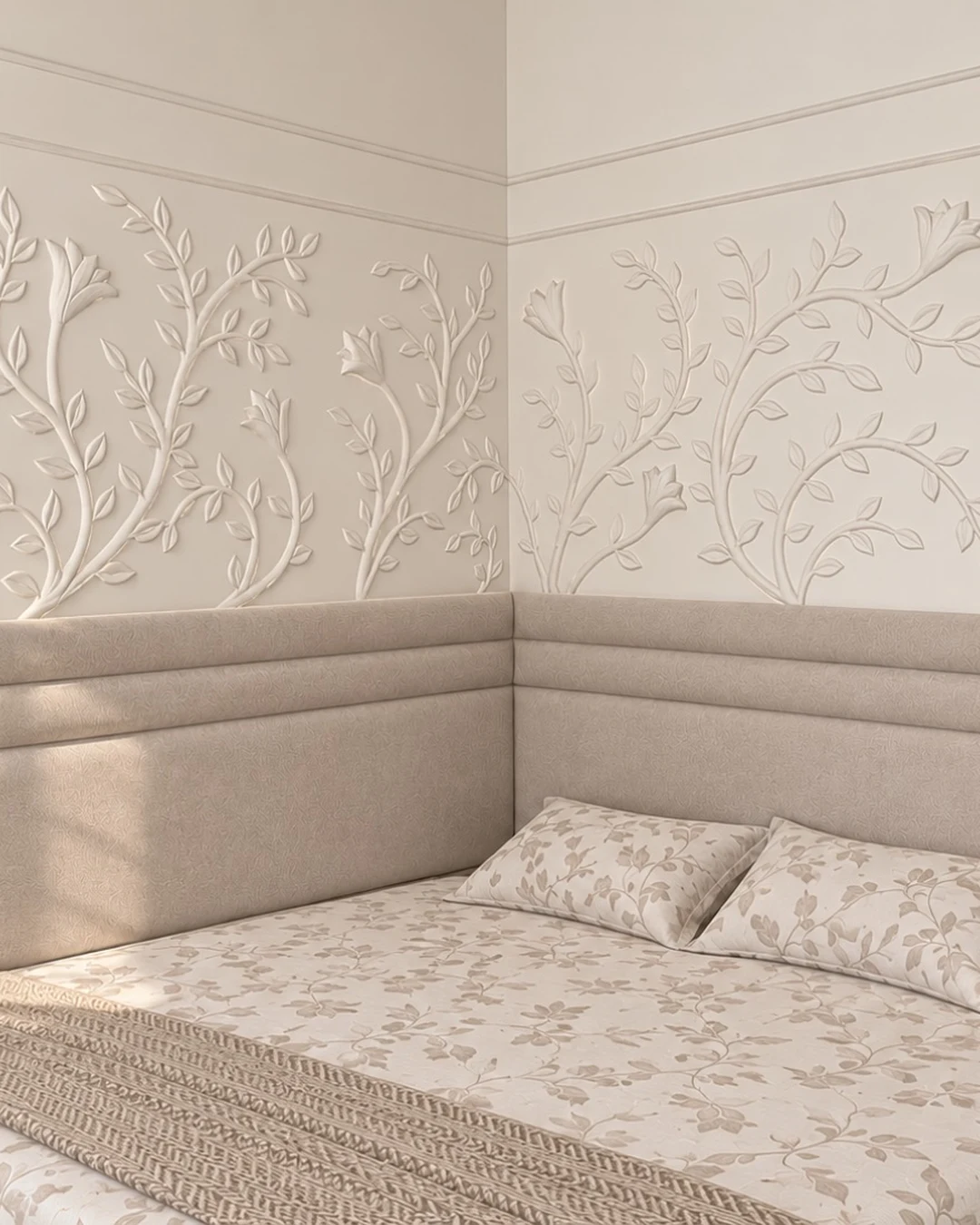
Some corners deserve a headboard that doesn’t stop at the angle — one that bends around it. A tall, curved beige headboard wrapping both walls of the corner, plaster-relief vines above it, white floral linens below: the headboard is the whole room here, and the corner disappears into it.
Honesty first: the photo shows it on one wide bed, not twins. A wrap-around corner headboard for two beds barely exists yet — almost every version on the market is made for a single bed, and the twin ones are usually watermarked product ads or unfinished rooms. But the idea is the same either way: order two matching curved panels, one per wall, in the same fabric, and the corner does the same work for two twins. Upholstered panels in a plain linen or velvet are the safest choice — a busy pattern across a bent corner gets hard to read.
The practical point: check the corner is a true 90 degrees before ordering. Older houses drift a few degrees off square, and a rigid panel will gap at the join — flexible upholstered panels or two separate headboards pushed tight together forgive that.
A Small Nightstand Shared by Both Beds
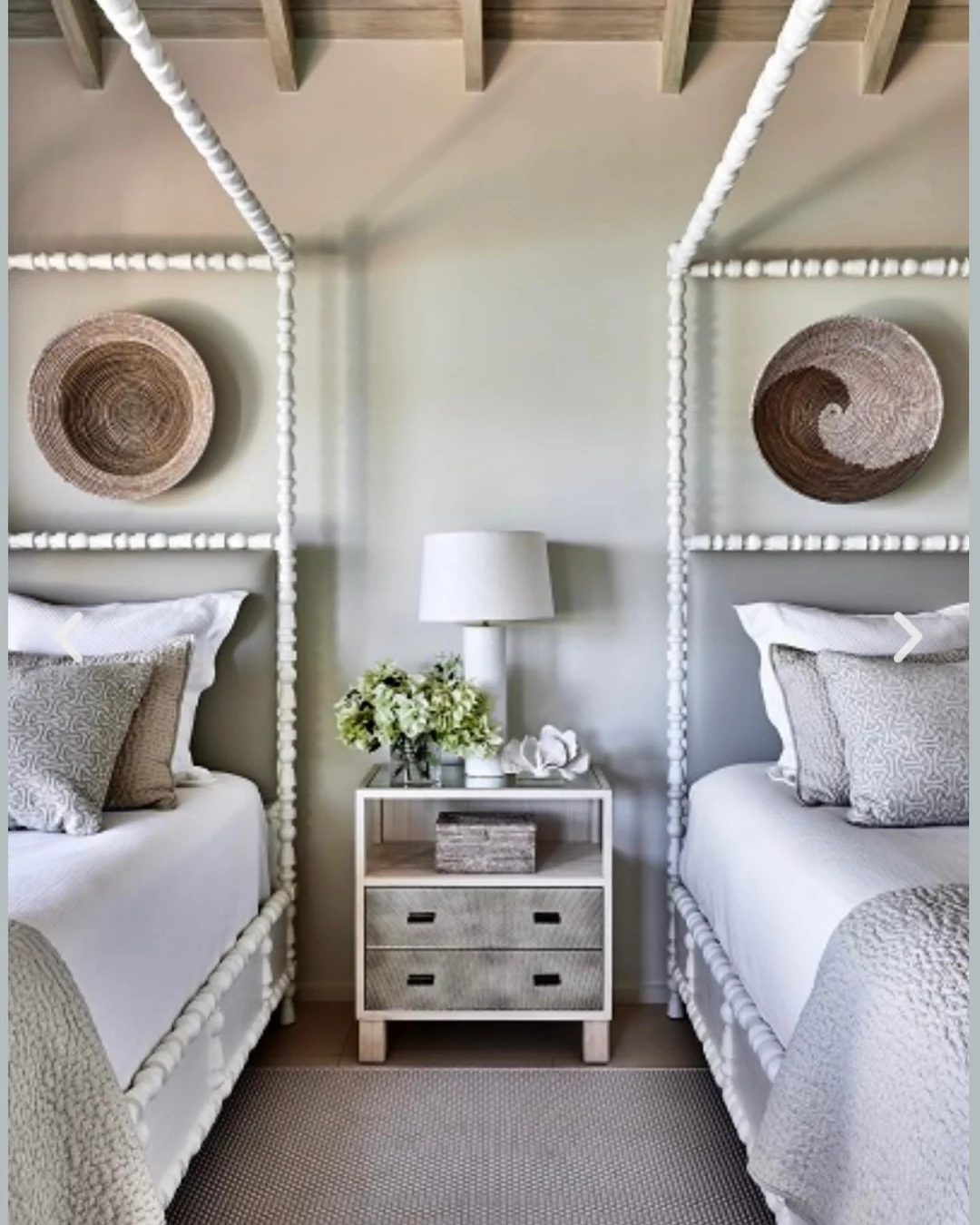
One small nightstand between two twin beds does the work of two — glasses, phones, books and a lamp, reachable from either side without anyone stretching. White spindle-frame canopy beds, a small white two-drawer nightstand with a lamp and a vase of green hydrangeas, round woven baskets above each headboard: the nightstand is small, but it’s the piece that makes the pair feel like a set.
Size matters more than style here. A nightstand wider than 24 inches starts pushing the beds apart and splitting the wall in half; narrower than 16 and it can’t hold two glasses and a lamp. Two drawers beat one — each guest gets a drawer of their own — and a lamp with a shade that throws light sideways, not straight down, keeps one reader from waking the other.
The practical point: aim for a nightstand 24 to 28 inches high — roughly mattress height — and no wider than 24 inches, so it sits between the beds instead of separating them.
One Rug for the Whole Corner
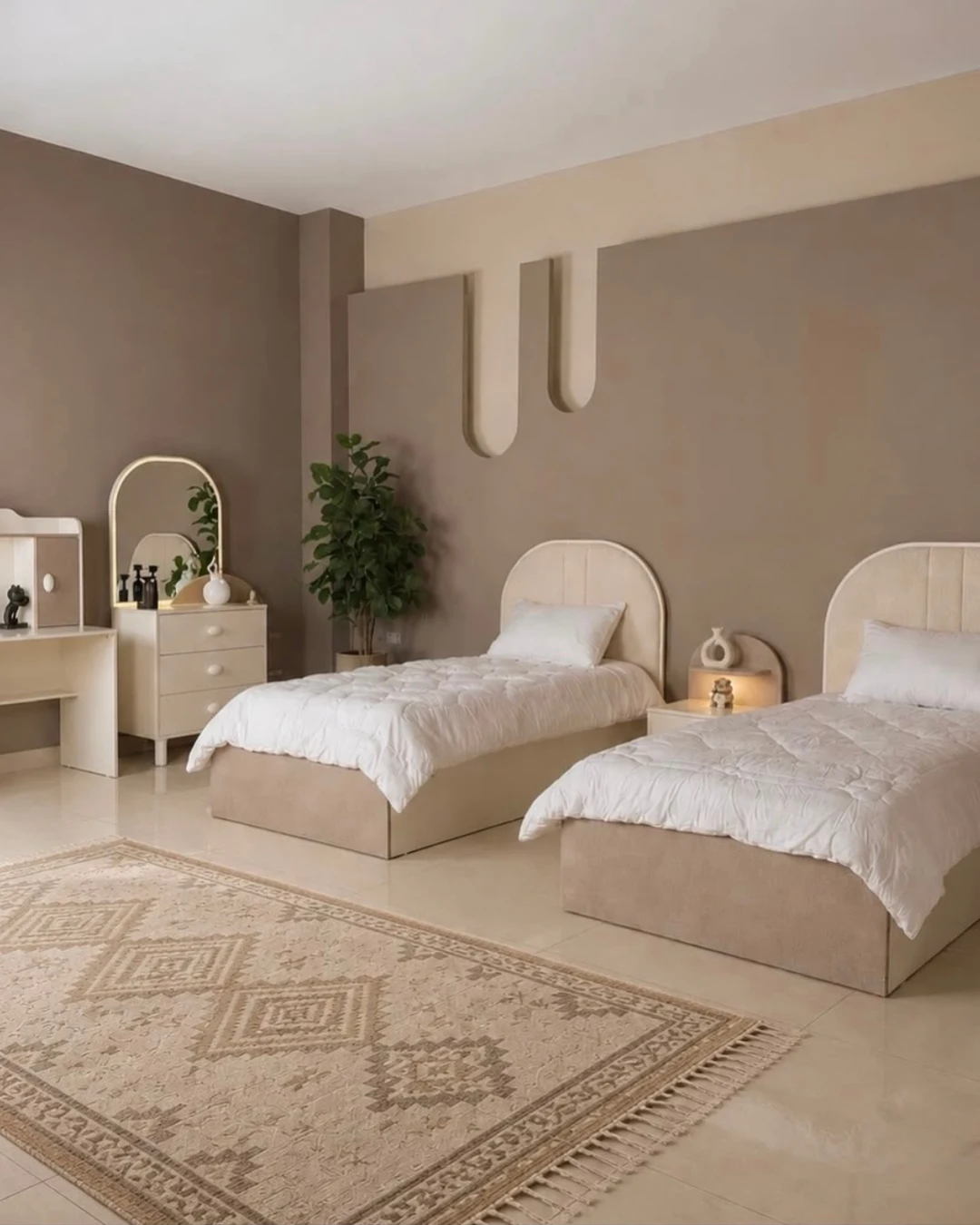
A rug that runs under both beds is what turns two twins into one room. A large geometric-patterned rug filling the foreground, cream arched headboards against a taupe accent wall, a vanity and a plant at the far end: the rug is the frame, and the beds sit inside it. Without it, each bed stands on its own patch of bare floor and the corner feels split.
Bigger is better here, within reason. A rug that stops short of the beds looks like a doormat; one that runs under the foot of both beds and extends a foot or two beyond them pulls the whole arrangement together. Low pile is the practical choice — a thick shag under bed legs is a nightmare to vacuum and swallows anything small that falls off a nightstand.
The practical point: an 8-by-10 rug suits two twins in a corner. It should extend at least 18 inches beyond the foot of each bed and run under the front third of both frames.
Curtains on Both Walls
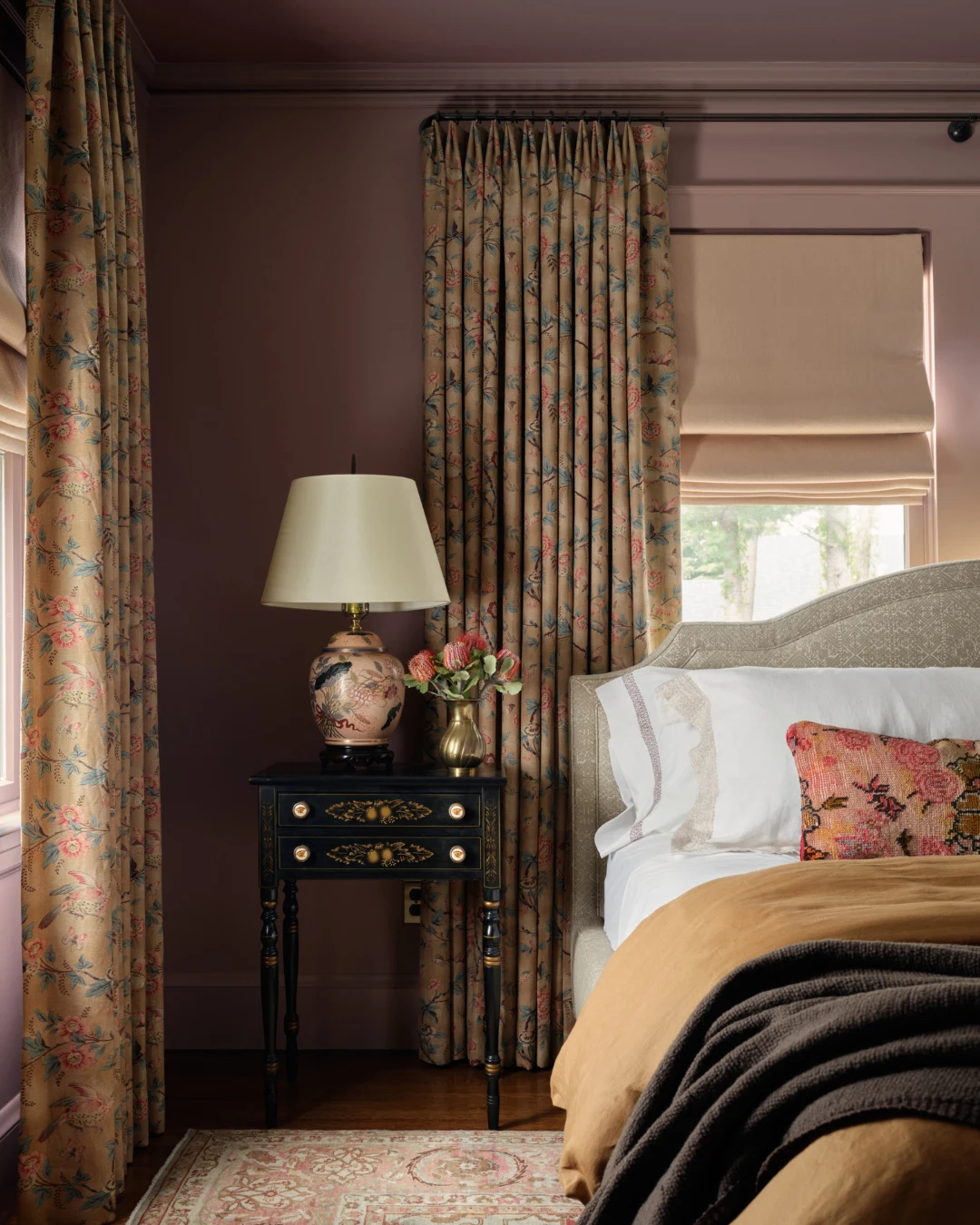
Curtains are the cheapest way to make a corner feel finished, and the trick is to dress both walls, not just one. Floor-to-ceiling curtains in a beige floral print framing windows on both walls of the corner, a roman shade half-raised on one side, a black nightstand with a ceramic bird-motif lamp between them: the curtains meet at the angle and the corner stops looking like a gap.
Matching the fabric on both walls is what sells it. Different curtains on each wall would split the corner in half; the same print, hung at the same height, turns two windows into one composition. Hang the rods four to six inches above each window frame and extend them a few inches past the frame on each side, so the curtains stack clear of the glass when they’re open.
The practical point: buy both panels from the same dye lot. Curtains from different batches can look like different colours in daylight, and in a corner the two walls sit side by side.
Floating Shelves Above the Bed in the Corner
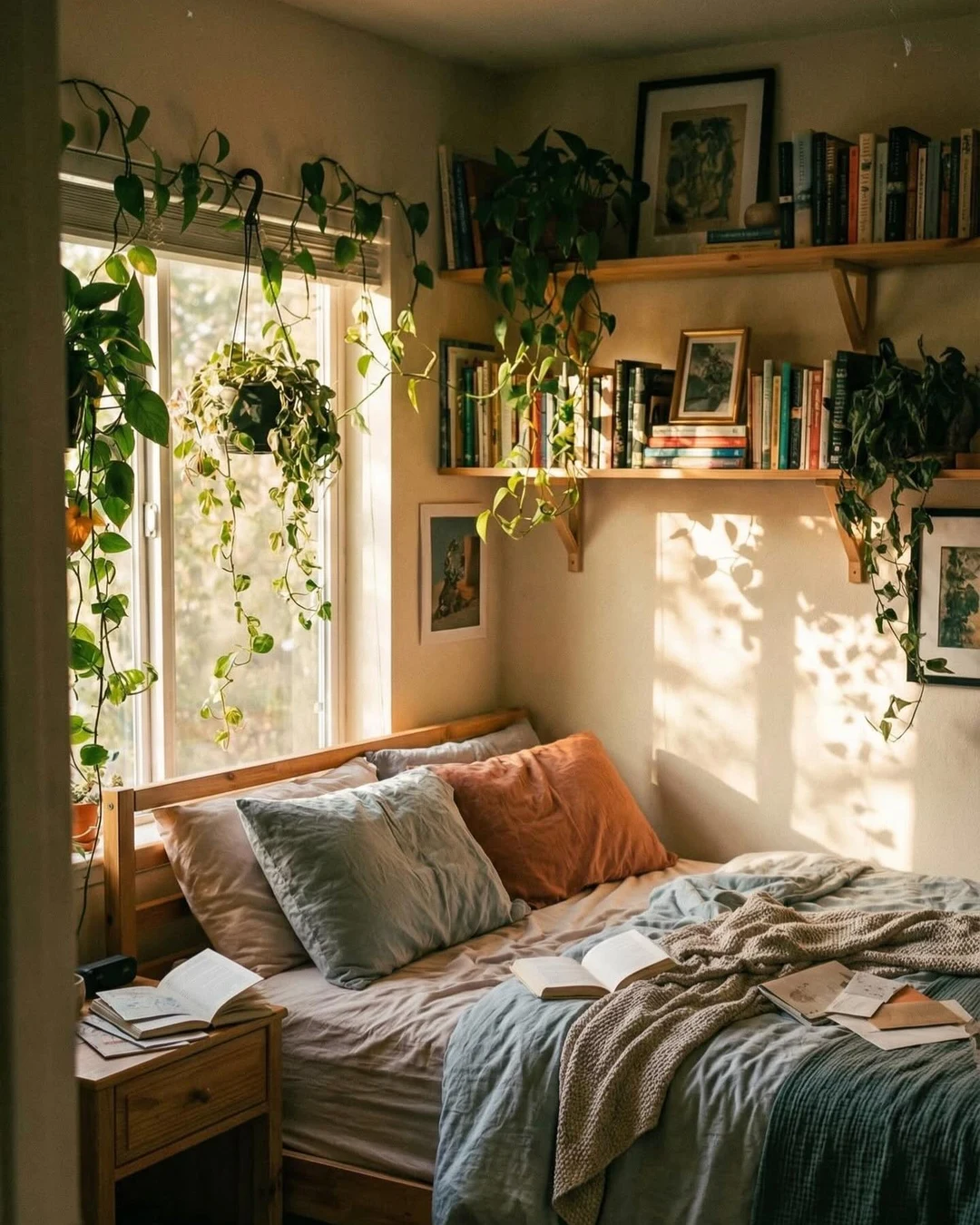
A corner bed needs somewhere for books, and floating shelves are the answer that doesn’t eat floor space. A sun-drenched corner, a wooden bed with rumpled light sheets and rust pillows, two floating wooden shelves above the bed holding books and framed artwork, trailing pothos cascading down: the shelves are the decoration and the storage at once.
Keep the load light and the styling loose. Books stacked flat, one framed print, a trailing plant — that’s enough. Shelves crammed edge to edge with objects look like a bookshop, and anything heavy above a pillow is a bad idea in a room where people sleep. Anchor every shelf into studs, not just drywall plugs; a shelf full of books pulls hard on its fixings.
The practical point: hang the lower shelf 18 to 24 inches above the pillow. Any lower and you’ll hit your head sitting up; any higher and the books are out of reach from the bed.
One Reading Light Above Each Bed
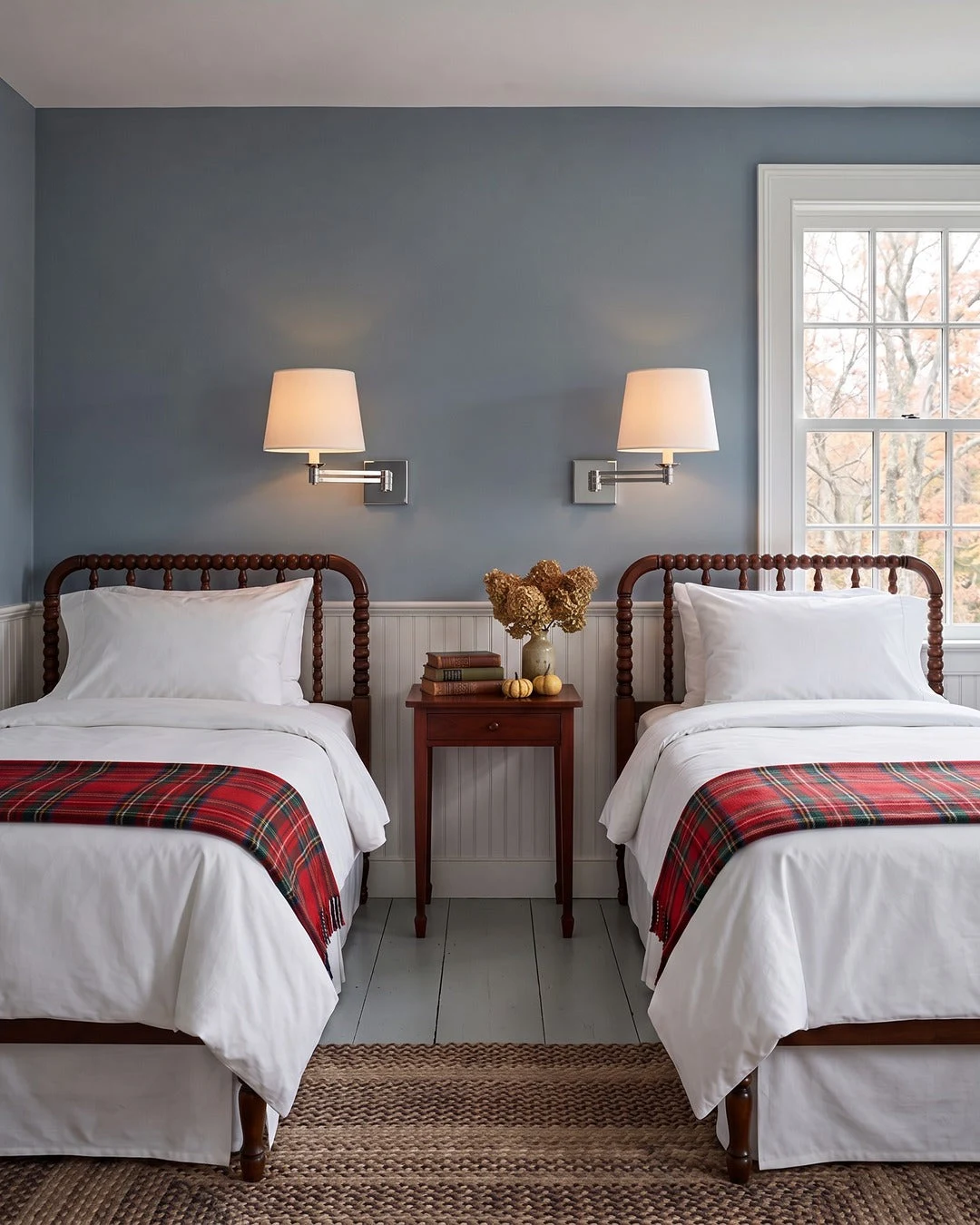
Two readers need two lights, and one lamp on a shared nightstand never serves both. Two lit wall sconces, one above each twin bed, a small nightstand between them with a vase of dried flowers: each sleeper gets their own light, aimed their own way, and nobody has to negotiate.
Swing-arm sconces are the best version of this idea. A fixed sconce throws light where the wall decides; a swing arm lets each reader pull the light toward their book and push it away when they’re done. Warm bulbs matter more here than anywhere else in the room — a cool white sconce above a pillow feels like a hospital corridor at midnight.
The practical point: mount each sconce 30 to 36 inches above the mattress, and put them on separate switches or pull cords, so one reader can switch off without reaching across the other bed.
Pillows That Soften the Angle
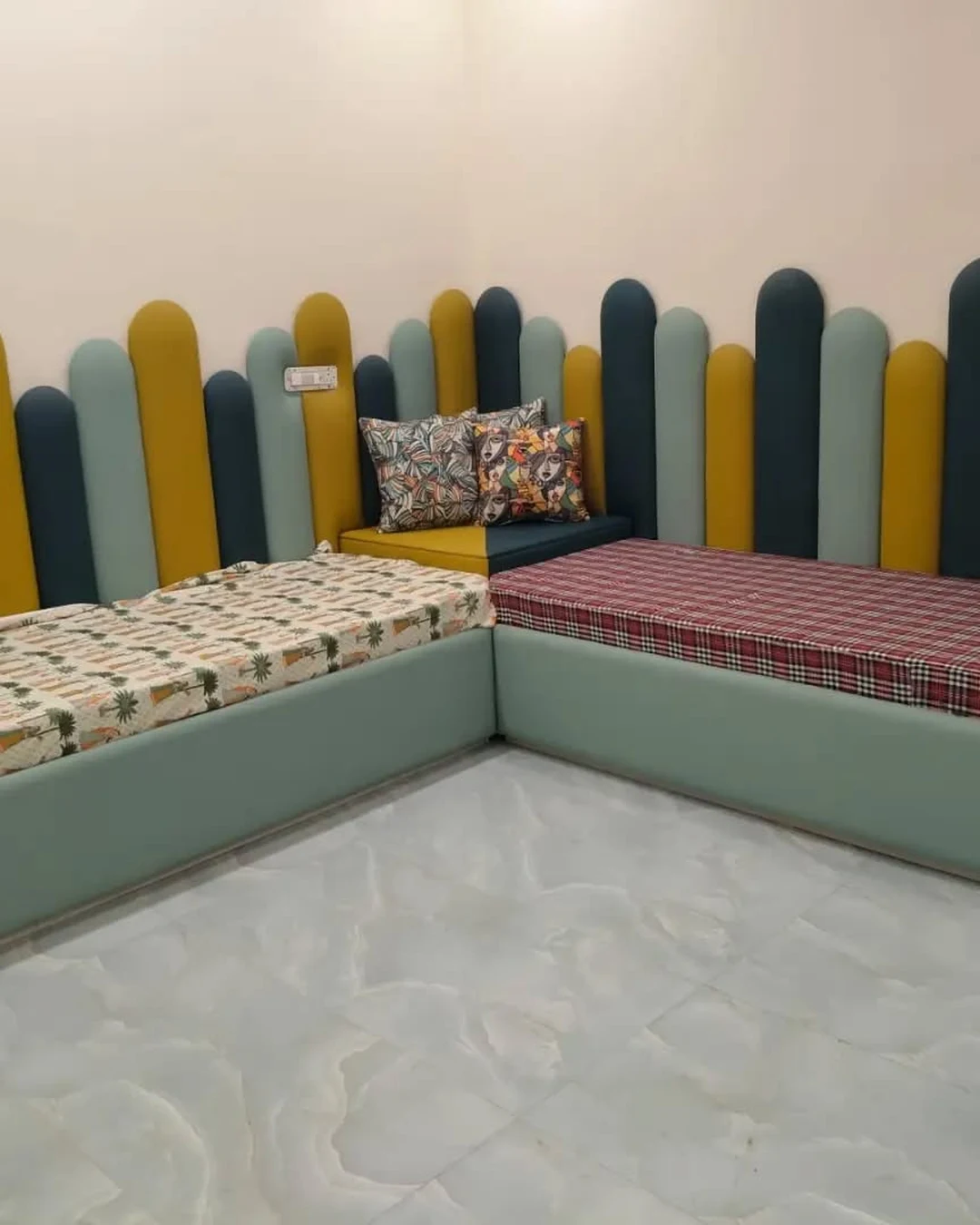
A corner is all straight lines and right angles, and pillows are the fastest way to soften it. Two colourful abstract pillows sitting in the corner seat of an L-shaped daybed, a tall scalloped padded panel in mustard, sage and navy behind them: the pillows sit exactly where the angle is sharpest, and the whole corner looks friendlier for it.
Plain talk: this photo shows a daybed-style corner seat, not twin beds — a showroom piece with clashing covers, palm print on one side and red plaid on the other, and no bedding at all. It’s the weakest photo in this list, but the idea is exact: pillows in the angle do the same work on twin beds. Learn from the clash, too — pick one pattern family for the corner pillows and keep the palette to two colours, or the angle reads busy instead of soft.
The practical point: use two 20-inch square pillows in the corner seat and one on each bed section, all in the same two colours. Same size, same palette, different patterns — that keeps the corner calm.
A Bench at the Foot of Both Beds
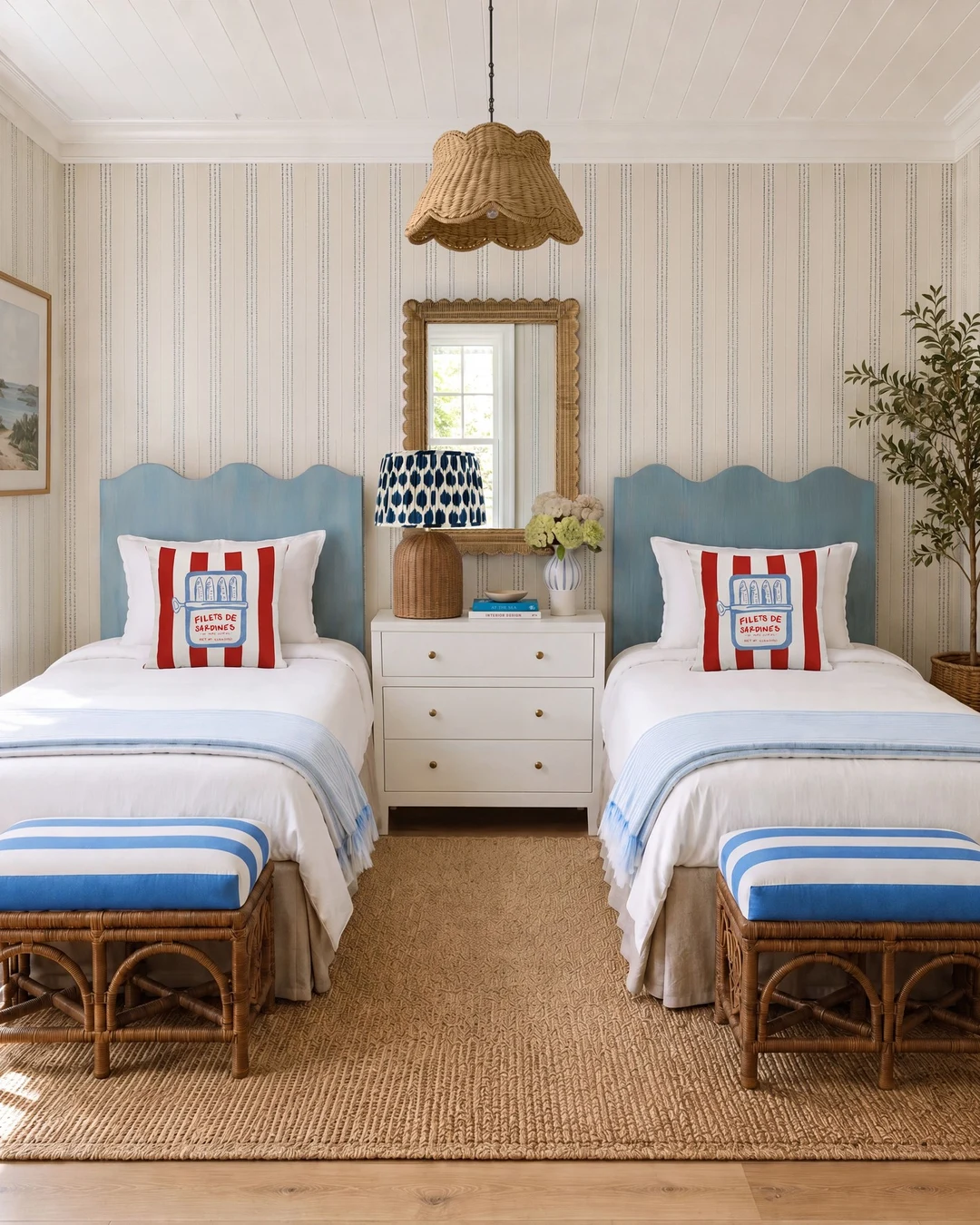
A bench at the foot of a bed is a place to sit, a place to lay out tomorrow’s clothes, and a visual full stop at the end of the bed. Two twin beds with light-blue scalloped headboards, a woven rattan bench with a striped cushion at the foot of each: the benches repeat each other the way the beds do, and the room gains a rhythm.
Benches work best when they’re a little narrower than the bed and a little lower than the mattress. A bench wider than the bed looks like it belongs to the room next door; one higher than the mattress is awkward to sit on. Rattan, wood or upholstered — the material matters less than the match: two identical benches, or one long bench spanning both beds, either way the pair reads as one decision. If twin beds with benches are your thing, these twin guest bedroom ideas carry the same trick further, with benches, dressers and the walkway between the beds.
The practical point: a bench 16 to 18 inches high and 2 to 3 inches narrower than the bed on each side sits right. Anything taller blocks the view of the bedding; anything wider crowds the walkway.
Storage Under the Beds
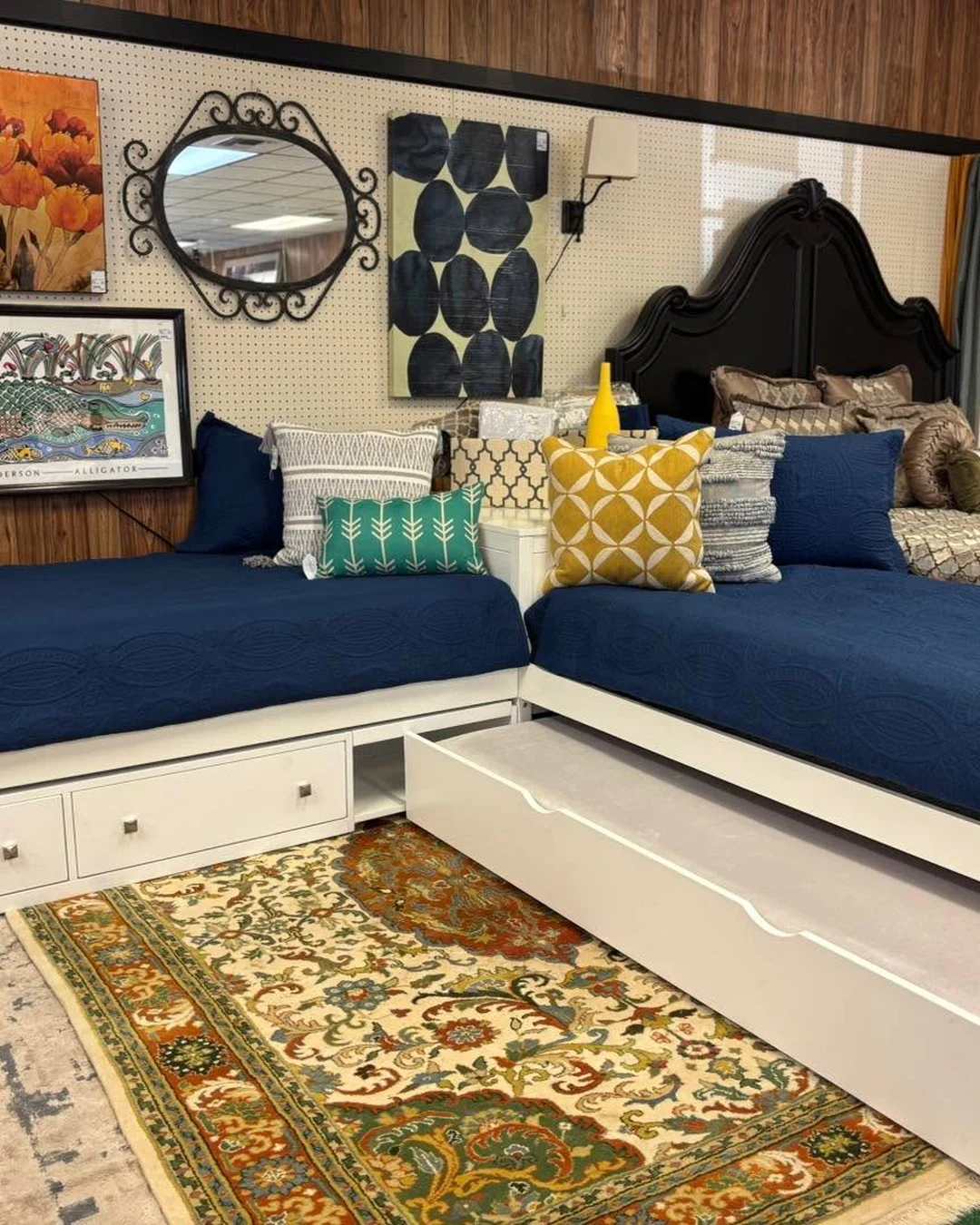
Corner rooms are usually small rooms, and small rooms need storage that doesn’t take up floor space. White drawers under one bed and a trundle pulled out under the other, dark blue quilts above: the storage is right there in the photo, doing its job in plain sight.
This photo comes from a furniture showroom — pegboard wall, price tags on the wall art and all — but it shows the storage better than any styled bedroom could. Drawers on runners hold spare bedding and out-of-season clothes; a trundle underneath is a third bed for the night someone extra stays over. The trade-off is real, though: drawers need clearance to pull out, and a trundle needs the full 38 inches of floor in front of the bed, so don’t plan storage under a bed that’s pushed hard against a wall.
The practical point: measure the pull-out before you buy. Drawers need 6 to 8 inches of depth and a clear run of floor in front; a trundle needs the whole bed’s width of empty floor to roll out.
Hang a Mirror That Opens the Corner
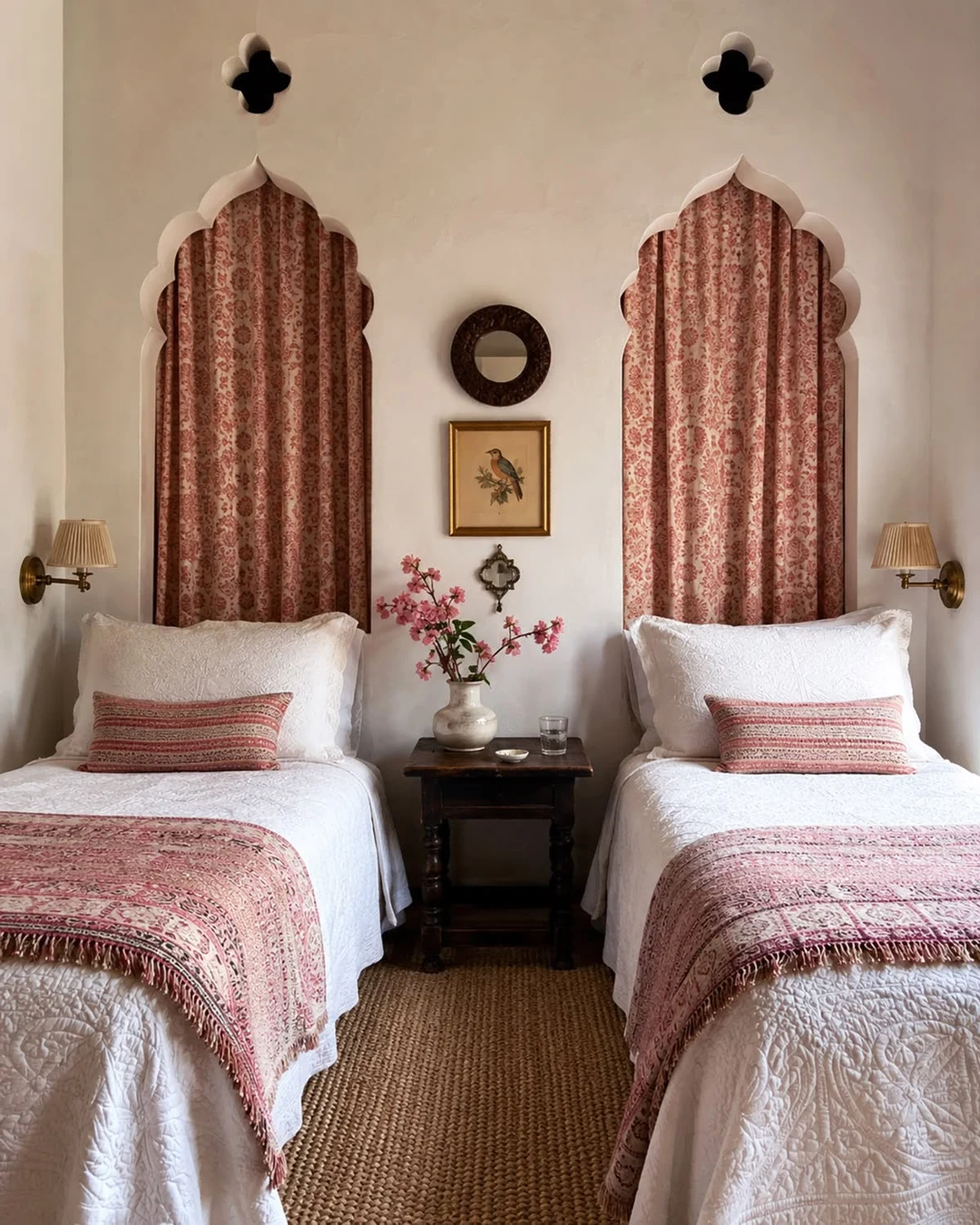
A corner can feel like a dead end, and a mirror is the cheapest way to open it. A round dark-framed mirror hanging above the shared nightstand between two twin beds, arched alcoves with red-patterned curtains behind each bed, wall lamps with pleated shades: the mirror catches the window light and throws it back into the room, and the corner stops feeling closed in.
Placement is everything. A mirror hung opposite a window doubles the light; one hung facing a blank wall doubles nothing. Round mirrors suit corners better than rectangular ones — no hard edges fighting the angle — and a frame that picks up a colour already in the room, dark wood or black metal, keeps it from looking like an afterthought.
The practical point: hang the mirror so its centre sits about 60 inches from the floor. Too high and it reflects the ceiling; too low and it reflects the beds.
Warm Light in the Corner
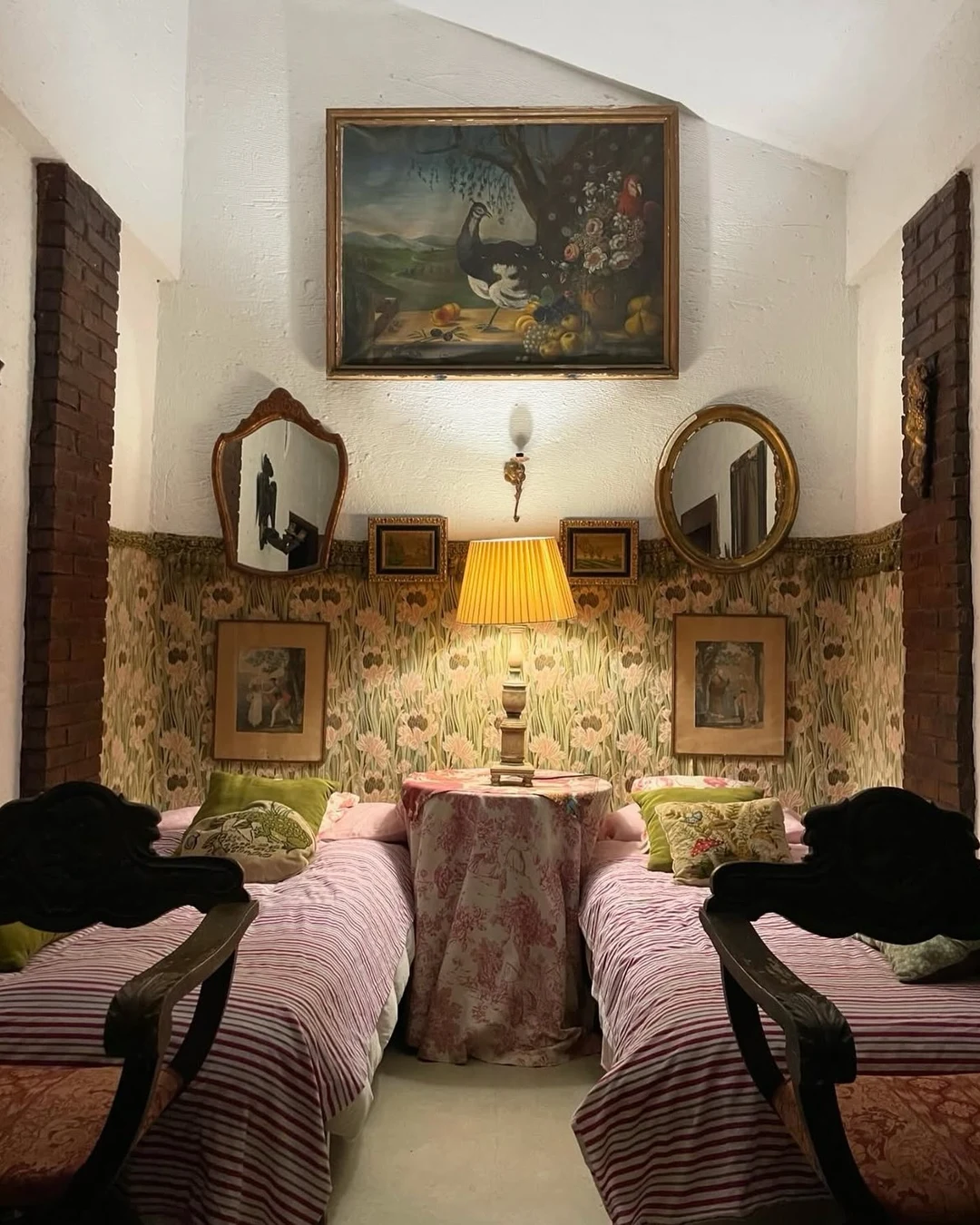
Corners go dark first, and warm light is what brings them back. Two twin beds with striped bedding in a wallpapered corner nook, a lit ceramic table lamp with a warm glow plus a swing-arm wall lamp on the shared nightstand between them, a large landscape painting above: the corner glows, and the whole room feels warmer for it.
Two light sources beat one bright one. A single overhead light flattens a corner; a table lamp and a wall lamp together give it depth, and the warm colour temperature — 2700K, the colour of candlelight — makes white bedding look soft instead of stark. Put the lamps on a dimmer if you can; a corner that can go from reading-bright to barely-there is a corner that works at every hour.
The practical point: use 2700K warm bulbs in both lamps, and keep one lamp lit even during the day. A corner with a lit lamp always looks lived in; a corner with a dead lamp looks forgotten.
Tuck a Small Desk by the Corner Window
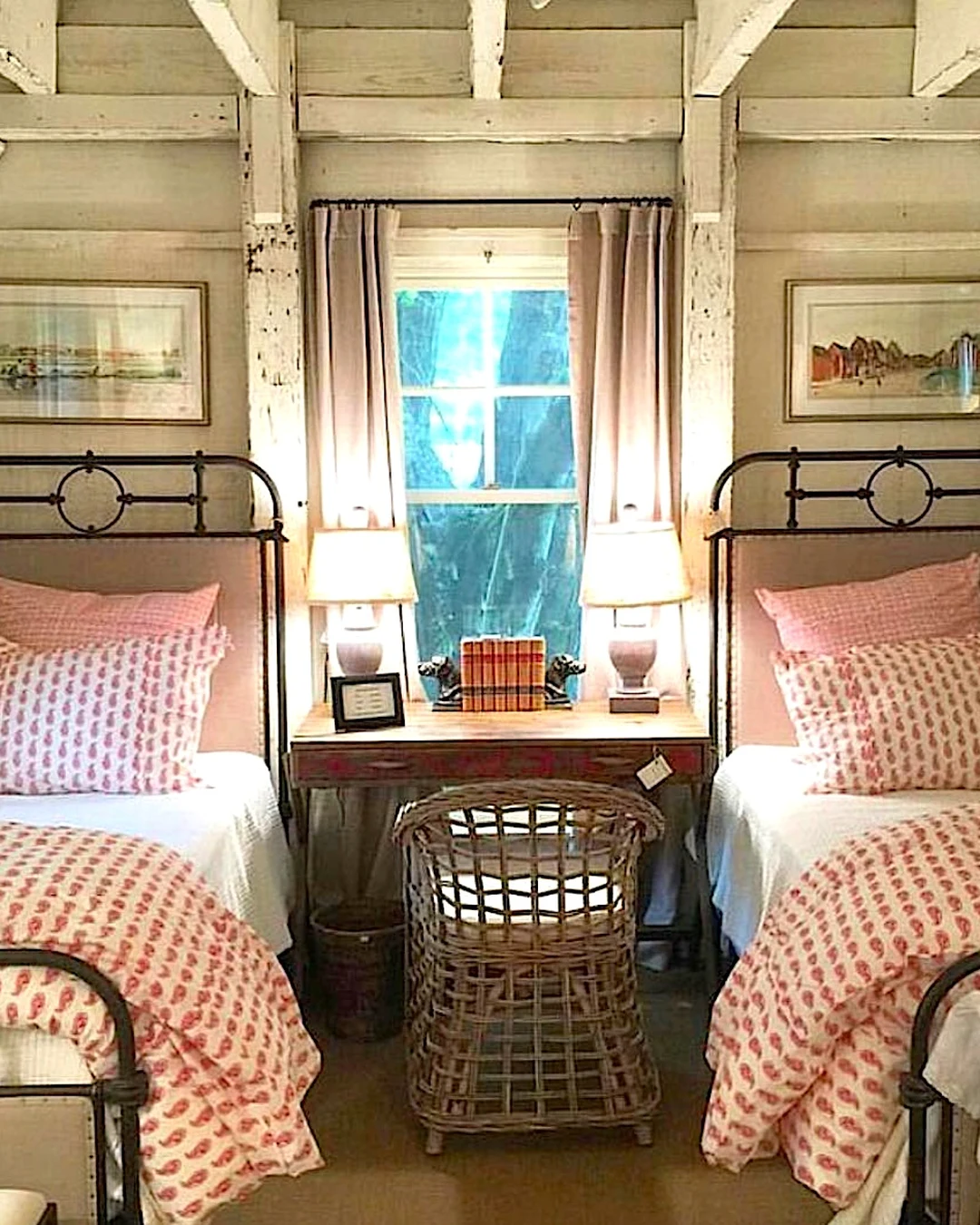
A corner window is wasted space until you put a desk under it. Two twin beds with black metal headboards and pink-patterned bedding, a wooden desk placed under the window between the beds, two lit table lamps on the desk, books and horse-head bookends, a wicker chair: the desk turns the corner into a place to write, read or work, and the window does the lighting.
Small is the point. A desk 36 to 42 inches wide fits between two twins without crowding either bed, and a chair that tucks fully underneath keeps the walkway clear when nobody’s working. Keep the desktop mostly clear — two lamps, a stack of books, nothing more — because a desk that collects clutter becomes a shelf, and a shelf in a corner is just another dead end.
The practical point: put the desk under the window, not beside it. Window light from the front is the best light for reading and writing, and it keeps the desk from blocking the view out.
Plants That Fill the Corner
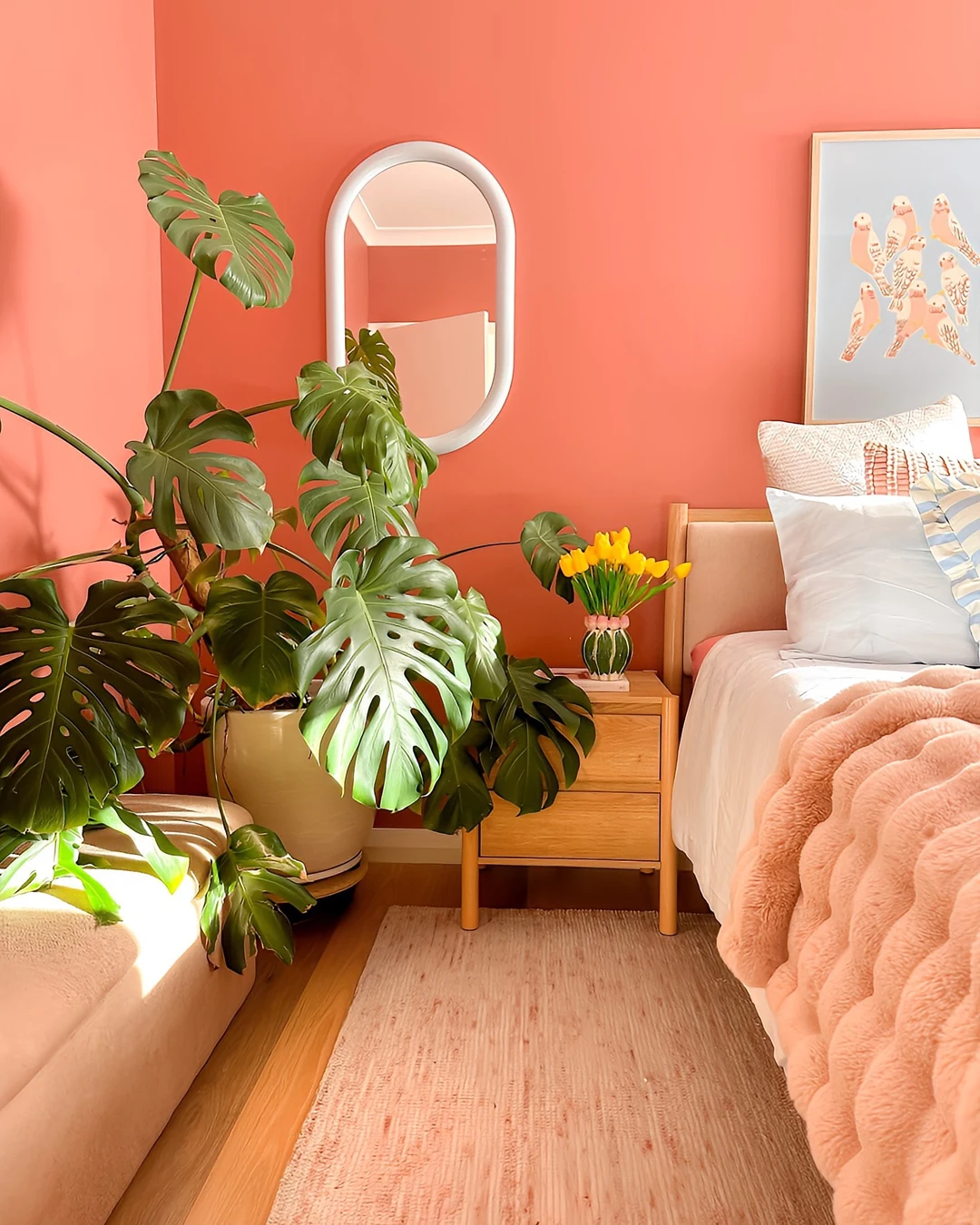
Every corner has one spot that nothing else fits — too narrow for furniture, too dark for a lamp — and that’s exactly where a big plant belongs. A large Monstera filling the corner against a coral-orange wall, an arched white mirror beside it, a nightstand with yellow tulips and a bed with a peach throw: the plant is the whole idea, and the corner finally has a job.
One big plant beats five small ones in a corner. A Monstera or a fiddle-leaf fig in a 10- or 12-inch pot fills the angle at eye level; a row of tiny succulents on a shelf looks like a collection, not a solution. The bed in this photo is a single — the plants are the point — but the rule holds for twins: one tall plant in the corner, where the two beds meet the wall, softens the angle better than any cushion.
The practical point: give the plant bright indirect light and a pot with drainage. Corners near windows suit Monsteras; dark corners suit snake plants, which forgive low light and missed waterings.
Leave Room to Walk Around the Corner
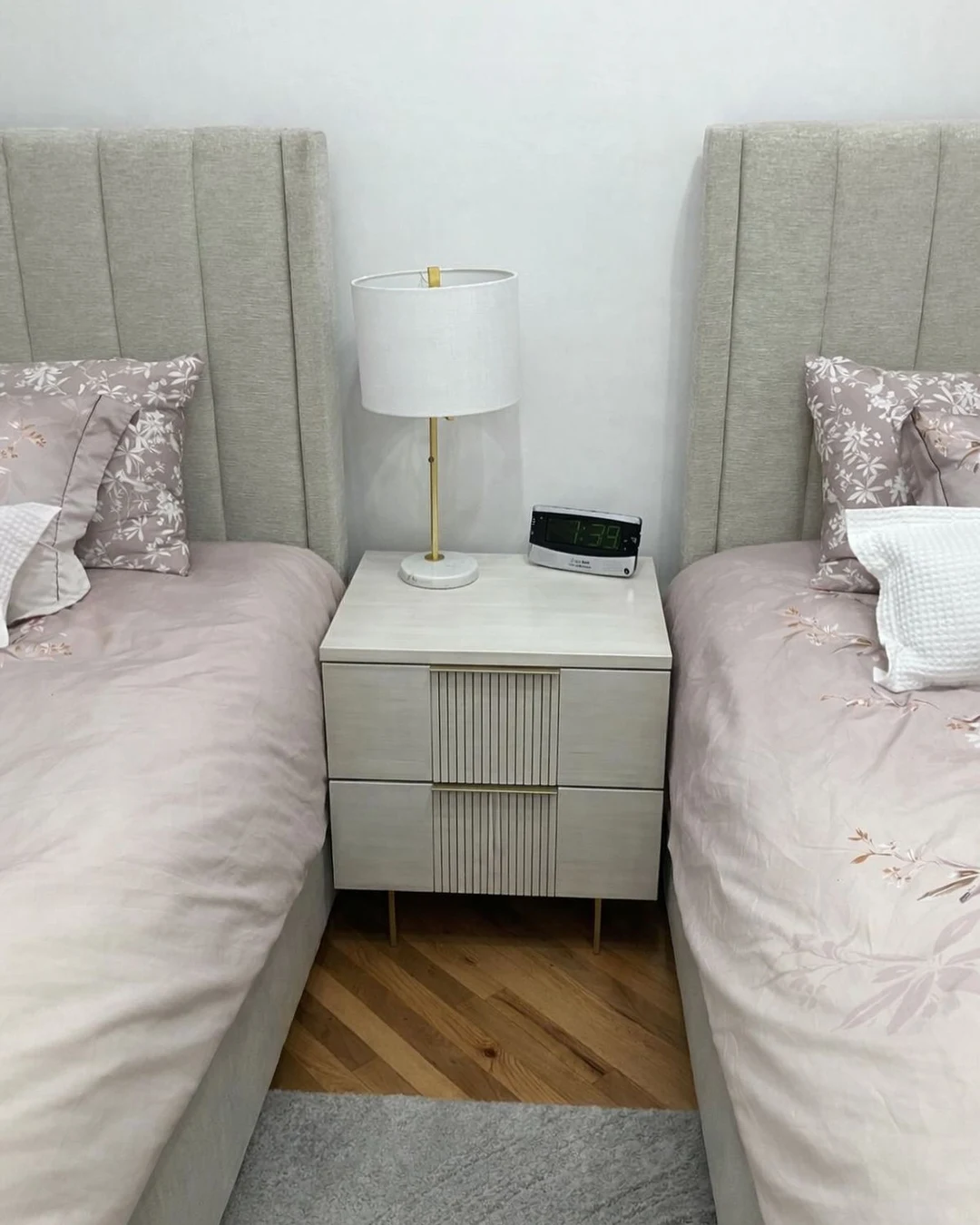
Nobody photographs the space between two twin beds, but everybody uses it. Two twin beds with grey upholstered headboards and pale lilac bedding, a white three-drawer nightstand with a lamp between them, a clear gap running between the beds: the gap is the most honest idea in this list, because a corner room that you can’t move around in is a room you stop using.
Leave at least 24 inches between the beds, and 30 if the room allows it. Less than that and the nightstand between them becomes a wall; more than 36 and the beds start to feel like they’re in different rooms. A small rug in the gap marks the walkway and softens the floor. If the room itself is tight, these ways to make a small bedroom look bigger help the gap read as breathing room, not wasted space.
The practical point: walk the gap yourself before guests arrive. If you have to turn sideways, the beds are too close — move them, even if it means a narrower nightstand.
The Corner That Became the Favourite Spot
Two beds in a corner sounds like a compromise — until the corner starts working for you. One rug, one shared nightstand, one reading light per bed and one big plant are enough to turn the awkward angle into the cosiest spot in the house. The rest — the mirror, the bench, the desk by the window — is what makes it a room someone chooses, not a room someone tolerates.
Start with the layout and the rug — those two do most of the work — then add the reading lights and the plant before your next guests arrive. Two beds, one corner, and neither one feeling like the spare: that’s the whole trick.