Two beds in one room sounds like a compromise — until you see it done right.
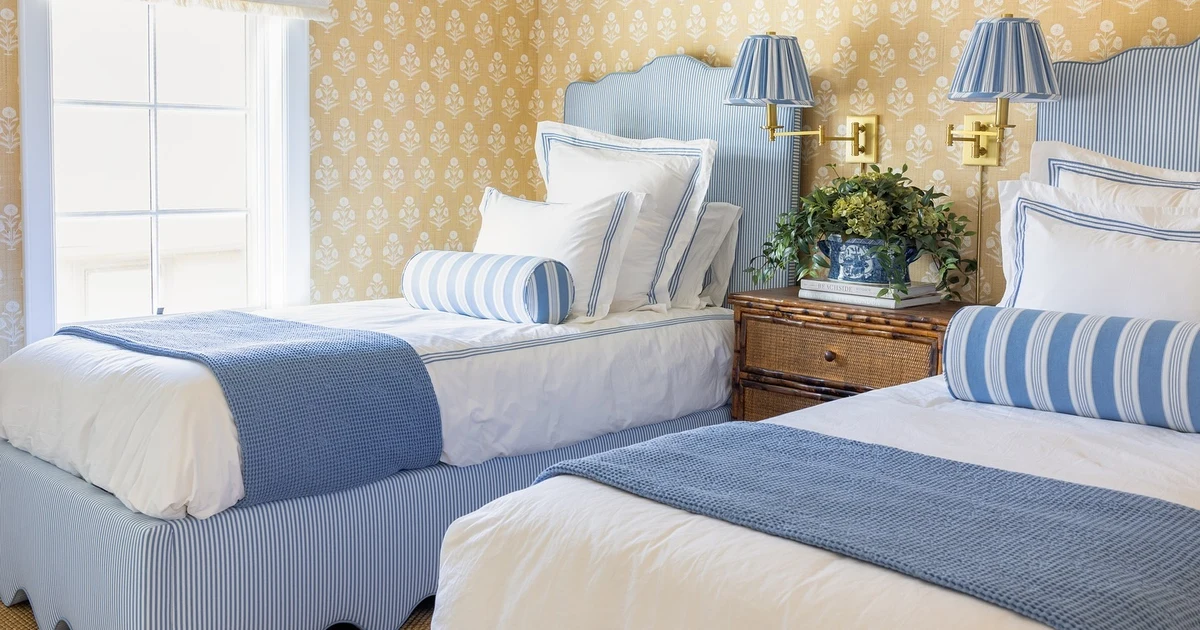
Most twin rooms fail before anyone sleeps in them. The beds get pushed to opposite walls, the bedding doesn’t match, and the whole room reads like a dormitory that gave up halfway through. But when the two beds are treated as one design — one headboard wall, one bedding language, one shared rug — the room stops feeling doubled and starts feeling deliberate. Guests notice the difference the moment they walk in: two beds, and neither one looks like the spare.
Here are 15 twin guest bedroom ideas that give two beds real character, from a shared headboard wall to the small desk tucked between the beds.
Two Beds, One Headboard Wall
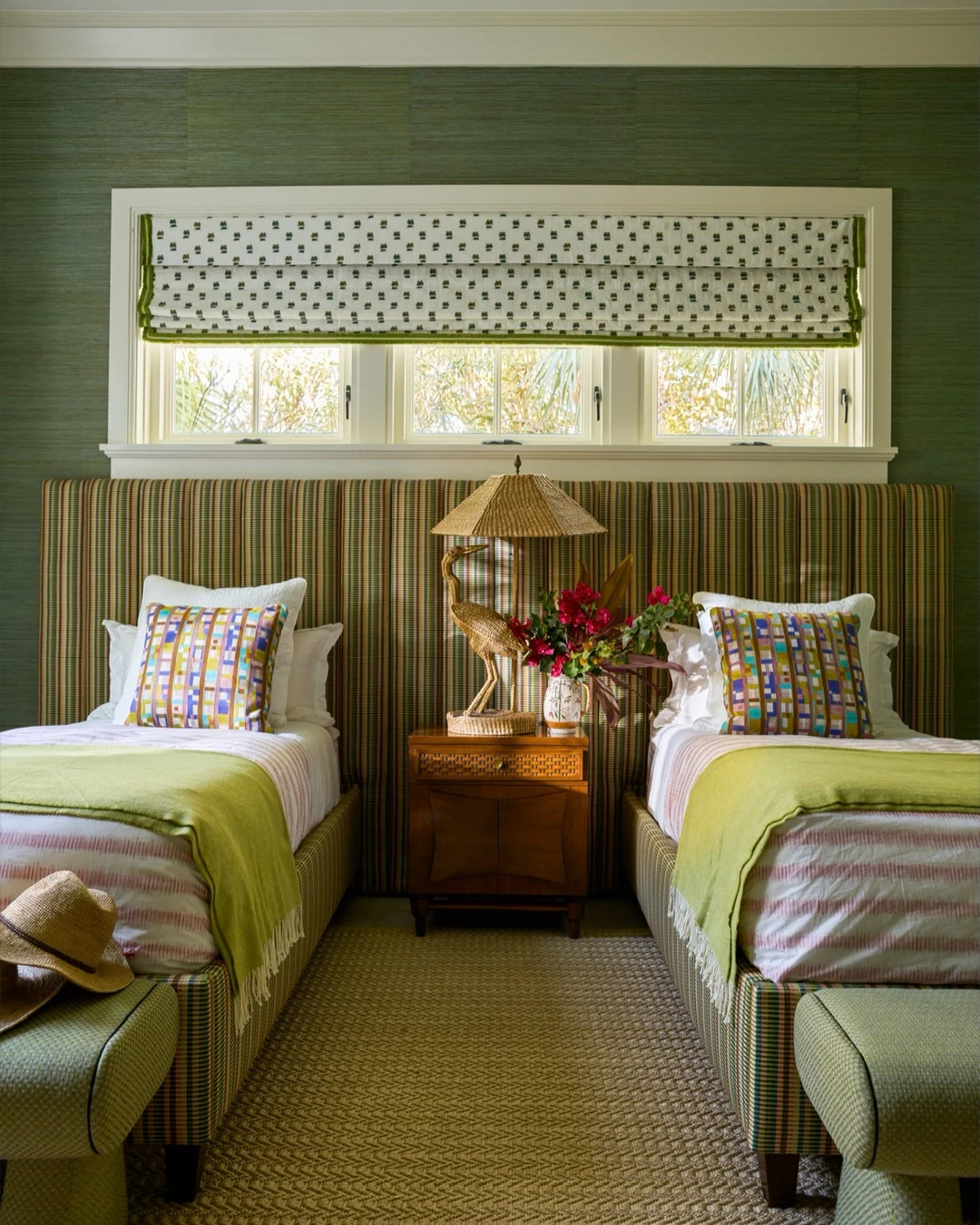
The fastest way to make a twin room look designed is to give both beds one thing in common — a single headboard wall that runs behind them both. Striped upholstery, a painted panel, even a long run of grasscloth wallpaper: the shared backdrop ties the beds together so the room reads as one composition instead of two singles that happen to share a floor.
It works best when the wall has something above it too. A wide window with a Roman shade, a long shelf, or a pair of sconces centred over the gap between the beds keeps the eye moving across the whole wall rather than stopping at one bed. Keep the nightstand between the beds low and narrow — a wooden one with a woven-shade lamp and a vase of flowers is enough. Anything wider starts to split the wall in half.
The practical point: measure the wall before you buy. Two twin beds need about 76 inches of width plus a nightstand of 18 to 24 inches — if the wall is shorter than that, push the beds together and let the headboard wall do the joining.
Matching Bedding, Different Pillows
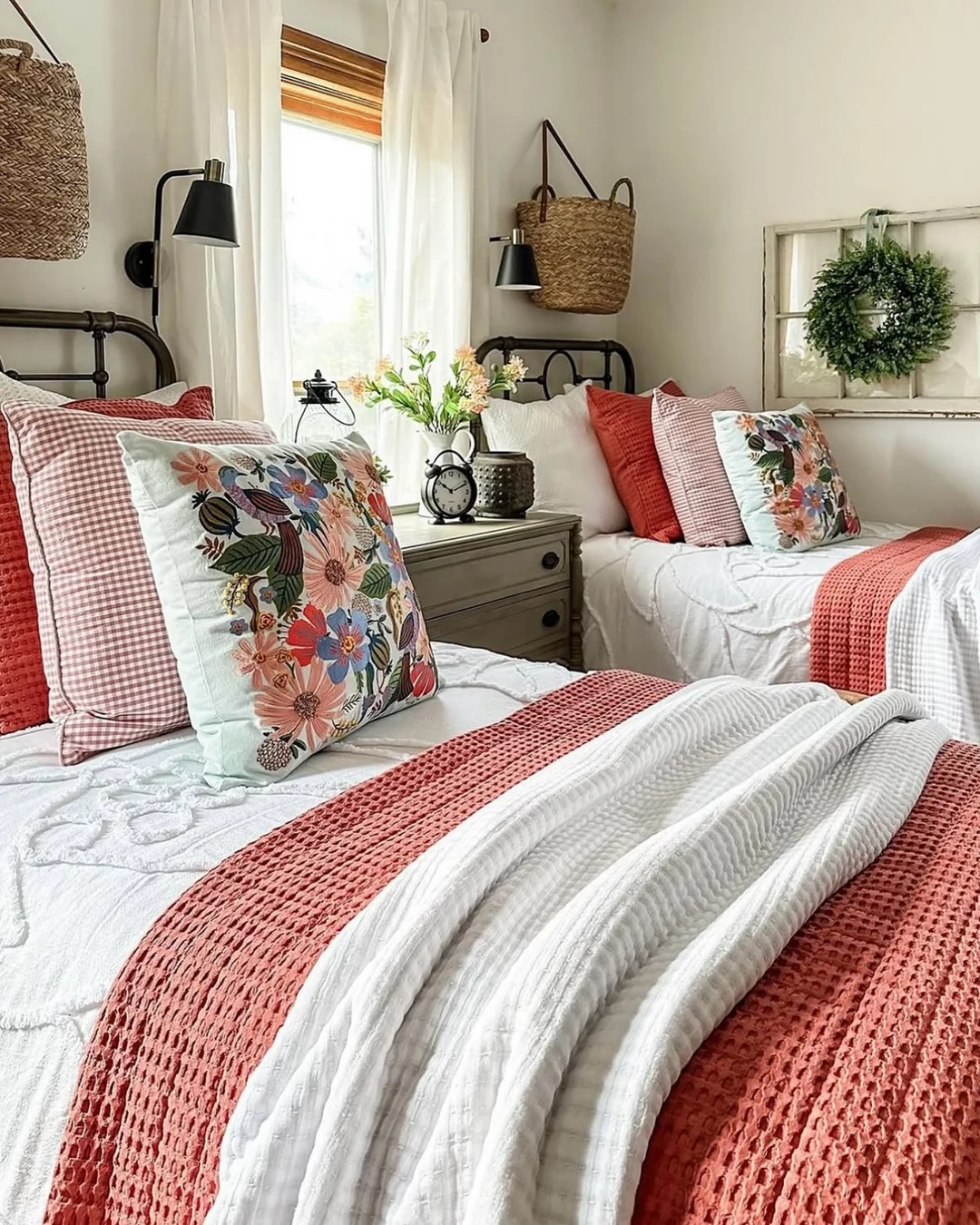
Matching bedding is what makes two beds look like a pair. Different pillows are what keeps them from looking like a hotel. Start with the same white duvets and the same throw — a coral waffle knit works beautifully against white — then let each bed have its own pillows. One side gets a floral and a red textured cushion; the other gets pink gingham and a blue floral print with birds.
The trick is to keep the difference small. Same number of pillows on each bed, same sizes, same rough placement — only the patterns change. That way the room still reads as a matched set, and each guest still feels like their bed was dressed for them, not copied from the other one. A small nightstand between the beds with an alarm clock and a pitcher of flowers finishes the picture without competing with it.
The practical point: buy the bedding as a set and the pillows separately. Two identical duvet sets plus four different pillow covers cost less than two fully different bedding schemes, and they look more deliberate.
A Nightstand Between the Beds
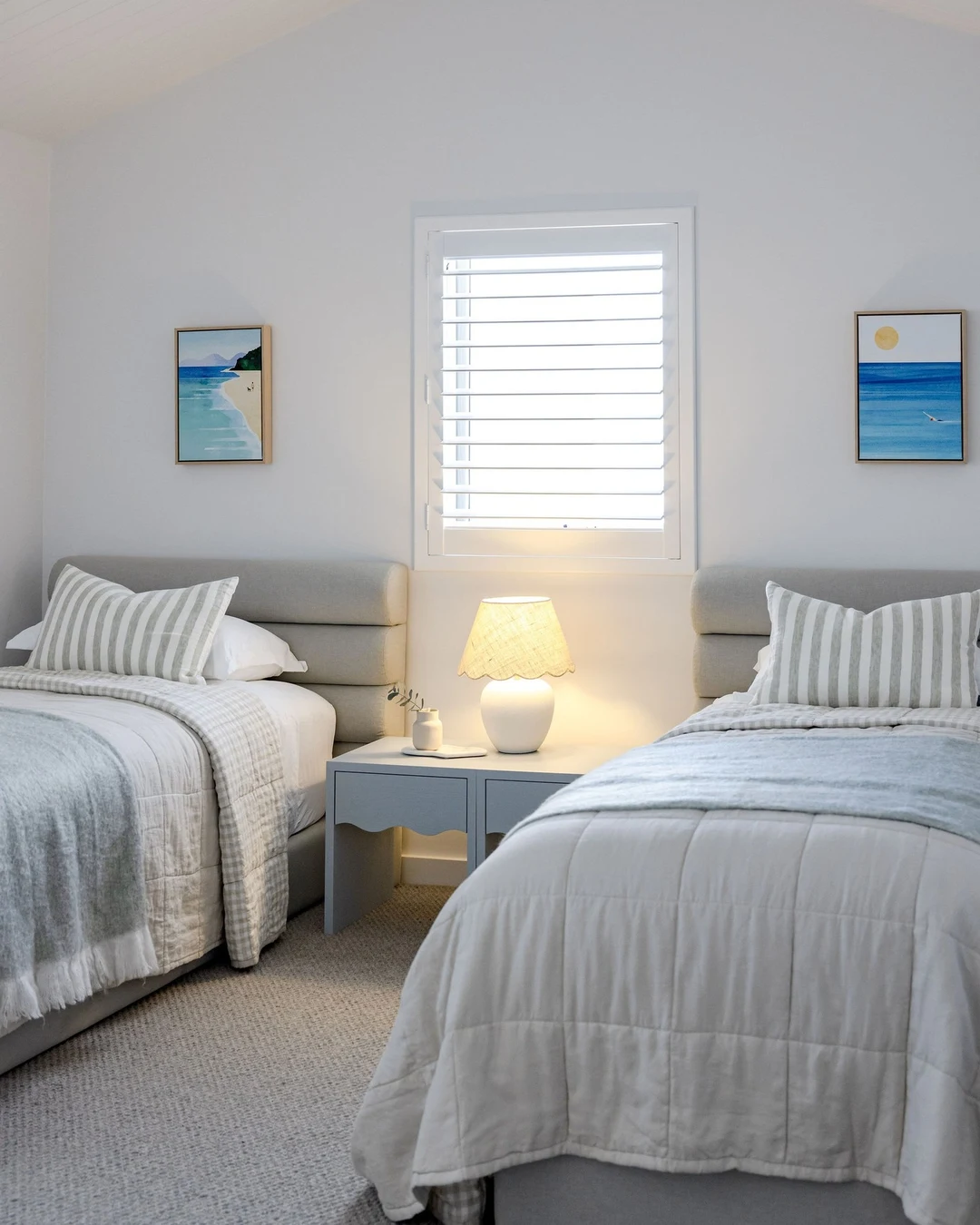
One nightstand between two twin beds is the hardest-working piece of furniture in the room. It holds both guests’ glasses, phones, books and water, so it needs to be reachable from either side without anyone stretching. A small light-blue nightstand with a lit scalloped-shade lamp and a vase of greenery does the job — and the window with white plantation shutters above it gives the whole arrangement a reason to be there.
Height matters more than width here. A nightstand that sits level with the top of the mattress lets a guest reach a glass of water half asleep; one that’s six inches too low means fumbling in the dark. Two framed coastal paintings flanking the window above keep the wall from feeling empty without crowding the lamp.
The practical point: aim for a nightstand 24 to 28 inches high — roughly mattress height — and no wider than 24 inches, so it doesn’t push the beds apart.
One Big Rug Under Both Beds
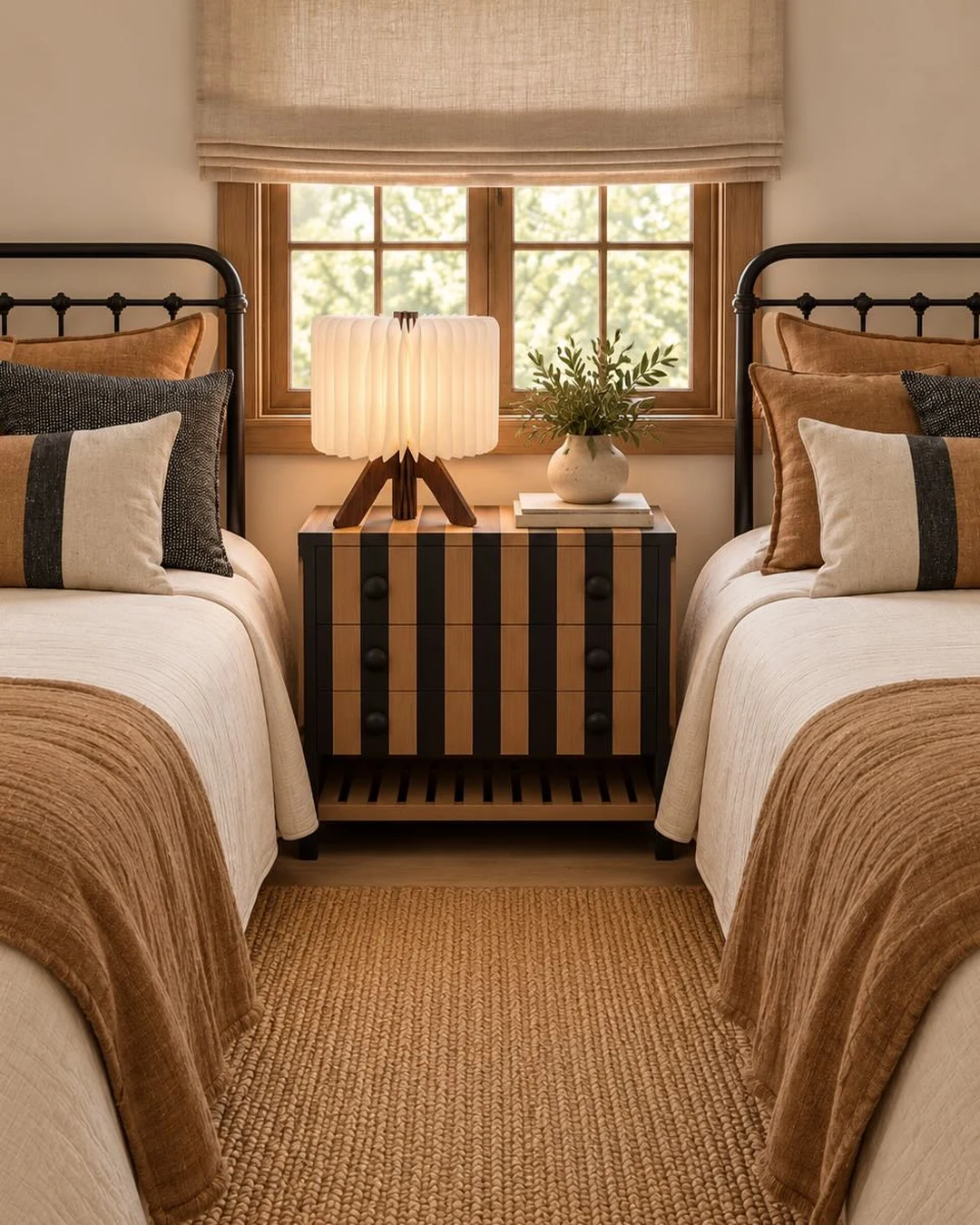
A rug that runs under both beds is the single easiest way to make a twin room feel like one room. A textured woven rug laid between the beds and under the foot of both pulls the two beds into the same frame, the way a frame pulls a picture together. Without it, each bed sits on its own island of bare floor and the room feels split.
Size it generously. The rug should extend at least 18 inches beyond the foot of both beds and at least a foot out on either side, so bare feet land on texture, not cold floor, when guests get up. A low pile works best — anything shaggy catches on the bed legs and shows every footprint. The striped nightstand between the beds with its lit lamp sits on the rug too, which is exactly right: everything in the room should belong to the rug, not float beside it.
The practical point: measure the two beds together, then add 36 inches to the length and 24 to the width. That’s your rug size — anything smaller will look like a runner that got lost.
Hang a Picture Above Each Bed
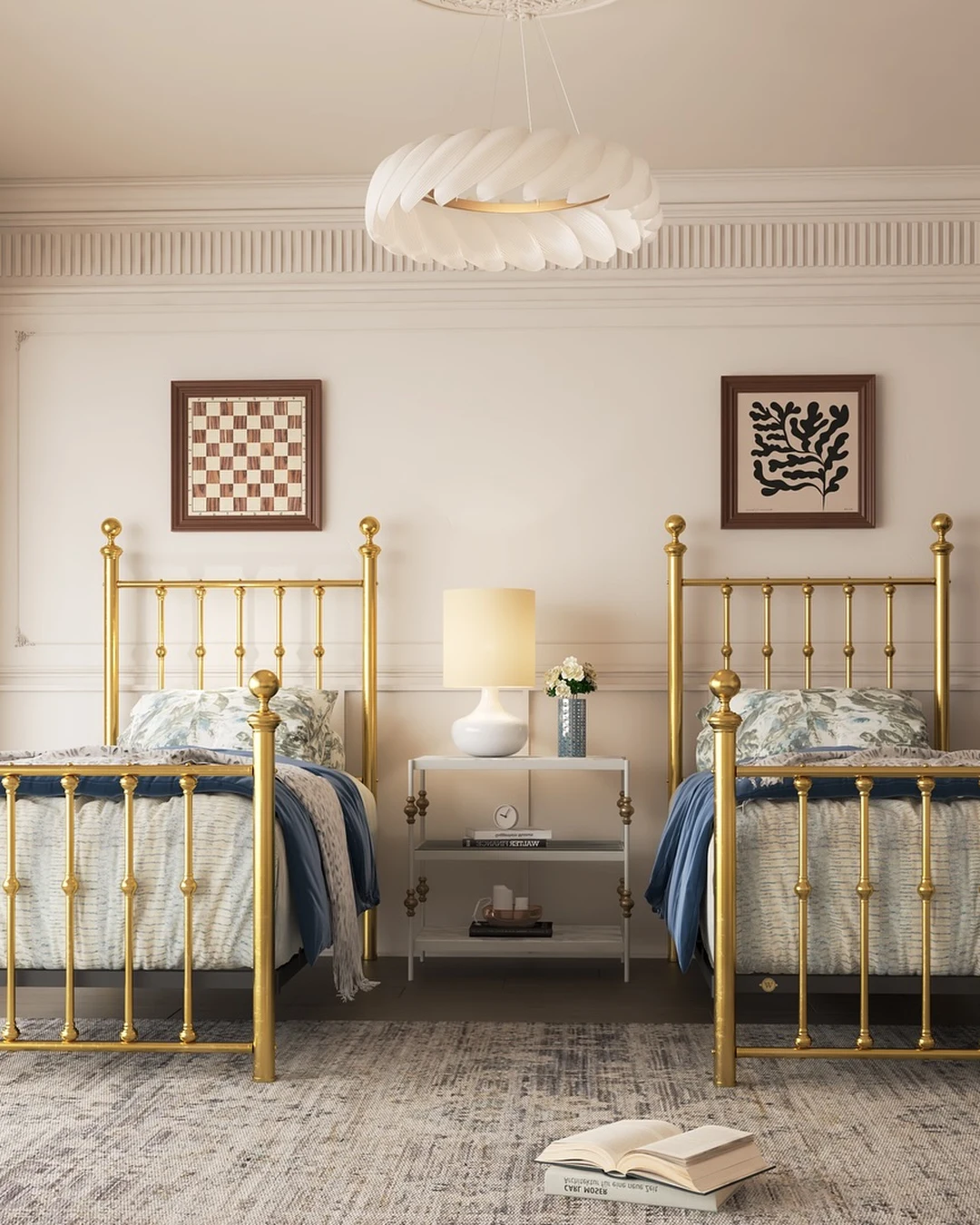
Two beds, two pictures — but not the same picture twice. A checkerboard print above one bed and an abstract botanical above the other, both in the same gold frame, gives each bed its own personality while keeping the pair visually related. The frames match; the art doesn’t. That’s the whole idea, and it’s what stops the room from feeling like a showroom.
Keep the frames the same size and hang them at the same height — the centre of each picture about 57 inches from the floor, or roughly eye level from the bed. Different subjects are fine; different sizes are not, because the eye reads size before it reads subject. A small nightstand between the beds with a lamp and a vase of flowers anchors the gap, and the large rug in front of the beds gives the whole wall something to stand on.
The practical point: if you can’t find two pictures you love, use two prints from the same series. Same artist, same palette, different images — the pairing does the work for you.
Give Each Bed Its Own Reading Light
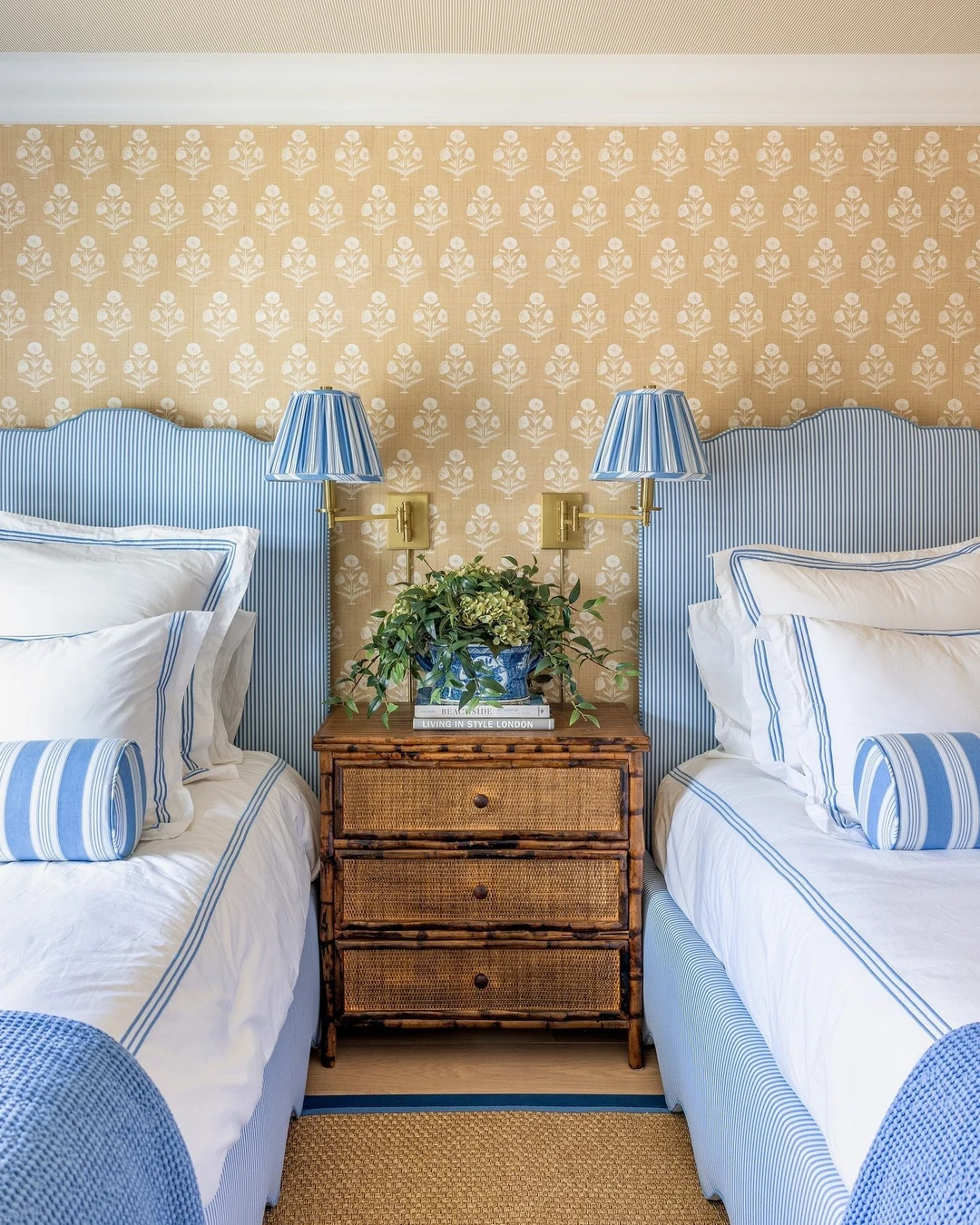
Nothing says “this bed is yours” like a light you control yourself. Two brass swing-arm sconces with striped shades, one mounted above each bed, let each guest read without lighting up the whole room — and without waking the person in the other bed. Swing arms matter: a fixed sconce lights the wall, a swing arm lights the page.
Mount them about 30 inches above the mattress, and a little toward the outer edge of each bed, so the light falls on the book and not on the other sleeper’s face. A blue-and-white ceramic planter with greenery on the nightstand between the beds fills the middle of the wall without competing with the sconces. If the room has a ceiling light, put it on a dimmer — the sconces should be the lights guests actually use.
The practical point: choose sconces with their own switch on the fitting. A guest who has to get out of bed to turn the light off will simply leave it on all night.
Benches at the Foot of Each Bed
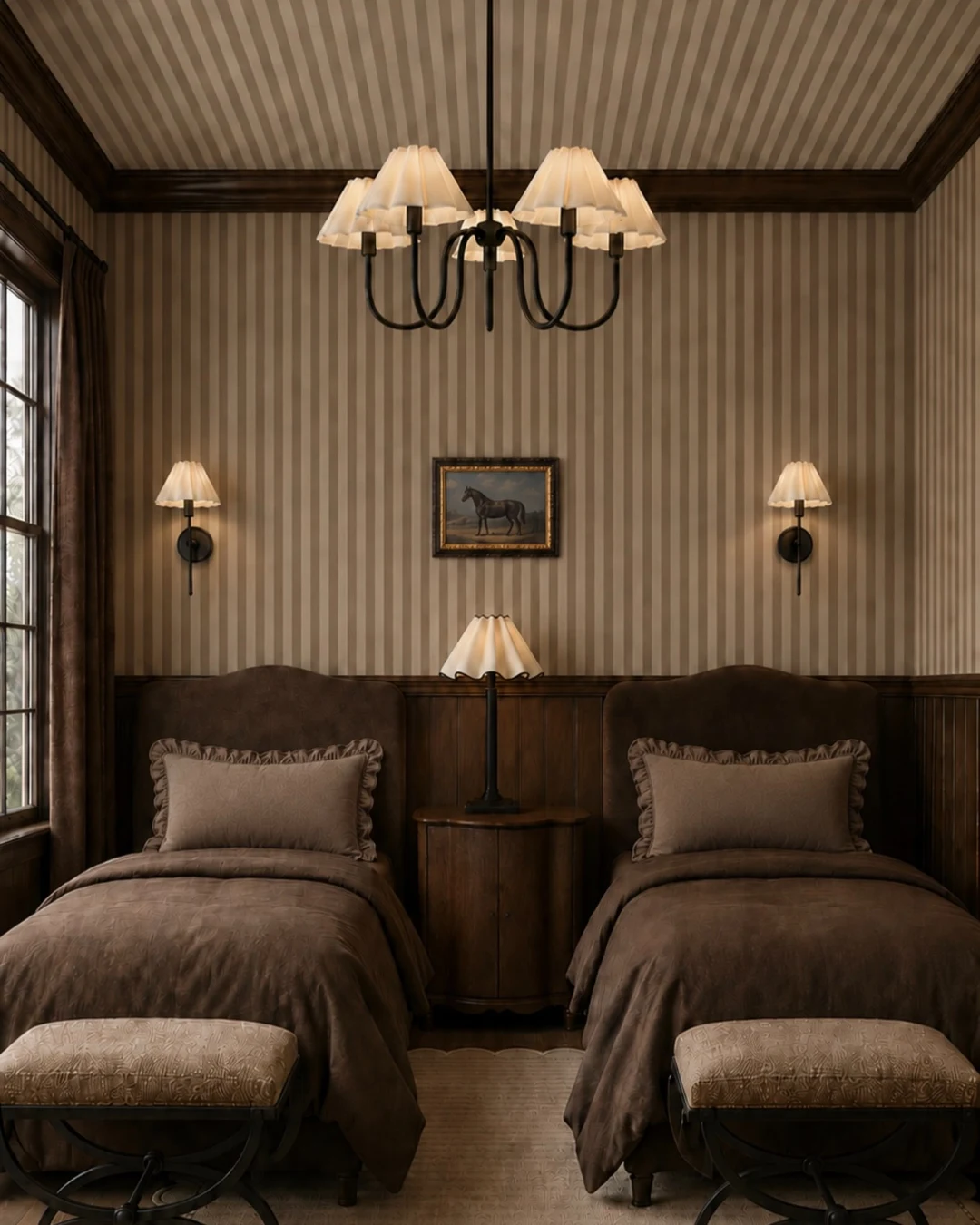
A bench at the foot of each bed is the piece guests use most and notice least. It’s where the suitcase goes, where the tray sits, where the book waits for morning. Two matching upholstered benches with dark metal frames, one at the foot of each bed, give the room its finished edge — without them, the beds end at the covers and the room feels undressed.
Match the benches to each other, not to the beds. Same bench, same fabric, same frame — the repetition is what makes the pair look intentional. Keep them low, about the height of the mattress, so they don’t block the bed or loom over it. And leave the top clear: a bench piled with cushions is a bench no one can use.
The practical point: a bench 36 inches wide fits a twin bed without sticking out past the sides. Anything wider starts to crowd the walkway between the beds.
Curtains That Frame the Whole Wall

Floor-to-ceiling curtains change a twin room more than almost anything else you can hang. Sheer white curtains across the whole window wall, with heavier drapes pulled to the sides, frame the room the way a picture frame frames a print — and they make the ceiling feel taller, which matters in a room with two beds in it. The pink vertically-panelled wall behind the beds and the soft chandelier above do the rest, but the curtains do the heavy lifting.
Mount the rod as close to the ceiling as you can, not at the top of the window. Curtains hung from the ceiling line make the wall feel taller; curtains hung from the window frame make it feel shorter. Let the sheers fall all the way to the floor, even if the windows stop short — the extra length is what gives the room its softness. If the room gets morning sun, line the sheers with a blackout layer on a second rod, so guests can sleep past sunrise.
The practical point: buy curtains at least twice the width of the window wall. Skimpy curtains pulled flat look like a sheet; full curtains gathered at the sides look like a room that was finished.
One Dresser, Shared by Both Guests
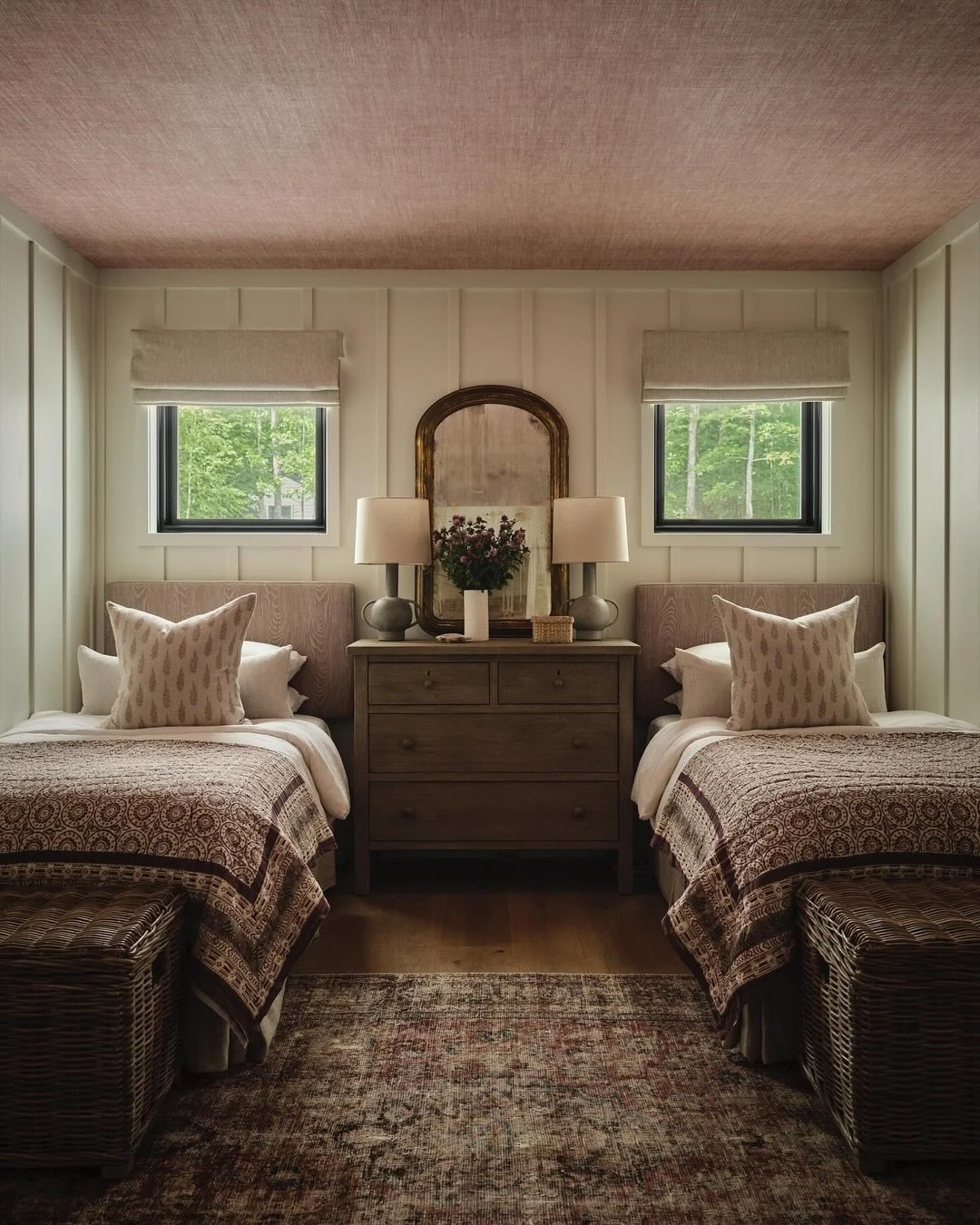
A dresser between two twin beds is the sharing made visible. One central wooden dresser, topped with two lamps, a mirror and a vase of flowers, gives both guests the same storage without either one owning it. It’s the piece that says the room was set up for two people, not one person with an extra bed.
Split it fairly. Top drawers: one each. Or split it by side — left half for one guest, right half for the other — and say so, because guests won’t guess. Keep the top mostly clear: two lamps and a vase are enough, and anything more turns the dresser into a display shelf nobody wants to touch. The wicker benches at the foot of each bed and the patterned quilts do the decorating; the dresser does the work. If the rest of the guest room needs the same treatment, these guest room decorating ideas cover the bedding, the tray and the welcome touches that make a guest room feel finished.
The practical point: a dresser 36 to 42 inches wide fits between two twin beds without pushing them apart. Wider than that, and the gap between the beds starts to feel like a corridor.
One Colour on Both Sides
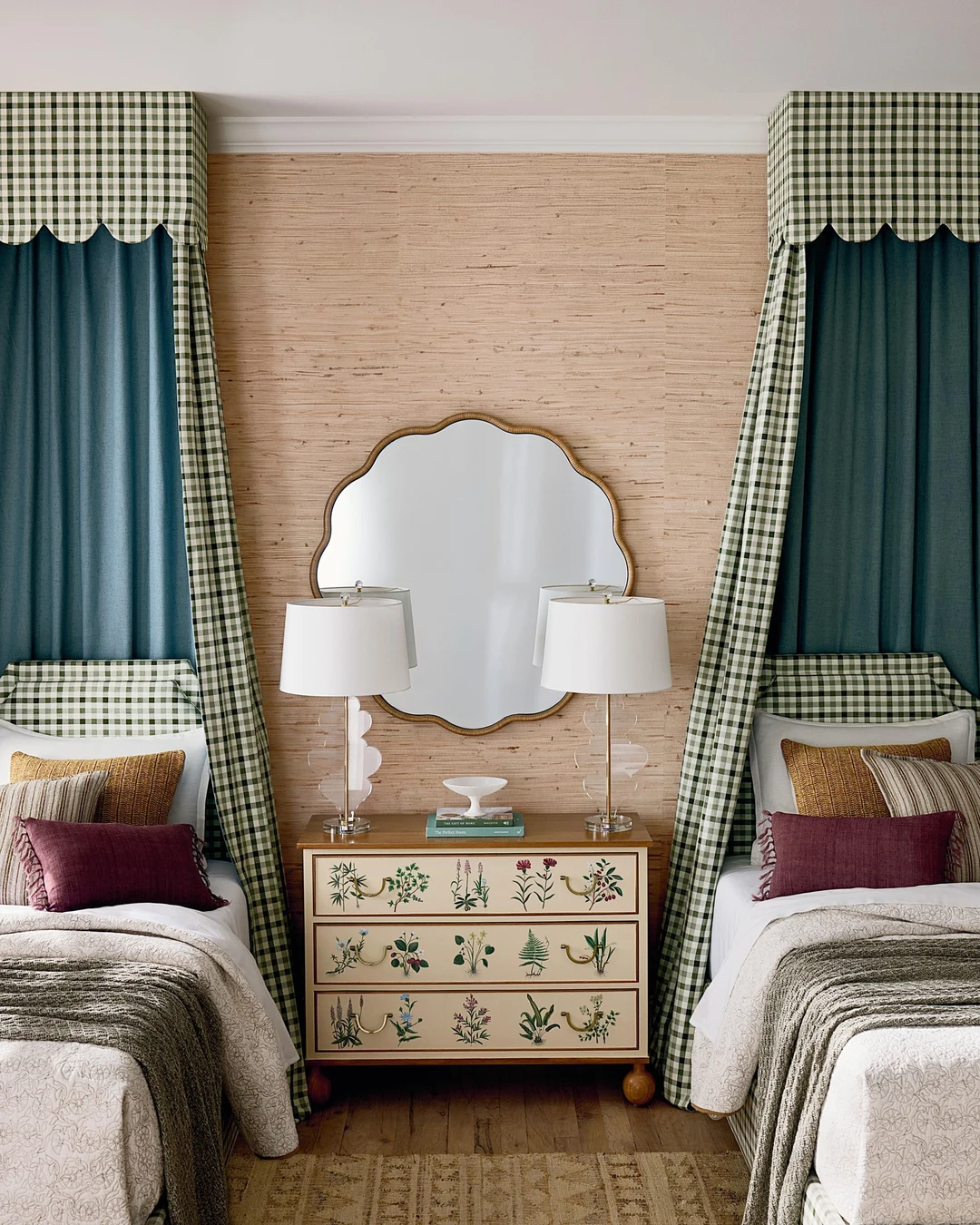
One colour, carried across both beds, is the simplest way to make a twin room look designed. Green-and-white gingham canopies, teal drapes and green upholstered headboards on both sides — the colour does the matching, so nothing else has to. The pillows can vary (mustard, burgundy, beige) because the green holds the room together underneath them.
Pick a colour with enough range to play with. Green works because it comes in gingham, velvet, linen and paint without looking like the same green twice. A single flat colour repeated exactly on both beds reads as a uniform; a colour family — deep teal drapes, olive throws, pale green headboards — reads as a design. The ornate scalloped mirror above the nightstand and the grasscloth wallpaper behind it stay neutral, which is what lets the green be the star.
The practical point: choose your colour first, then buy everything in its family. Three shades of one colour look richer than three different colours that happen to match.
Tuck a Small Writing Desk Between the Beds
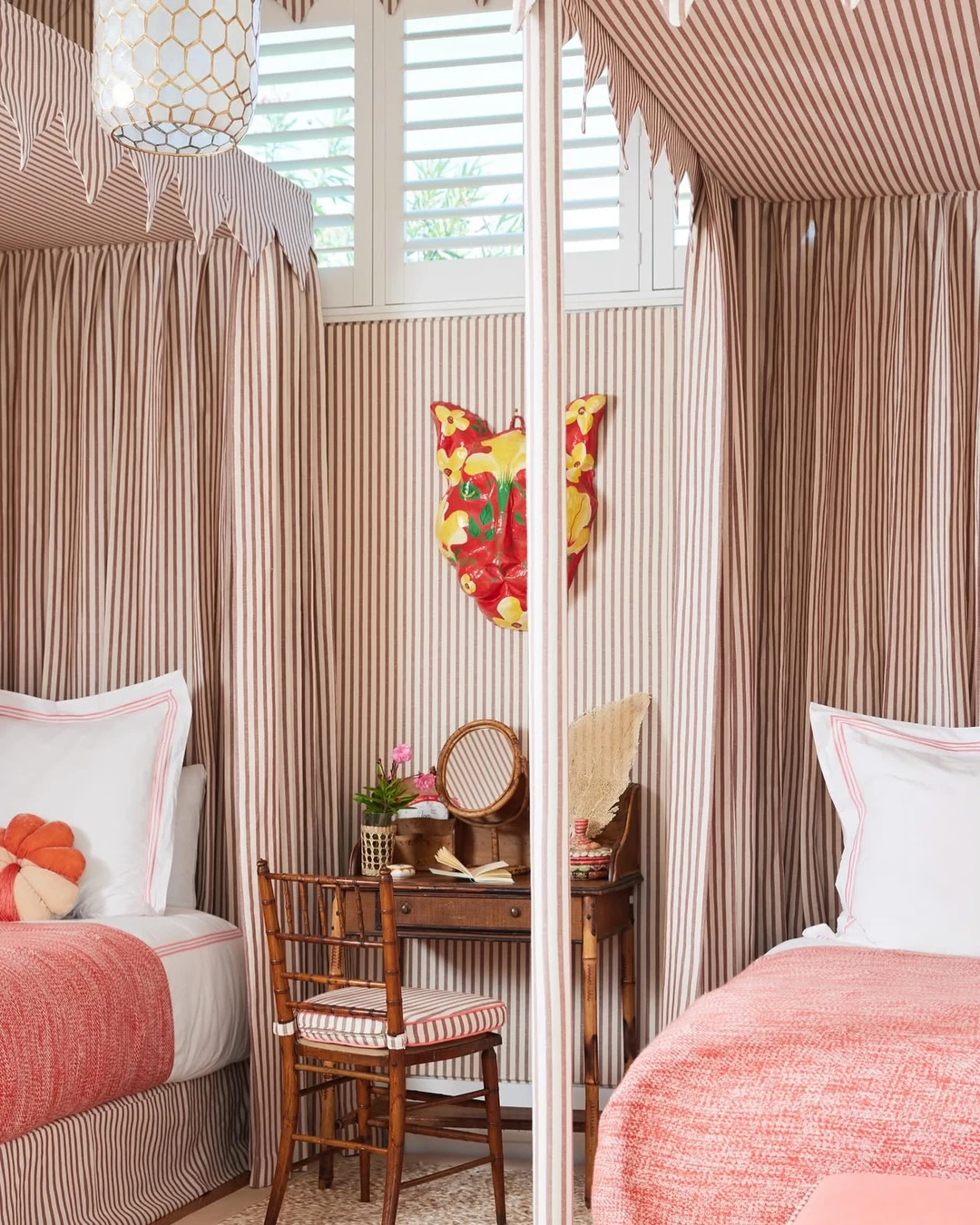
A small desk between two twin beds is the surprise that makes guests love the room. An antique-style wooden writing desk with a round mirror, an open book and a potted plant, tucked between two canopy beds with coral throws, gives the room a place to sit that isn’t a bed. Guests use it for morning coffee, for a postcard, for the five minutes of quiet before the day starts.
Keep it small — a desk 30 inches wide is plenty, and anything bigger starts to push the beds apart. A chair with a striped cushion that slides fully under the desk matters more than the desk itself, because a chair sticking out into the walkway is a chair someone will trip over. The butterfly-shaped wall sculpture above the desk and the shuttered window behind it make the corner feel like a destination, not a leftover.
The practical point: a writing desk only works if it has a lamp or a window. A desk in a dark corner is a desk nobody uses — put it where the light already is.
Keep a Carafe on the Shared Nightstand
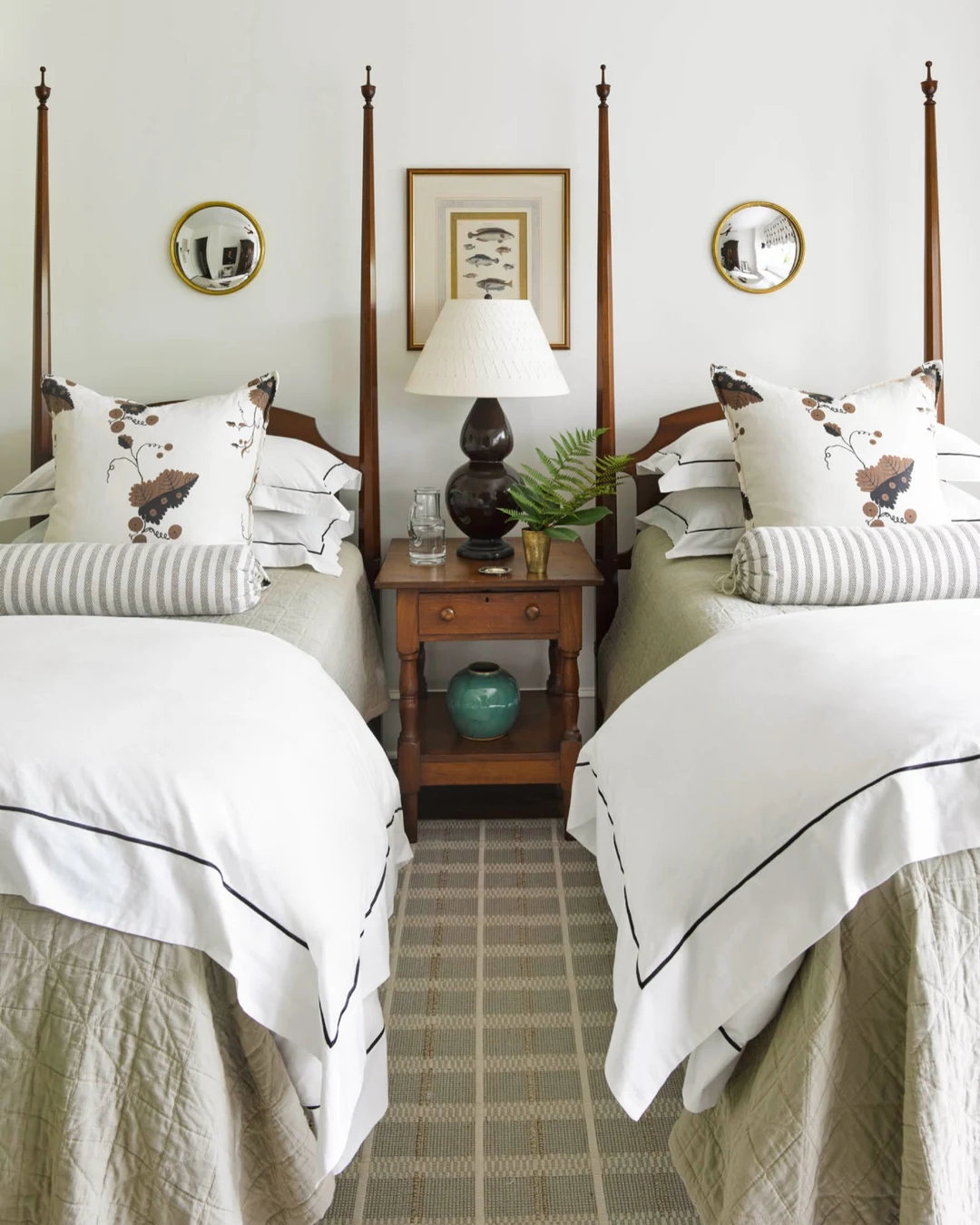
A glass water carafe on the shared nightstand is the smallest gesture in this room and the one guests remember most. Two four-poster twin beds, a dark ceramic lamp, a small potted fern — and between them, a carafe of water with a glass, so nobody has to get up in the night or knock on a door to ask. It costs almost nothing and it says the room was set up by someone who has actually stayed in a guest room.
Use glass, not plastic, and keep it small — a carafe that holds two glasses of water is enough, and a bigger one gets knocked over. Put a small tray or a folded cloth underneath it, because a wet ring on a wooden nightstand is the opposite of the welcome you meant. The turquoise vase on the lower shelf and the framed fish print above the nightstand do the decorating; the carafe does the caring.
The practical point: fill the carafe fresh every evening and put a clean glass beside it. A dusty carafe is worse than no carafe at all — it tells guests the room hasn’t been touched since the last visitor.
Mirror on the Wall Facing the Beds
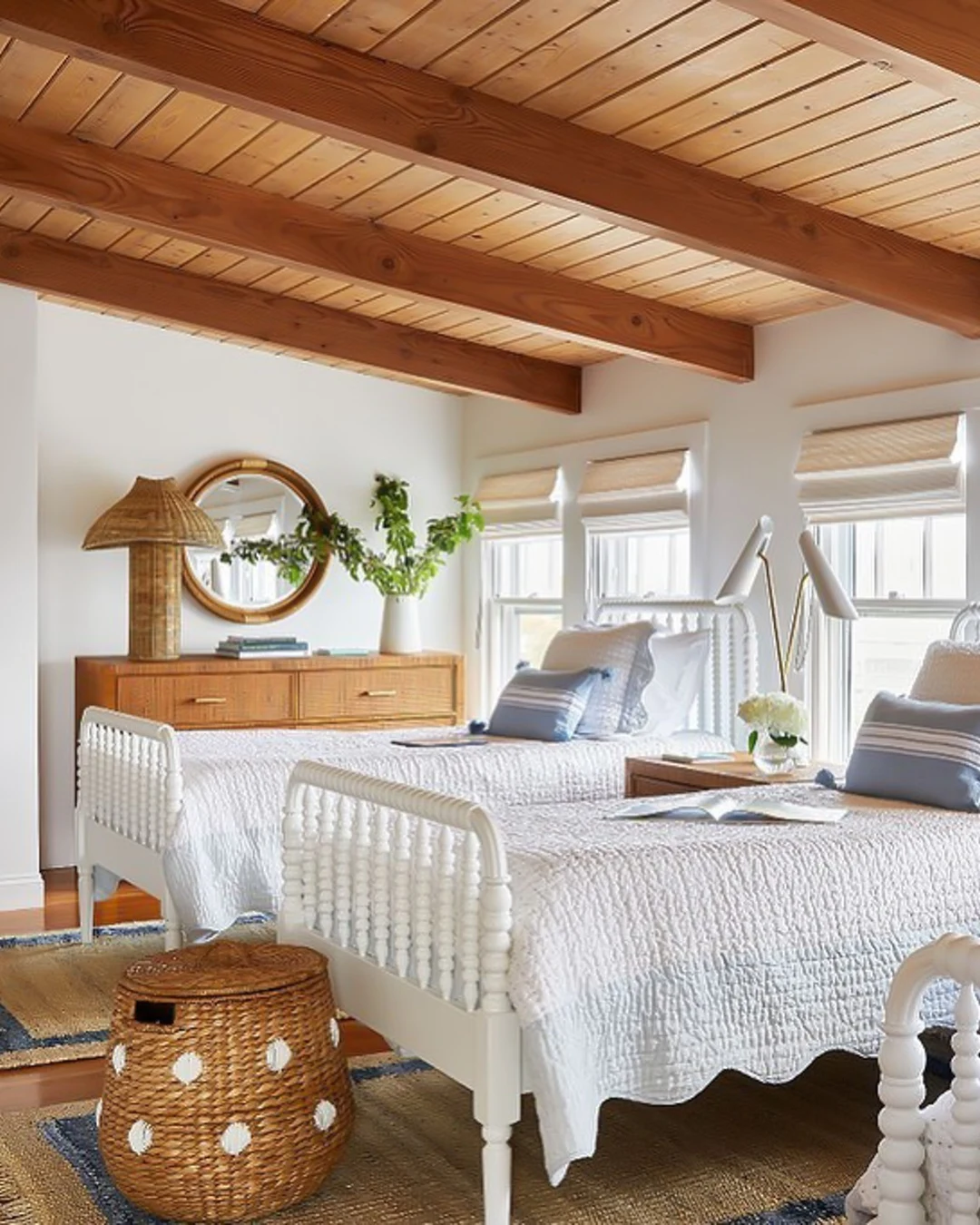
A mirror on the wall facing the beds does two jobs at once: it gives guests somewhere to check themselves in the morning, and it bounces light back across the room so the twin beds don’t feel cramped. A large round mirror with a rattan frame, above a wooden dresser on the far wall, catches the windows behind the beds and doubles the light in the room. The white spindle beds, the wood-beamed ceiling and the jute rug all stay calm — the mirror does the brightening.
Hang it where it reflects something worth seeing: a window, a plant, the best wall in the room. A mirror that reflects a blank wall or a closed door just doubles the blankness. Round works better than rectangular here, because the room is already full of straight lines — two beds, a dresser, a rug — and a circle breaks the grid without breaking the calm.
The practical point: hang the mirror so its centre sits about 60 inches from the floor. Too high and it reflects the ceiling; too low and it reflects the beds.
Two Throws, Two Colours
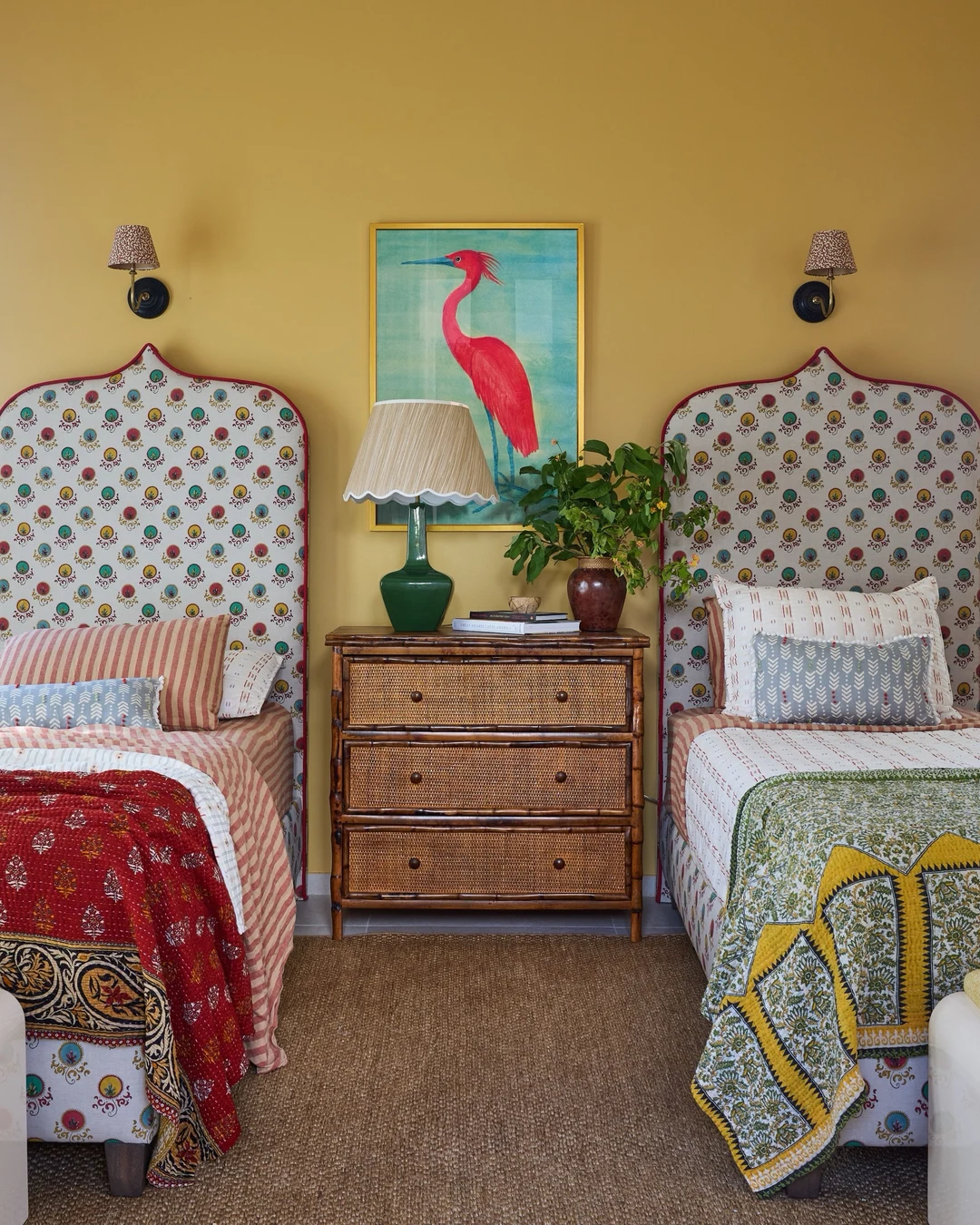
Two throws, two colours — one per bed — is the boldest idea in this room, and the easiest to get wrong. A red ornate throw on the left bed and yellow-and-green bedding on the right, against a mustard-yellow wall with a pink heron painting above the nightstand, works because the colours are warm, saturated and confident. The throws are the same weight and the same size; only the colour changes. That’s what keeps it from looking like a mistake.
The rule is simple: same throw, different colour — never different throws in different colours, because then nothing matches at all. Pick two colours that share a temperature (both warm, like red and mustard, or both cool, like sage and slate) and let the wall colour sit between them. The yellow upholstered benches at the foot of each bed tie the two sides together, which is exactly what they need.
The practical point: if you’re nervous, start with throws in the same colour family — rust and terracotta, say — and move further apart next time. Bold is a habit, not a single purchase.
Space to Walk Between the Beds
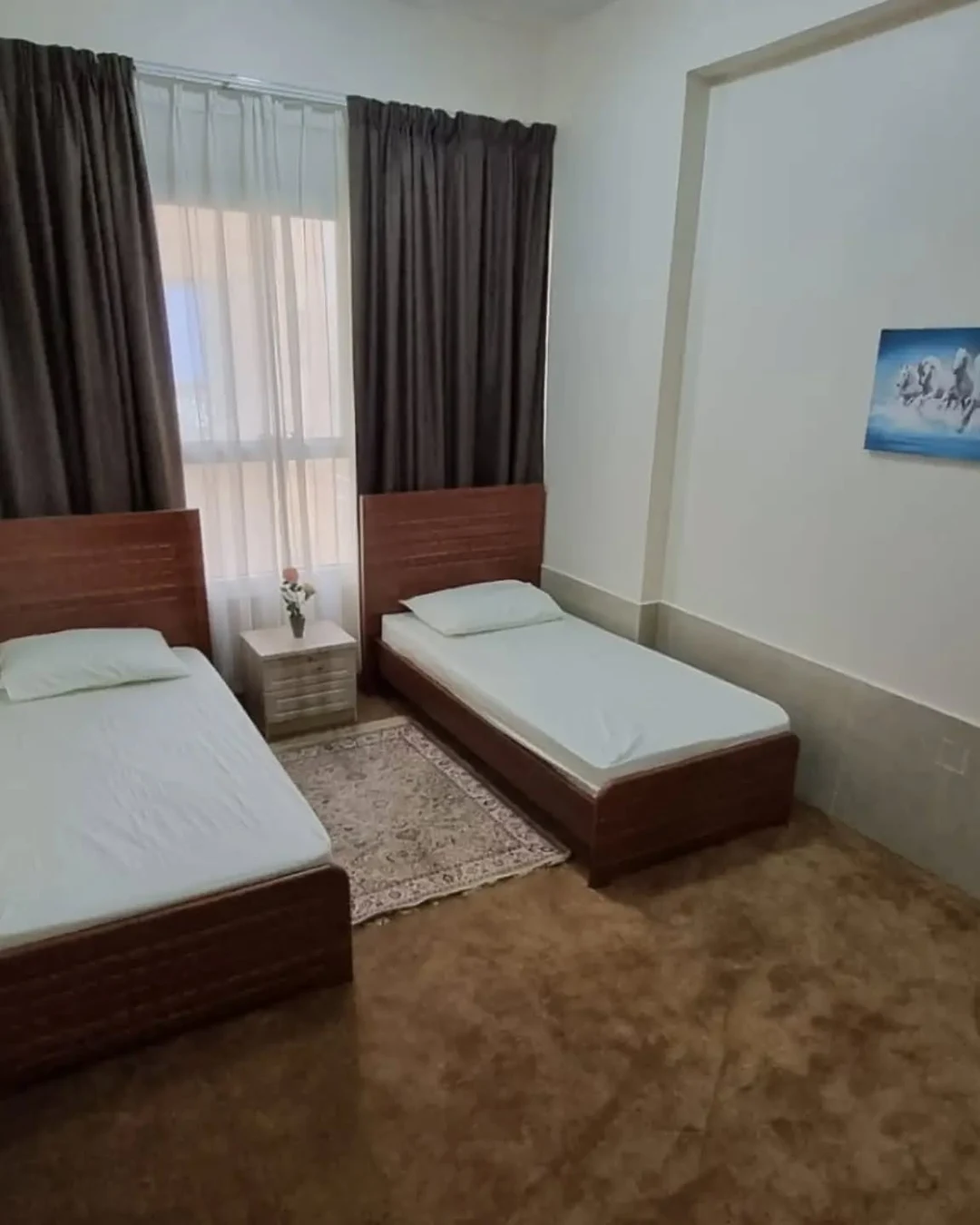
Nobody photographs the space between two twin beds, but everybody uses it. A clear gap with a small patterned rug marking the walkway, a nightstand with flowers between the beds, and enough room to pass without turning sideways — that’s what makes a twin room feel generous instead of cramped. Guests don’t remember the gap; they remember bumping into the bed in the dark.
Leave at least 24 inches between the beds, and 30 if the room allows it. Less than that and the nightstand between them becomes a wall; more than 36 and the beds start to feel like they’re in different rooms. A small rug in the gap marks the walkway and softens the floor, and the sheer curtains and heavy drapes at the window behind the beds keep the light soft at both ends of the day. If the room itself is tight, these ways to make a small bedroom look bigger help the gap read as breathing room, not wasted space.
The practical point: walk the gap yourself before guests arrive. If you have to turn sideways, the beds are too close — move them, even if it means a narrower nightstand.
A Room for Two, Made for Both
Two beds don’t have to mean twice the furniture and half the thought. One headboard wall, one shared rug, one dresser and one colour are enough to make the pair feel like a design instead of a doubling. The rest — the carafe, the reading lights, the bench at the foot of each bed — is what turns a room with two beds into a room made for two people. Set it up once, properly, and the next guest will feel it before they unpack.
Start with the headboard wall and the rug — those two do most of the work — then add the carafe and the reading lights before your next guests arrive. Two beds, one room, and neither one feeling like the spare: that’s the whole trick.