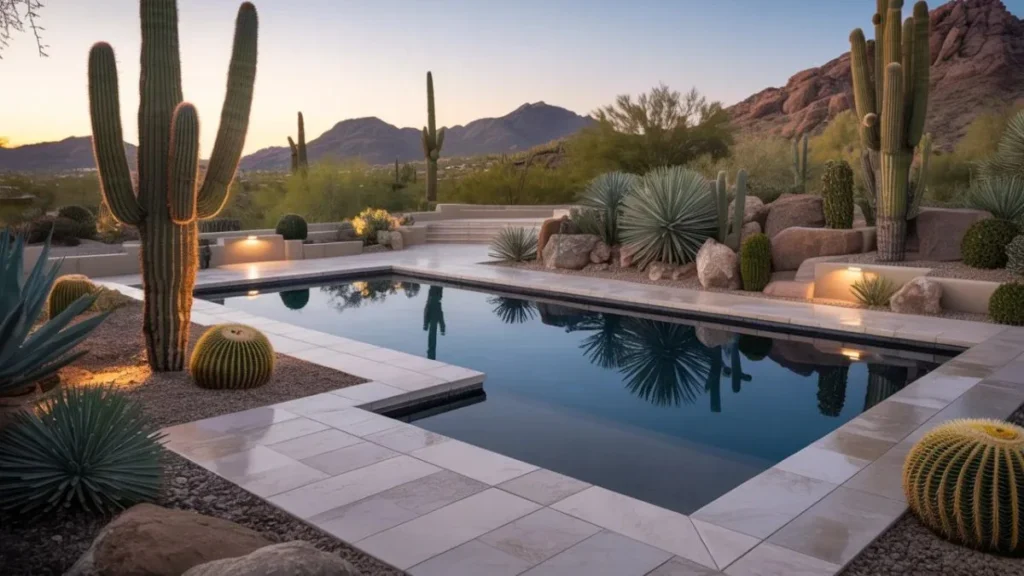
Most pool landscaping advice was written for green, rainy climates — and it shows. In the desert Southwest, the rules are completely different and ignoring that distinction is one of the most expensive mistakes a homeowner can make. Arizona’s top pool designers know this, and the results they produce — lush, resort-worthy backyards that barely need watering — prove that the desert is one of the most striking canvases for pool landscaping in the entire country.
Desert pool landscaping is about harnessing the natural drama of the environment rather than fighting it. Rugged boulders, architectural succulents, travertine stone that stays cool underfoot in 110°F heat — the materials and plants available to desert homeowners are genuinely extraordinary. You just need to know what the professionals reach for.
Here is what Arizona’s leading pool designers recommend, pulled from real projects and hard-won experience across the Sonoran Desert.
Why Desert Pool Landscaping Is Unlike Any Other Climate
The desert Southwest presents conditions that demand a completely different design philosophy from what works in the Southeast or Pacific Northwest. Temperatures regularly exceed 110°F, UV intensity is extreme, and water conservation is not just a preference — in many Arizona municipalities, it is a legal requirement.
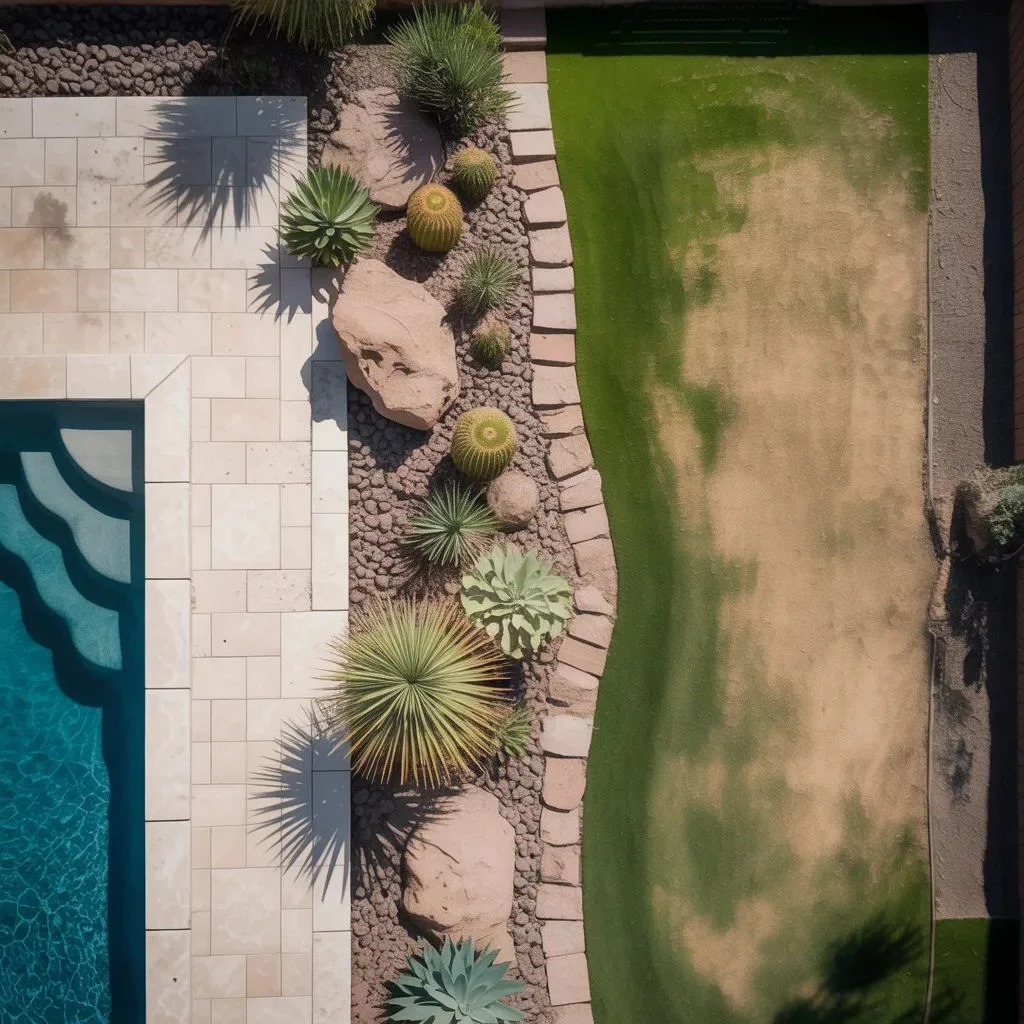
Standard lawn grass around a pool is a liability in this climate. It burns, turns brown for half the year, and consumes enormous amounts of water. Most experienced Arizona pool designers have stopped specifying it altogether, replacing grass entirely with hardscape, decomposed granite, artificial turf, and drought-tolerant plantings that look better than lawn ever did.
The other major factor is bee and insect management. Blooming flowers attract pollinators to pool water, which is dangerous for both bees and swimmers. Top Arizona designers deliberately specify plants that minimise flowering or place them strategically away from the pool’s edge.
Understanding these constraints is what separates a desert pool landscape that looks like a magazine shoot from one that is a constant source of frustration and maintenance.
The Plant Selection Secrets Designers Swear By
Plant selection is where desert pool landscaping separates great designers from average ones. The goal is a palette that looks lush and intentional without demanding irrigation systems running around the clock. Here is what Arizona’s top pool builders consistently reach for.
Succulents and Agave as Anchor Plants
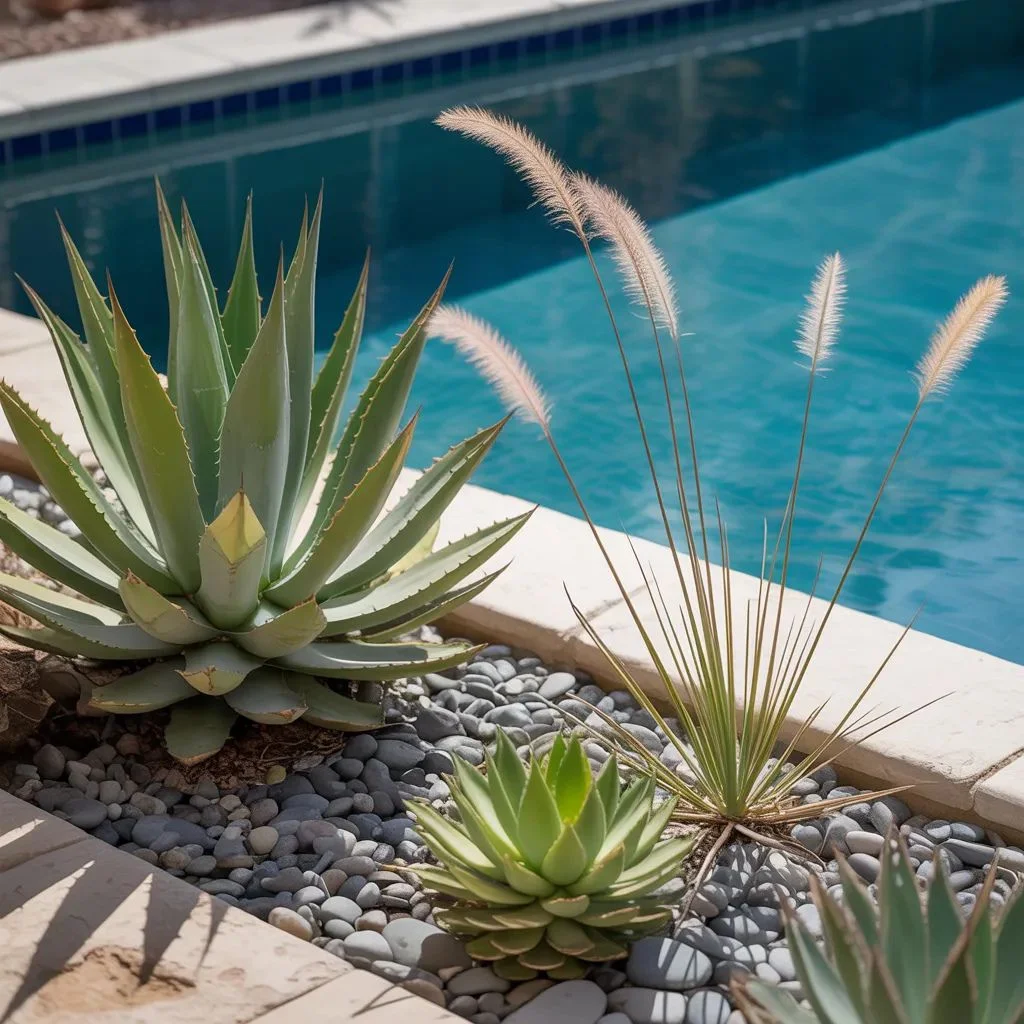
Agave and aloe vera are the backbone of almost every professional desert pool landscape. They are structural, sculptural, drought-hardy, and striking in scale. A large Agave americana flanking a pool entry creates the kind of dramatic focal point that would cost thousands to achieve with traditional landscaping.
Designers typically use a combination of sizes — large specimen agaves as anchors, medium aloe clusters for mid-layer interest, and small cacti varieties tucked into rock groupings at ground level. The layering creates depth and keeps the space from feeling flat.
Ornamental Grasses for Softness and Movement
One of the most underused plants in desert pool landscaping, ornamental grasses add the movement and softness that hard materials like stone and tile cannot provide. Mexican feather grass (Nassella tenuissima) is a favourite for its airy, wispy texture that catches desert breezes beautifully. Purple lily turf and bear grass are other reliable choices that experienced designers use to break up the hard edges of pavers and pool coping.
Trees for Shade — Chosen Very Carefully
Shade trees are essential in Arizona, but the choice of species makes or breaks a pool landscape. Trees that shed heavily create constant maintenance — leaves, seed pods, and debris clog filters and create safety hazards. The professionals avoid heavily shedding species near the water and prefer mesquite, palo verde, and select palm varieties like the Mediterranean fan palm or queen palm.
Palms offer height and tropical flair without the debris problem, and palo verde trees provide filtered shade and brilliant spring colour without the constant leaf litter of deciduous trees.
Colour Without the Bees
Arizona designers who want colour around pools reach for bougainvillea and lantana — both are vibrant, heat-tolerant, and relatively low-bee-attracting when positioned correctly. Dwarf evergreen shrubs and ornamental grasses are used at the pool’s edge, while colour-heavy plants are kept in planters or beds positioned a few metres away from the water.
Decking Materials That Stay Cool and Look Stunning
Pool decking in the Arizona desert must do two things well: stay cool enough to walk on barefoot and hold up to UV exposure and extreme temperature cycles. The professionals have a clear hierarchy of preferred materials.
Travertine: The Designer’s First Choice
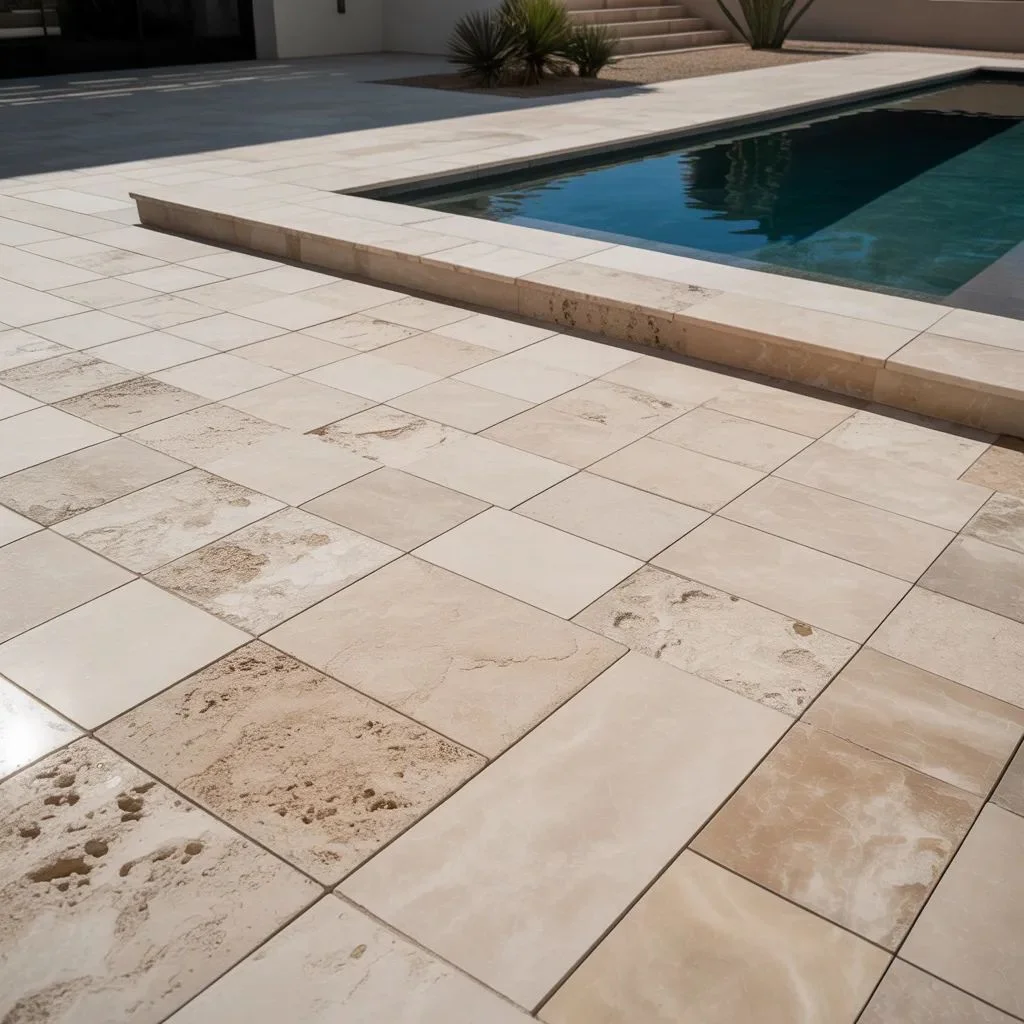
Travertine is the single most recommended pool deck material across Arizona’s premier pool companies. Its natural porosity keeps surface temperatures significantly lower than concrete or darker stones, and its warm earth tones blend seamlessly into desert surroundings. Biscotti, ivory, and walnut travertine tones are consistent favourites because they complement the sandy palette of the Sonoran Desert without clashing.
Large-format travertine pavers — 16×16 and 12×24 tiles — are the standard spec in high-end projects. The precision installation required for these larger formats is part of what elevates the finished look to a resort-level aesthetic.
Natural Flagstone and Pavers
For homeowners seeking a more organic, irregular look, flagstone and concrete pavers are strong alternatives. Natural flagstone has the advantage of looking as though it grew from the desert floor, which creates seamless continuity between the pool area and surrounding landscape. Pavers come in a wider variety of colours and sizes, offering design flexibility while remaining durable and practical.
Decomposed Granite and Gravel
Beyond the immediate pool surround, decomposed granite and gravel replace grass in most professionally designed desert pool landscapes. Apache Brown gravel and similar earthy tones are used extensively as ground cover, creating a clean visual that requires virtually no maintenance. The key is using larger-format specimen plants and boulders to break up the gravel fields so the space feels designed rather than neglected.
Artificial Turf as a Strategic Accent
Artificial turf is used selectively in desert pool landscaping — not as a replacement for the whole lawn, but as a targeted green accent that adds visual freshness without water consumption. Many designers use it to define a small lounging zone or play area adjacent to the pool, creating a barefoot-friendly surface that stays green year-round in Arizona’s brutal summers.
The Art of Using Boulders and Rocks Around a Pool
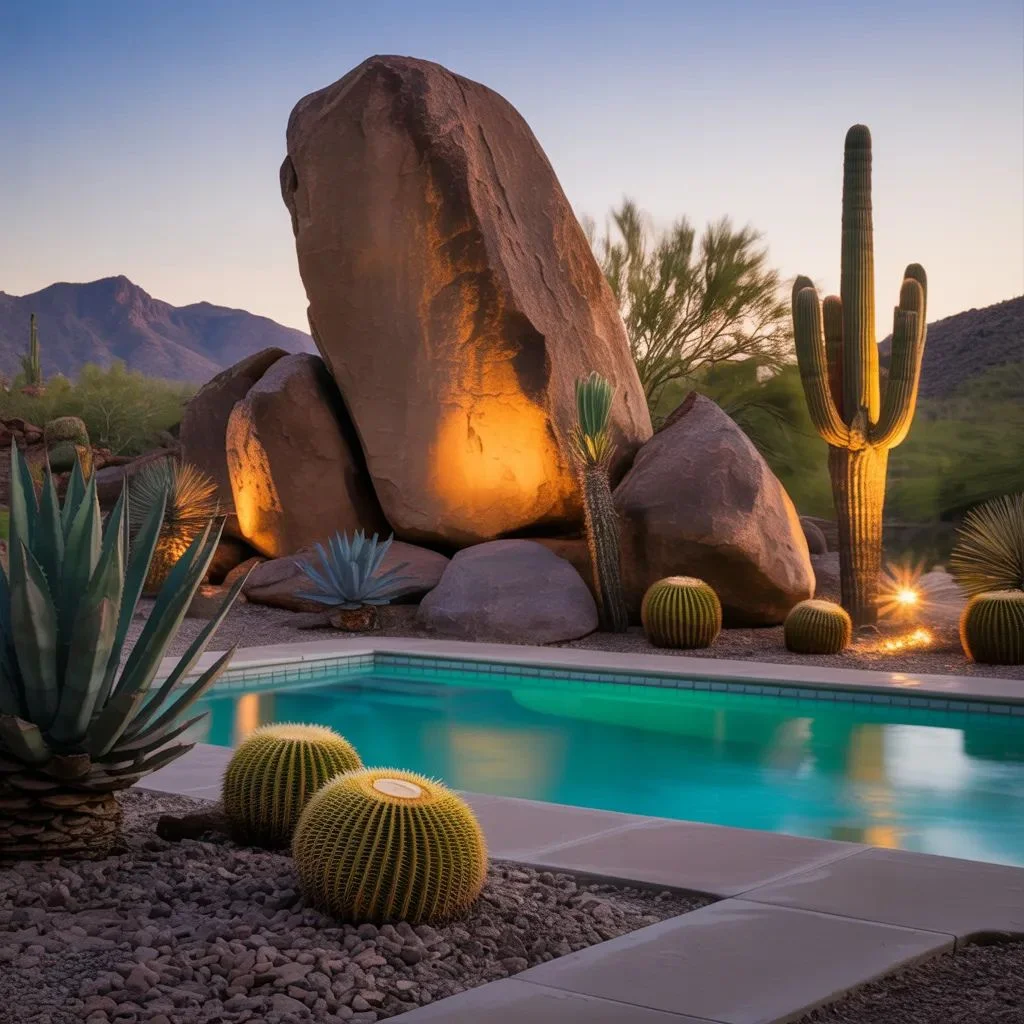
Nothing says authentic desert pool landscaping like the strategic placement of natural boulders. Arizona’s top designers do not scatter rocks randomly — they use them as landscape architecture, placing individual boulders and clusters with the same intention a sculptor would bring to a gallery piece.
Large boulders serve multiple purposes simultaneously: they create visual height and drama, they define zones within the yard, and they provide a natural counterpoint to the smooth geometry of the pool and pavers. A single statement boulder placed next to a towering agave becomes an art installation. A cluster of mid-size rocks nestled against a low wall creates depth and texture.
The scale relationship between boulders and plants is where designers develop genuine skill. In desert pool landscapes, matching a large boulder with a large specimen plant — rather than surrounding it with small groundcover — creates the proportional drama that makes a project feel professionally conceived rather than assembled.
River rock paths are also a consistent feature in top Arizona projects. A winding river rock path through decomposed granite breaks up the ground plane beautifully, adds tactile interest, and guides the eye through the landscape in a way that feels both natural and intentional.
Water Features That Actually Work in the Desert
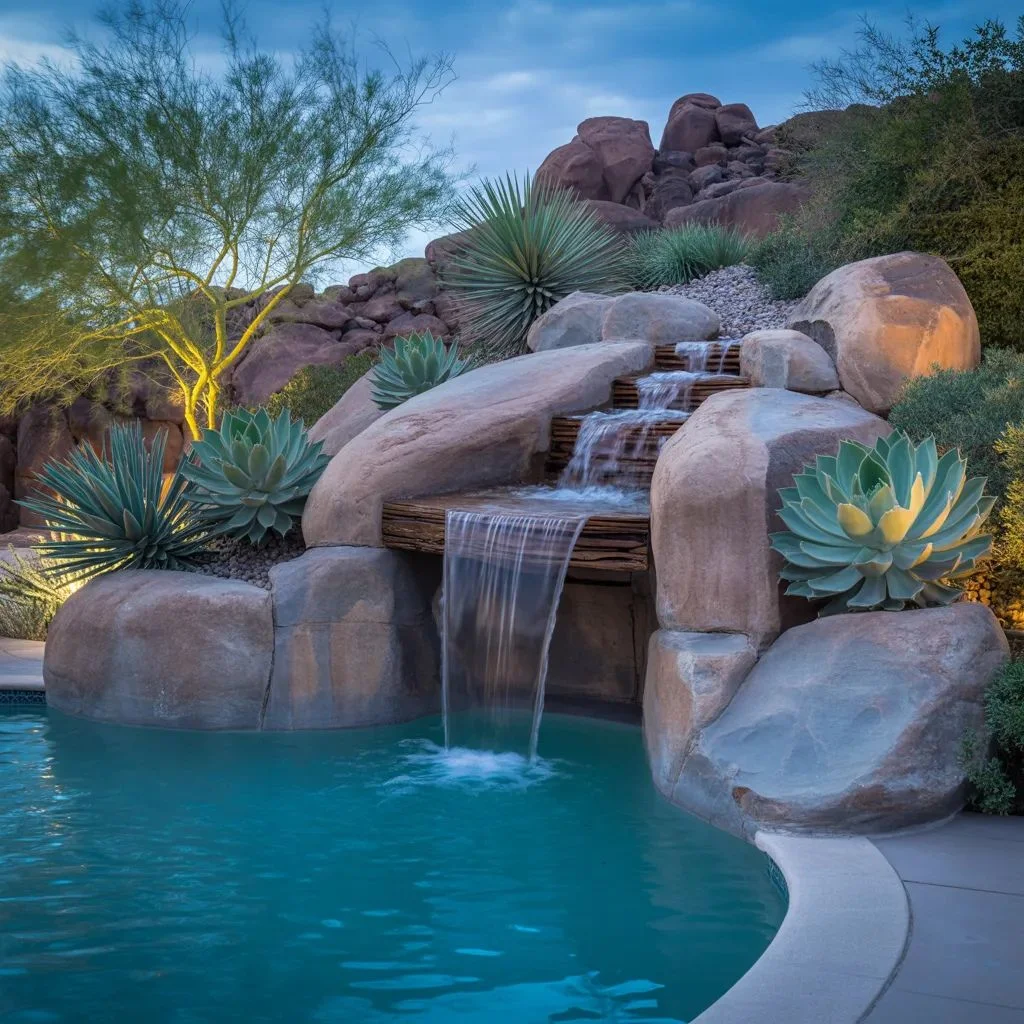
Water features in a desert pool landscape are not purely decorative — they serve a functional cooling purpose through evaporation, creating a slightly lower ambient temperature in the immediate pool area. In Arizona’s extreme summers, this microclimate effect is a genuine benefit that experienced designers factor into their specifications.
Natural Stone Waterfalls
The natural rock waterfall is a staple of Arizona’s best pool projects. Built to appear as though water emerges organically from the desert landscape, these features blend seamlessly with boulder arrangements and desert plantings while adding the soothing sound of moving water. The most sophisticated versions use boulders to create a cascade that feeds into the pool, concealing the spa or raising it above the water level for dramatic effect.
Raised Spillway Spas
One of the most popular design moves in high-end desert pool landscaping is the raised sit-and-spin spa positioned above the pool. Elevated anywhere from one to three feet above the pool water level, the spa creates a natural spillway into the pool, functioning as a beautiful water feature while also giving spa users elevated views of the surrounding desert landscape and any mountain scenery beyond.
Simple Fountains for Smaller Budgets
Not every project has the budget for a boulder waterfall. A sleek, simple fountain that creates a calming trickle can still provide the acoustic benefit and cooling effect of moving water without the construction complexity. In a desert pool setting, the principle of ‘less is more’ applies to water features just as much as it does to plantings — a single elegant fountain outperforms a cluttered arrangement every time.
Shade, Privacy, and the Structures That Deliver Both
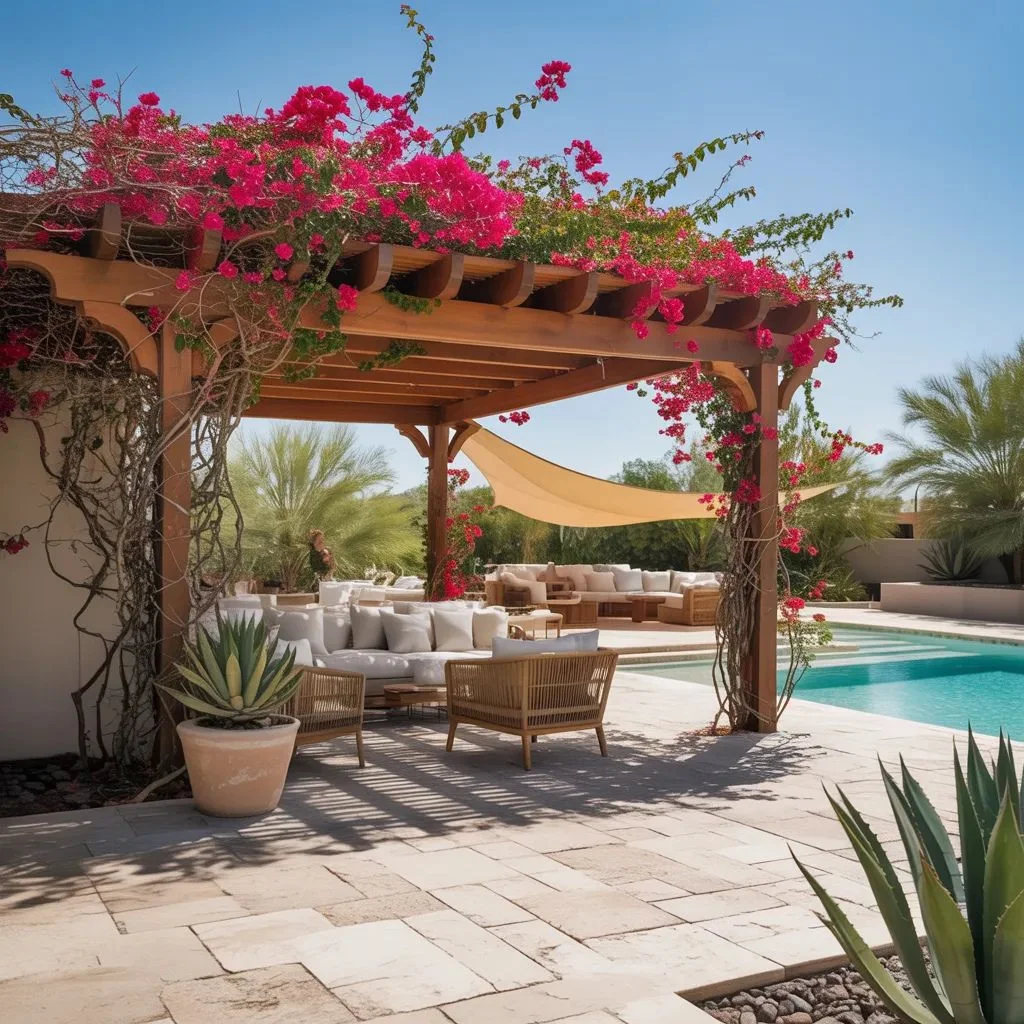
Shade is not optional in Arizona — it is a design necessity that affects how much the pool area is used. A beautifully landscaped backyard that offers no relief from the sun will sit empty during the most usable hours of the day. Top designers address this from the start rather than treating it as an afterthought.
Pergolas and shade sails are the most common structural solutions. They provide significant UV protection while maintaining an open, airy feel that keeps the space from feeling enclosed. When paired with climbing bougainvillea or draped with outdoor fabric, pergolas become both functional and visually striking in a desert setting.
For privacy, bamboo screens, tall ornamental grasses, and privacy hedges are used to create secluded spaces without requiring a solid wall. Pygmy palms are a consistent recommendation from experienced Arizona designers — they provide height and screening without excessive root spread or debris around the pool area.
Built-in shade structures like extended patio roofs and ramadas are increasingly popular in premium desert pool projects. They create defined outdoor rooms that protect furniture, electronics, and guests from direct sun while framing views of the pool and landscape beyond.
Lighting Your Desert Pool Landscaping for Day and Night
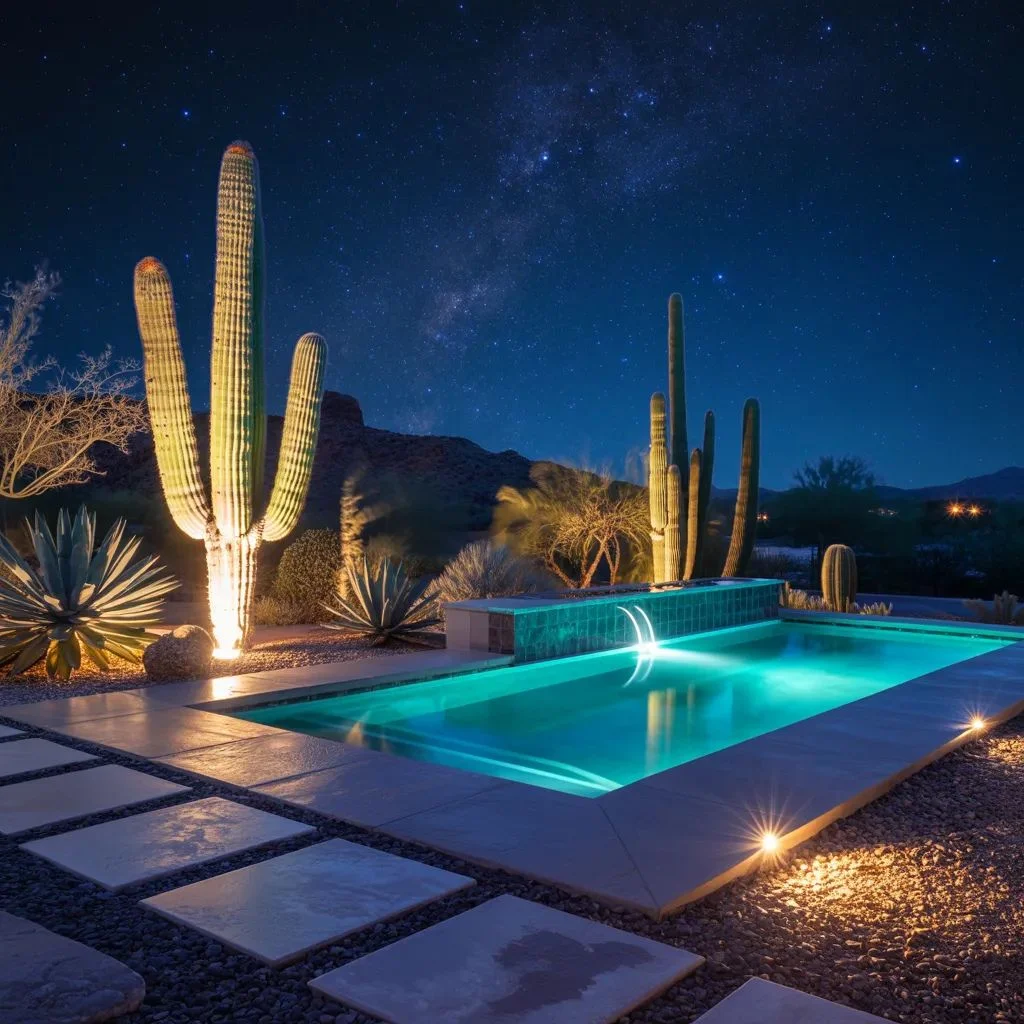
The best Arizona pool designers will tell you that lighting transforms a desert pool landscape from beautiful to extraordinary. The desert’s clear night skies and dramatic topography create perfect conditions for lighting design that makes the backyard feel like a completely different — and arguably more stunning — space after dark.
Uplighting is the signature technique in desert pool landscaping. Desert plants with uplighting become sculptural silhouettes against the night sky — a saguaro cactus bathed in warm light, an agave casting geometric shadows across travertine pavers, a row of palms glowing along the pool’s edge. These are the images that professional desert landscaping projects are built around.
Boulders are another prime candidate for uplighting. LED rock lights positioned at the base of large boulders give the stones a dramatic presence after dark and define the edges of planting beds and pathways without requiring additional landscape structures.
For the pool itself, interior LED lighting allows water colour to be adjusted to suit the mood or occasion. Many Arizona projects pair a Sapphire Sea Glass or Electric Blue pool interior finish with LED lighting that deepens the water’s colour at night, creating a glowing centrepiece that can be seen from inside the home.
Path lighting along travertine walkways, understated step lights on raised spa edges, and subtle string lights over covered entertaining areas complete the layered lighting approach that makes desert pool spaces genuinely usable and visually spectacular after sunset.
Low-Maintenance Design Principles the Pros Follow
The best desert pool landscapes do not just look effortless — they are genuinely low effort because the professionals build ease of maintenance into every design decision. Here are the principles that Arizona’s top pool designers consistently apply.
- Choose trees that do not shed: Mesquite, ash, and select palm varieties drop minimal debris into pool water. Heavily shedding trees are placed well away from the pool edge or avoided entirely.
- Minimise bee-attracting plants near water: Dwarf evergreen shrubs, ornamental grasses, and non-blooming plants at the pool’s perimeter reduce insect issues substantially.
- Use drip irrigation, not spray systems: Drip systems deliver water directly to plant roots with minimal evaporation, supporting drought-tolerant plantings without wasting water or wetting pool decking.
- Select drought-resistant native plants: Native and adapted plants — agave, aloe, desert willow, palo verde — thrive on minimal supplemental water once established, cutting irrigation costs dramatically.
- Incorporate decomposed granite over traditional lawn: Replacing water-guzzling grass with granite, gravel, or artificial turf eliminates the single largest maintenance and water burden in most desert backyards.
- Design for drainage: Proper grading and drainage planning prevents pooling water around plant beds and hardscape, protecting both the landscape and the pool structure.
Your Desert, Your Oasis — Make It Count
Desert pool landscaping is not about making the best of a difficult climate — it is about using one of the world’s most dramatic landscapes to your full advantage. The boulder-studded terrain, the architectural plants, the warm earthy tones of travertine and granite, the star-filled skies that make night lighting so spectacular — these are assets that landscapers in greener climates would envy.
The secrets Arizona’s top pool designers carry are not complicated: choose plants for structure, texture, and drought-tolerance rather than water dependency; pick decking materials that beat the heat; use boulders intentionally; light the space for evening drama; and build in low maintenance from the very first design decision.
Follow those principles and your desert pool landscape will not just survive the Arizona climate. It will thrive in it — and look better for it.
Recommended: Your Front Door Deserves Better: Summer Deco Mesh Wreaths That Deliver All-Season Wow.