That awkward triangle under your stairs is the hardest spot in the house to get right. Done well, it swallows the TV, the boxes and the cables — and the whole room finally feels calm.
Most living rooms hand you one obvious wall for the television. A staircase wall hands you a slope, a low ceiling and a corner nobody quite knows what to do with.
Here’s the good news: the slope is the point. A tv unit under a staircase works best when the slope decides the layout, not the other way round — it tells you where the screen belongs, how deep the unit can be, and what stays hidden behind doors.
Fourteen small decisions separate a tidy setup from a tangle of wires and black boxes. Work through them in order, and the whole wall starts making sense.
Below are the 14 ideas, starting with the one measurement that saves every other mistake.
Measure the Slope Before You Buy Anything
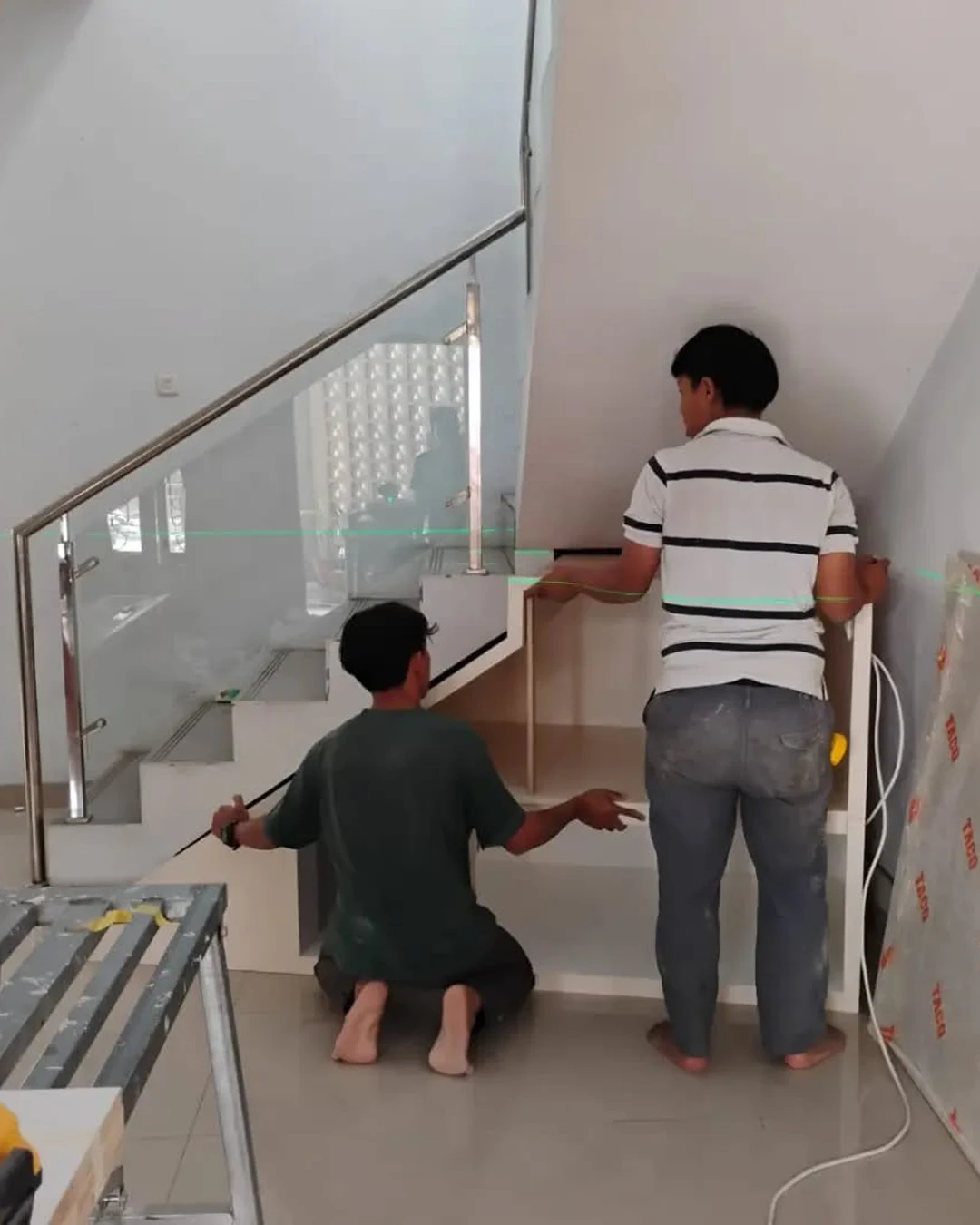
Slopes lie. A tape measure held against the tall end tells you nothing about the low end, and that low end is exactly where the TV has to live. Measure the height at three points — where the screen will sit, a foot to each side — and write down the smallest number, not the biggest.
Laser levels earn their keep here. A green line thrown across the slope shows you the diagonal in one glance, and two people can hold a unit in place while you check it against the line. Bring the numbers to the shop, not a guess, and the unit that comes home will actually fit.
The practical point: Measure the lowest clearance where the TV will sit, then subtract two inches for ventilation and cables before you buy anything.
Why Open Shelving Works Better Down Here
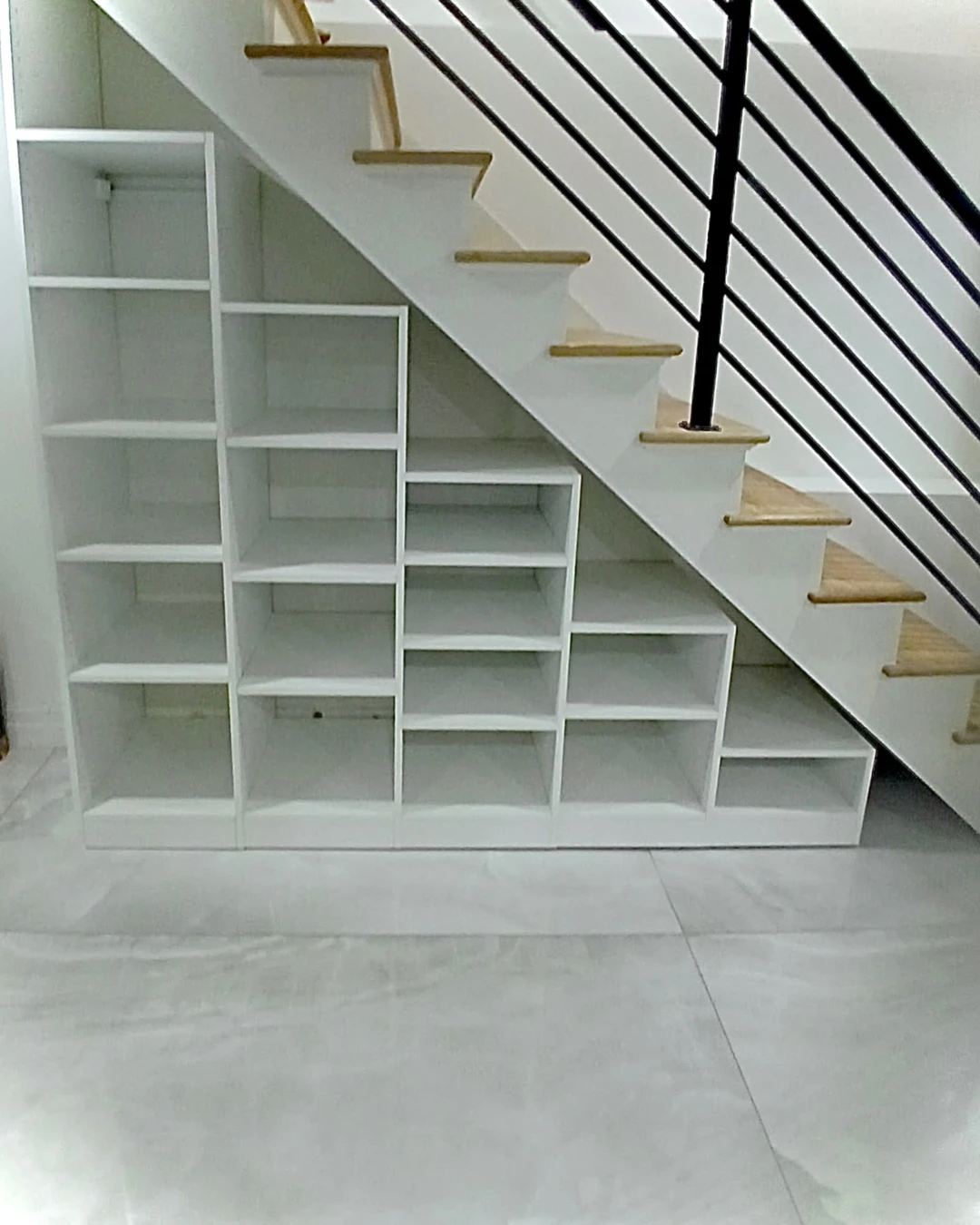
Closed doors under a slope waste the very space that makes the spot interesting. Open shelves step down with the diagonal, so every awkward triangle becomes a place for books, plants or a speaker — and the whole unit looks built in, not bolted on.
Honesty check: open shelves show dust, and they show clutter faster than any door ever will. Keep the lowest shelf for closed baskets and let the upper shelves carry the pretty things. That way the slope does the styling and the baskets do the hiding.
The practical point: Keep open shelves shallow — ten to twelve inches deep — so nothing disappears into the dark triangle at the back.
Hide the Cables or They Will Ruin Everything
Cables are the difference between a wall that looks designed and a wall that looks thrown together. One black lead drooping from the TV undoes every other decision on this list, and your eye will find it before it finds anything else.
Run everything behind the panel before the TV goes up, not after. A slim cable channel painted the wall colour disappears completely, and the set-top box belongs inside the cabinet with a small hole drilled for its sensor, not sitting on top of it.
The practical point: Drill the cable hole before mounting anything — retrofitting means pulling the whole unit off the wall.
Let the TV Sit Low and Close to the Wall
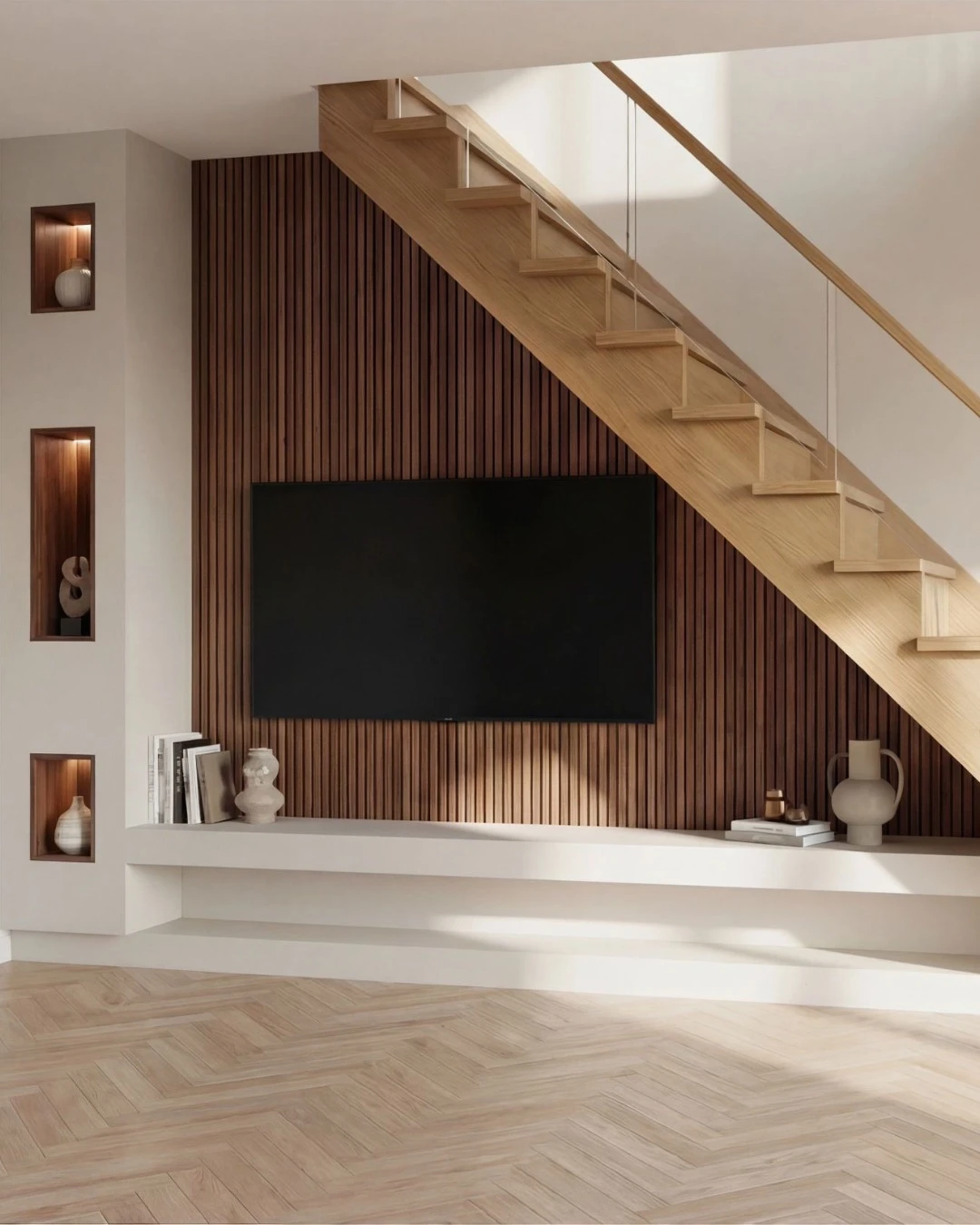
Sit on your sofa and look straight ahead. That eyeline — not standing height, not the centre of the wall — is where the middle of the screen belongs. Under a staircase the ceiling is already low, so a low mount feels natural instead of forced.
Slim mounts earn their money here. Anything under an inch deep keeps the screen tight to the wall and out of the walkway, and a slight tilt helps when the sofa sits close. A TV that juts out into the room turns a hallway into an obstacle course.
The practical point: Check the height from the sofa, not from the doorway — the centre of the screen should meet your eyeline.
Match the Unit to the Stairs, Not the Sofa
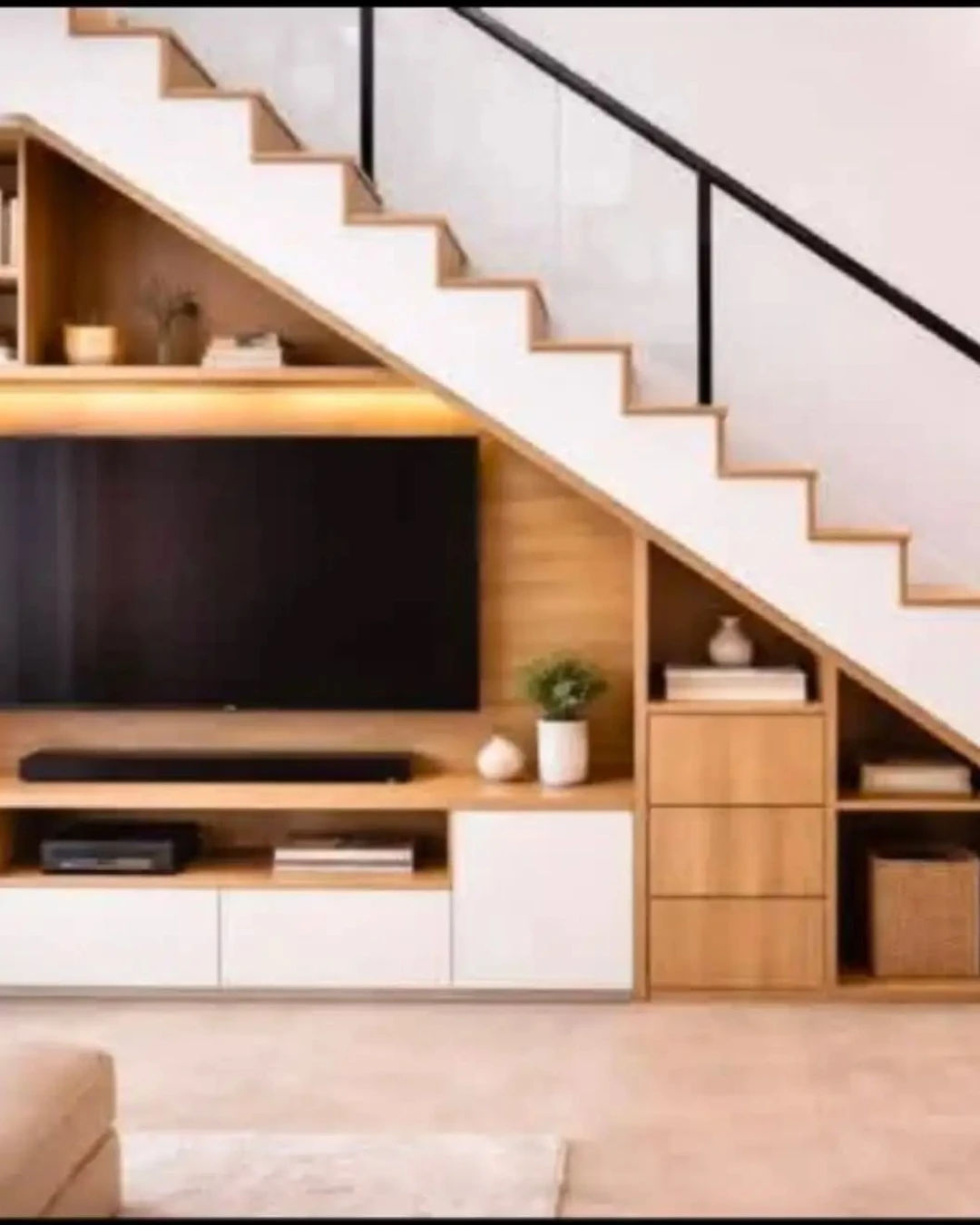
Your staircase is the biggest object in the room, and it wins every visual argument. When the unit’s wood matches the stair treads, the whole wall reads as one piece of furniture instead of two ideas fighting each other.
Matching the sofa instead is the classic mistake. Sofas move, get re-covered and get replaced; the staircase stays. Same wood, same stain — or a deliberate contrast in a completely different material. What never works is a near-miss that looks like a mistake.
The practical point: Take a tread sample or a daylight photo to the shop — wood that looks matched under showroom lights can clash badly at home.
Light the Niche — Don’t Leave It Dark
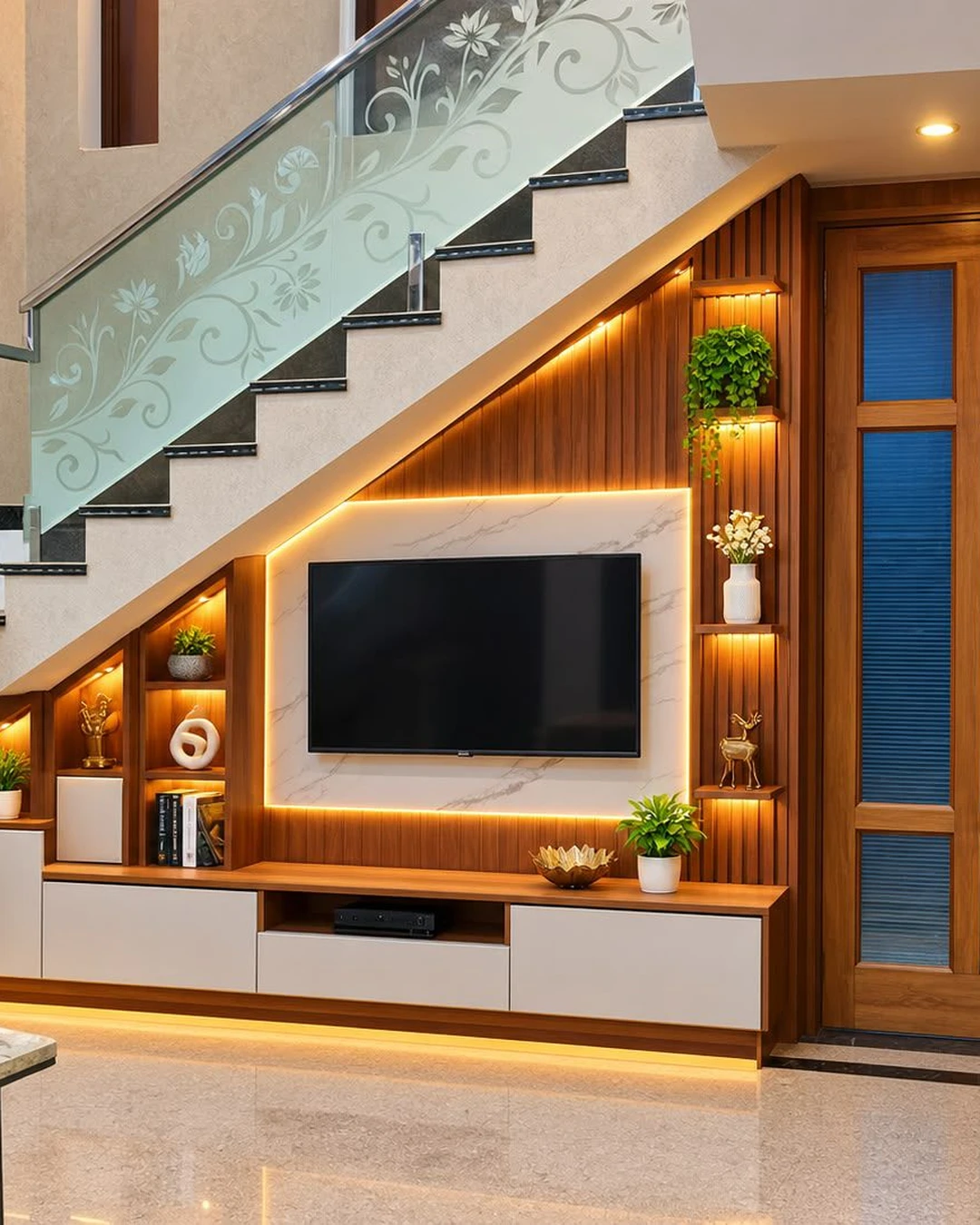
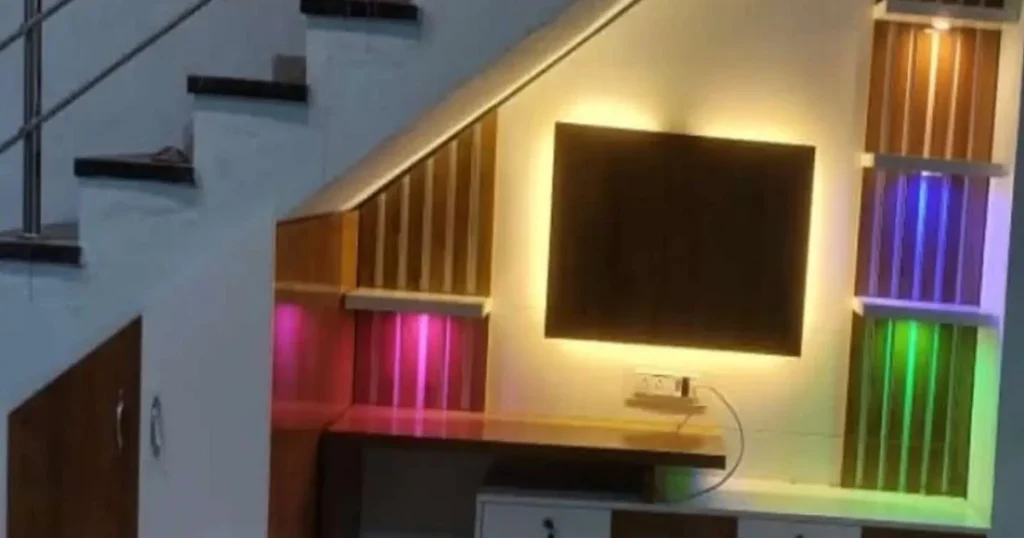
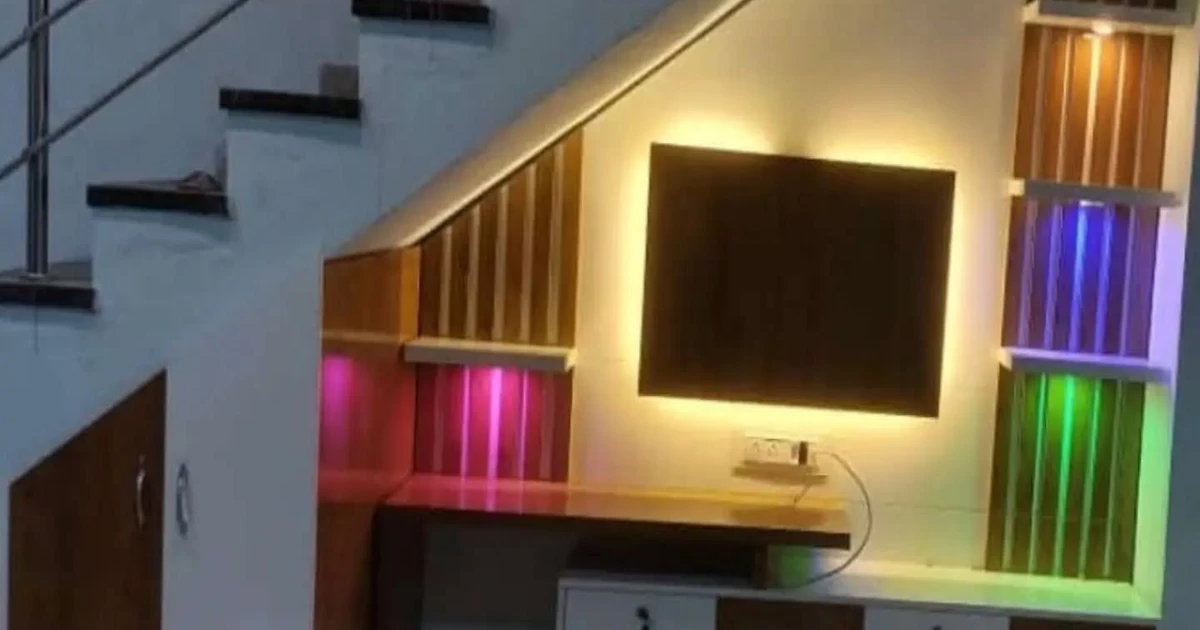
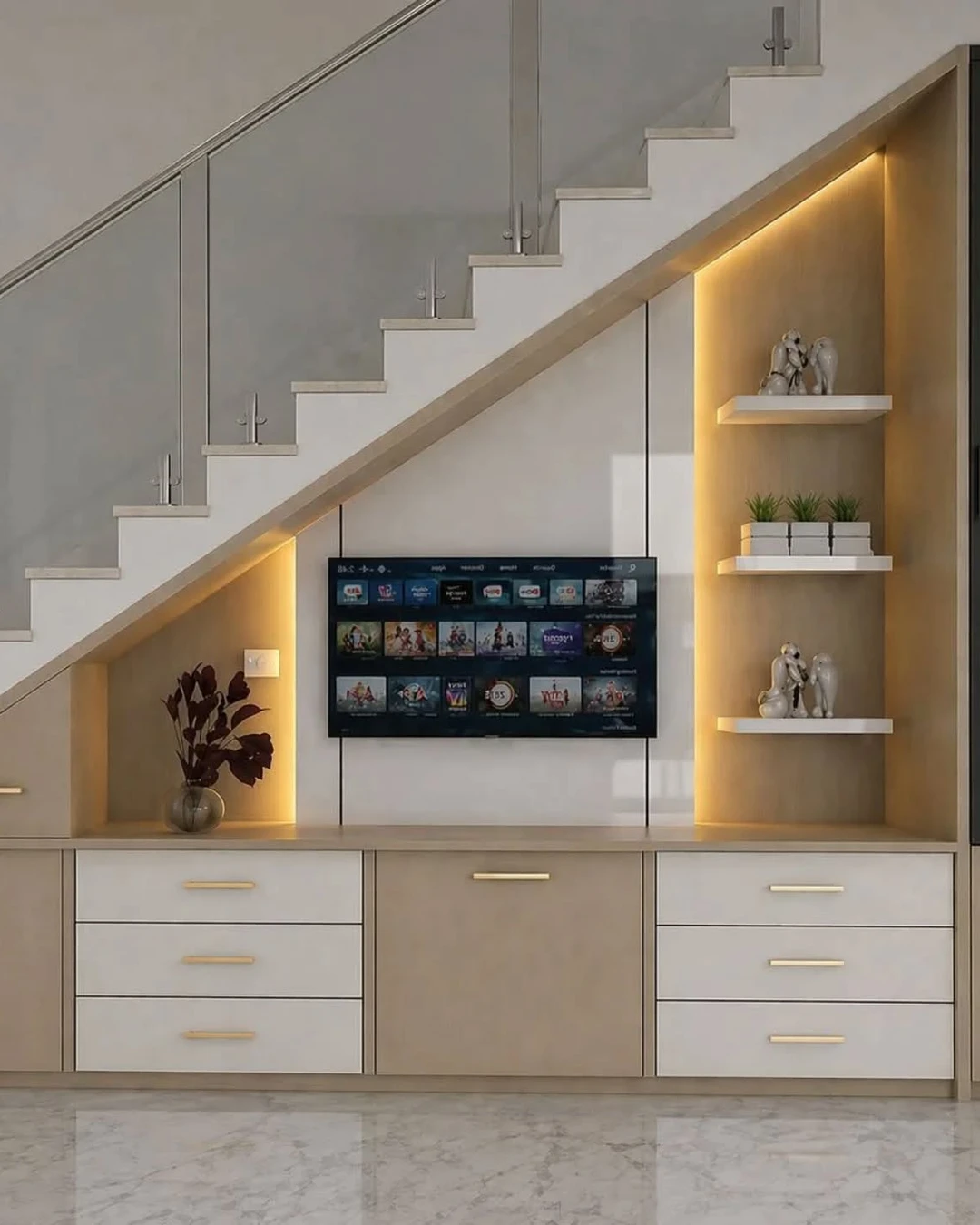
Triangles under stairs are dark by nature, and a TV floating in a black hole looks like a mistake even when the unit is beautiful. Warm LED strips along the slope edge change the whole mood — the wall glows, the shelves read, and the screen stops looking like it’s hanging in a cave. This unit sits beside the front door, so the same glow doubles as a welcome when you walk in.
Colour temperature matters more than brightness. Warm white around 2700 to 3000 kelvin feels like evening light; cool white turns the same unit clinical. Put the LEDs on a dimmer or a smart plug so the glow works as evening light even when the TV is off.
The practical point: Light the shelves and the panel, never the screen itself — light behind the TV flatters, light on it glares.
Closed Doors for the Messy Stuff
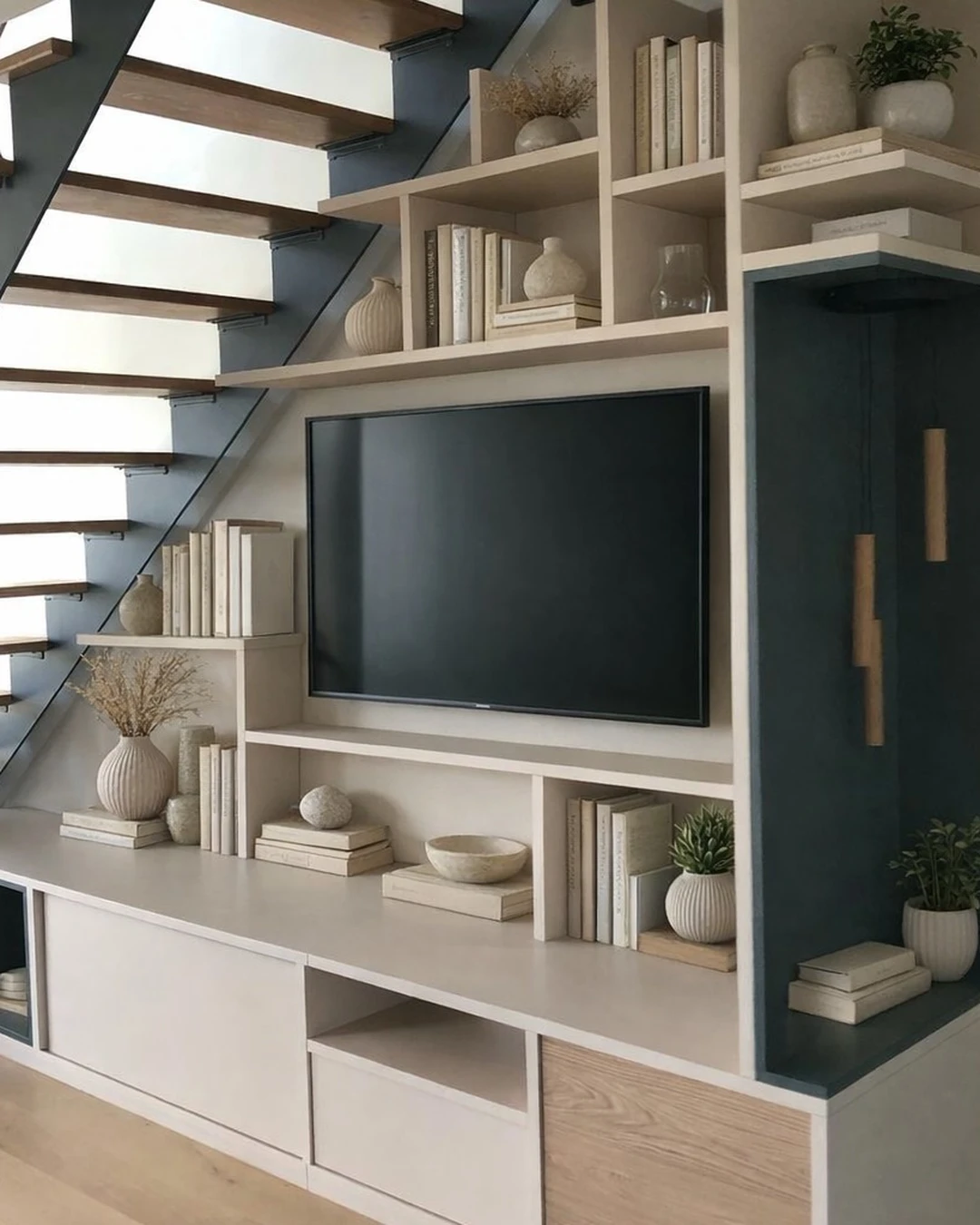
Every TV setup has a messy half: consoles, remotes, controllers, chargers, the router nobody wants to look at. Closed doors swallow all of it, keep the dust off, and let the wall stay calm — which is exactly what a small under-stair wall needs.
Heat is the trade-off nobody mentions until a console starts cutting out mid-game. Closed doors trap warm air, so vent the back of the cabinet or leave a finger-width gap behind each door. Doors that follow the slope look built in; doors that ignore it look like an afterthought.
The practical point: Leave a one-inch gap behind any door that hides a console, or cut a discreet vent slot at the back of the cabinet.
Keep the Screen Out of the Window Glare
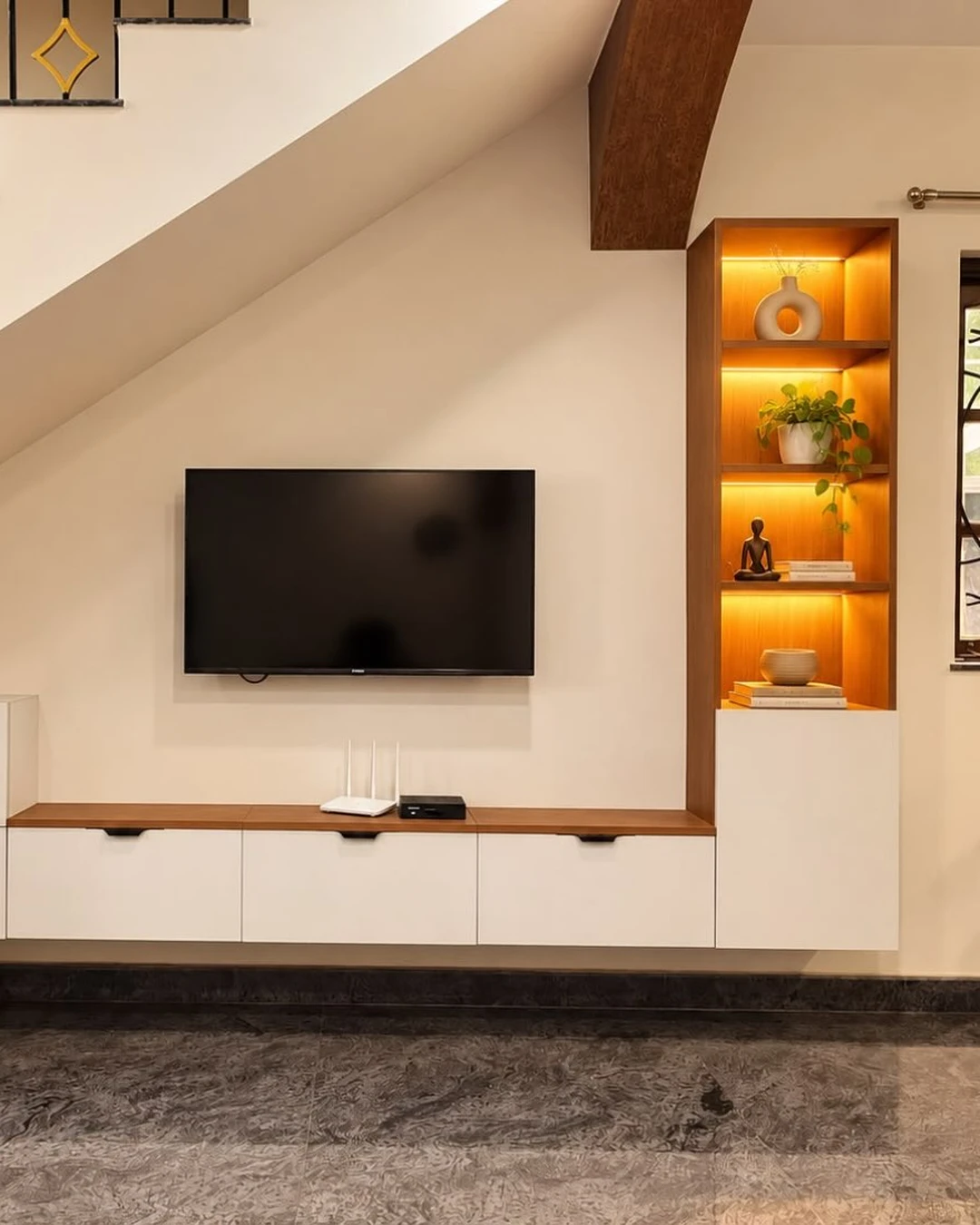
Glare ruins a good setup faster than any other mistake. Under a staircase the TV often faces straight across the room at a window, and by four in the afternoon the screen turns into a mirror. Angle the unit so the screen faces away from the brightest window, not towards it.
Test at the hour you actually watch. Midday light tells you nothing — late-afternoon sun through a side window is the usual culprit, and it’s the light that makes subtitles unreadable. A matte screen protector helps a little, but it never fixes a bad angle.
The practical point: Stand where the window is and look at the screen — if you can see the window reflected in it, the angle is wrong.
Float the Unit and the Hall Feels Bigger
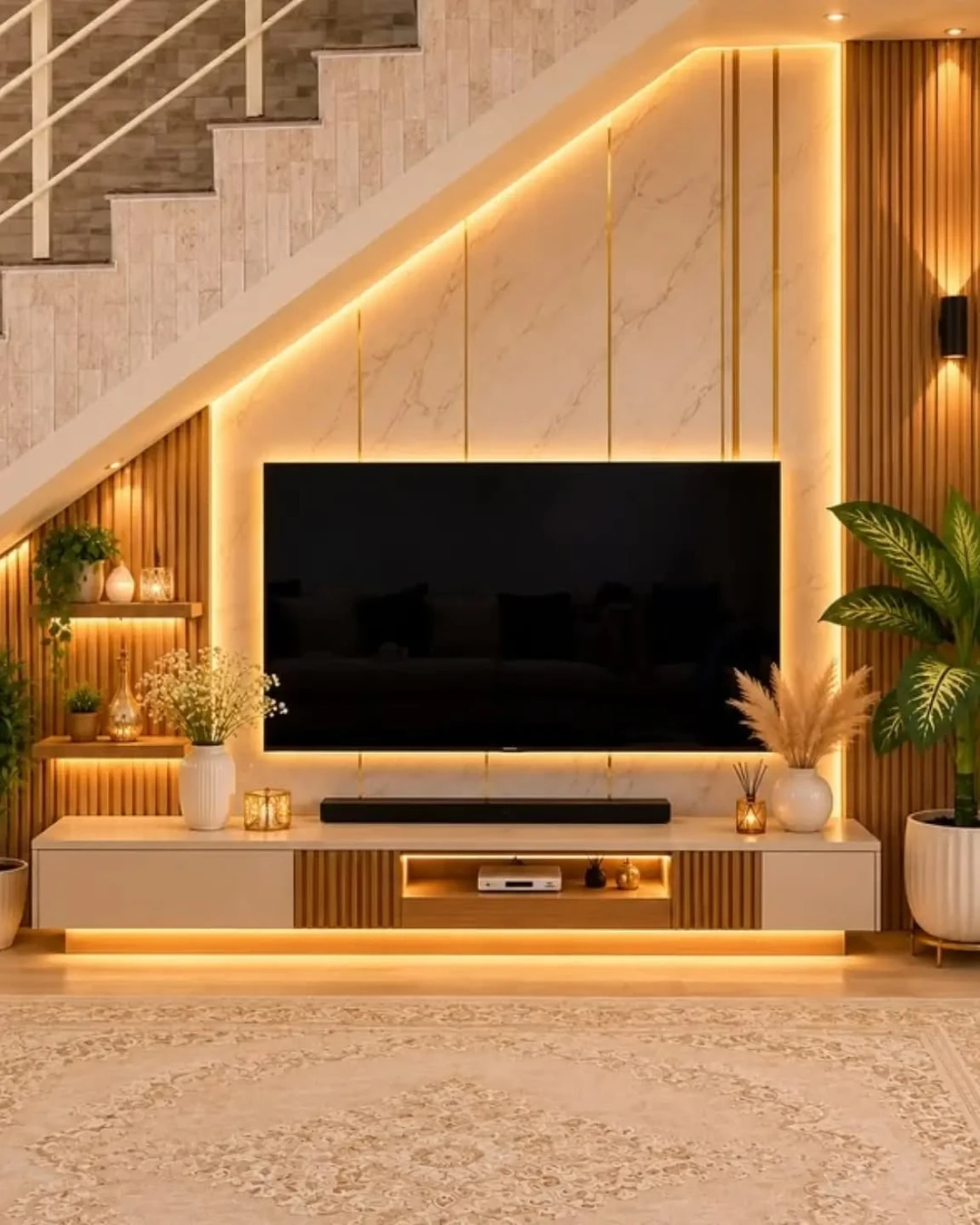
Wall-mounted consoles leave the floor visible, and visible floor reads as space. Under a staircase every inch of floor matters, because the slope already steals the headroom — a floating unit gives some of it back, and cleaning underneath takes thirty seconds instead of a furniture-moving operation.
Floating only works on a wall that can hold it. Studs or solid masonry, proper fixings, and a console that isn’t overloaded with books and boxes. The hallway around it deserves the same thinking — see Japandi Hallway Design Starts with Better Choices, Not More Decor.
The practical point: Mount into studs or use proper masonry fixings — a loaded floating console pulls hard on its fixings.
Sound Needs Space Too
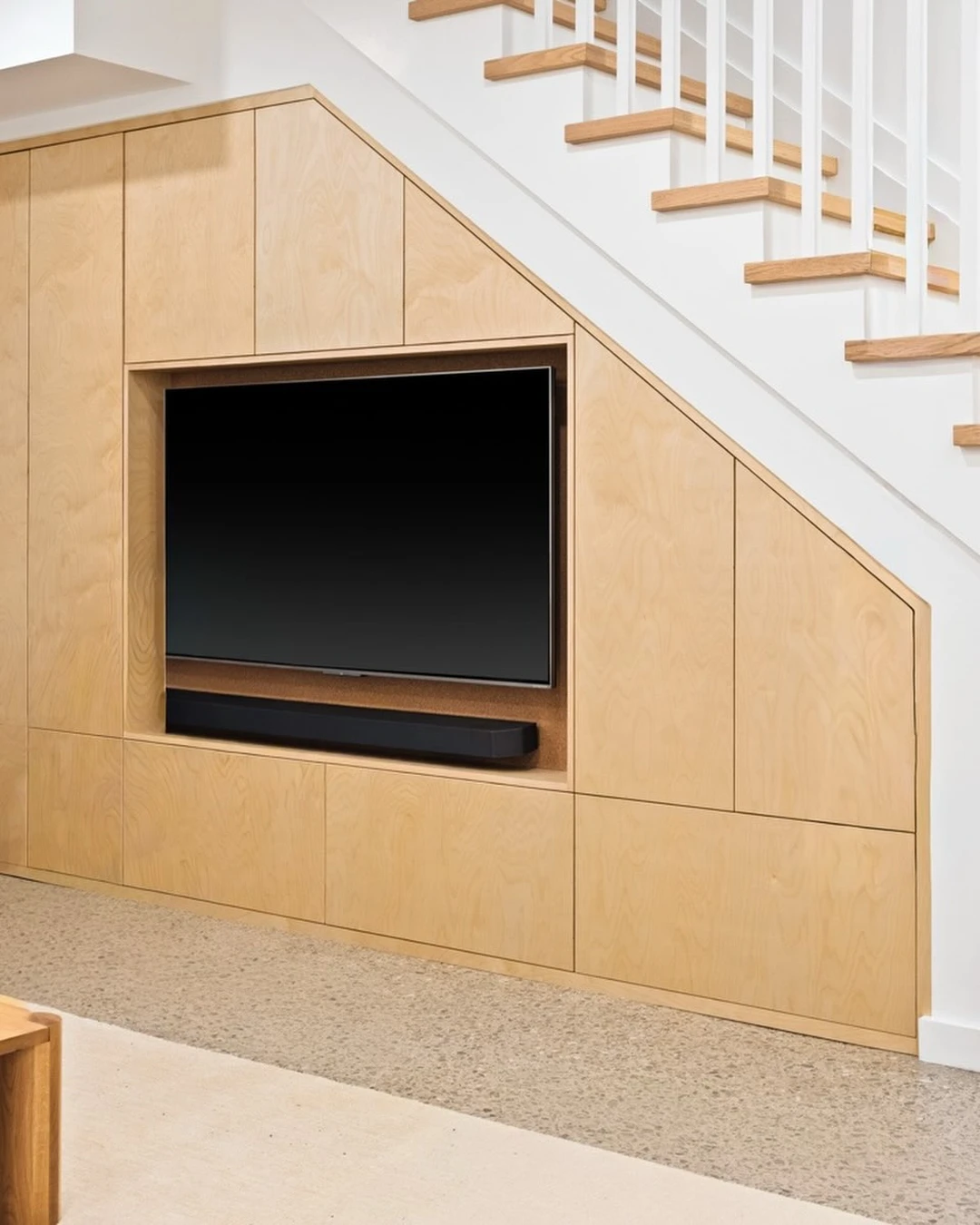
Soundbars get treated like an afterthought, shoved into whatever gap is left. Cram one into a closed niche and dialogue turns muffled, because the sound has nowhere to go — it bounces off the shelf above and dies before it reaches the sofa.
Give the bar clear air in front and above it, at least two inches on top, and keep the front of the niche open. Before you fix the shelf for good, play something dialogue-heavy and stand where you sit. If voices sound boxed in, the bar needs more air, not a bigger bar.
The practical point: Leave two inches of clear air above the soundbar and keep the front of its niche open.
Use the Dead Corner for Storage, Not Decoration
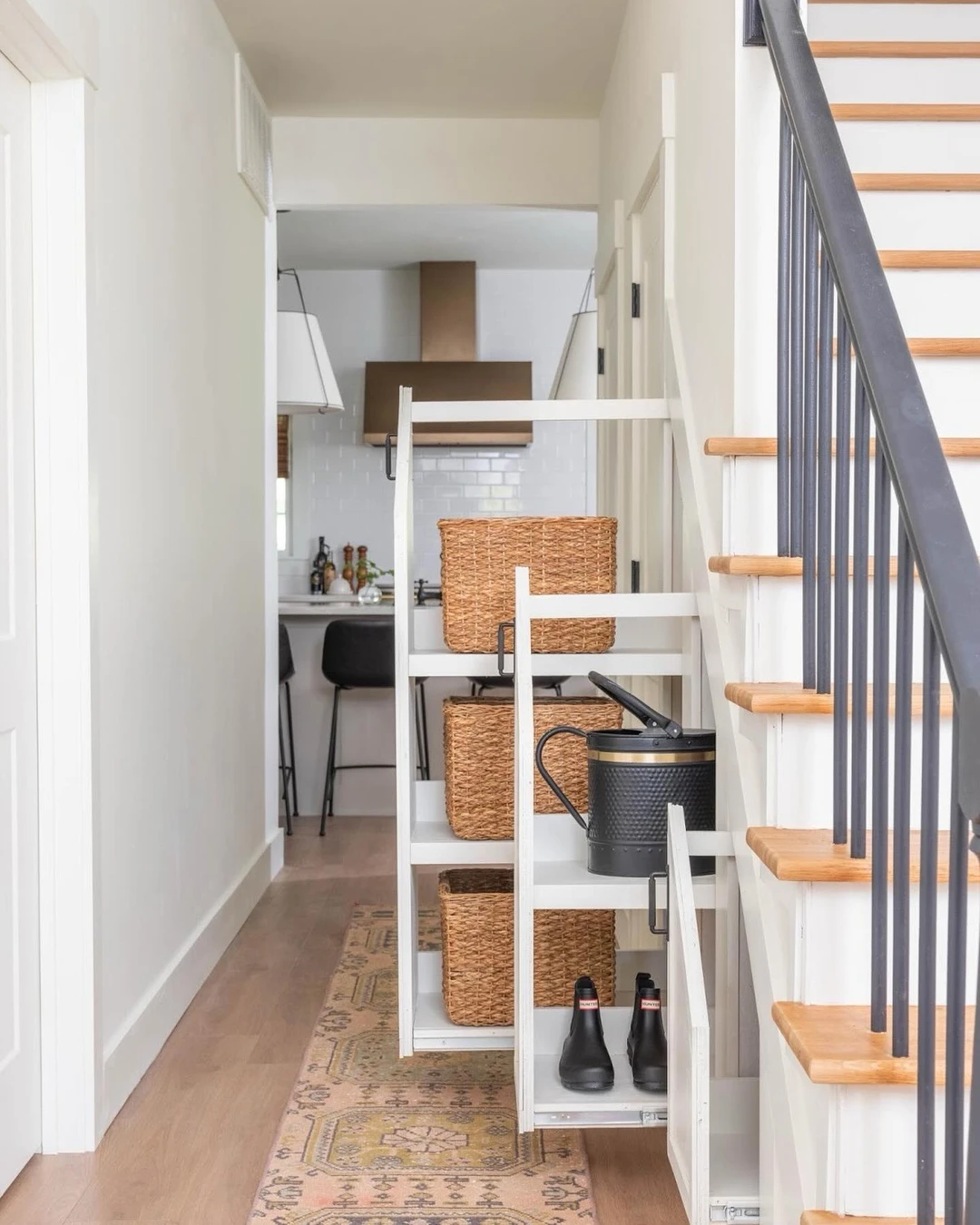
Deepest, lowest, darkest — the triangle at the very bottom of the stairs is useless for display and perfect for storage. Pull-outs on runners beat fixed shelves you can’t reach into, and baskets hide the clutter while sliding out in one pull.
Board games, spare cables, the Christmas lights, the vacuum attachments — this is where the unglamorous half of the house lives. A hallway pull-out like this one turns a dead corner into the most-used storage in the room, and nobody ever sees the mess.
The practical point: Fit pull-outs on full-extension runners — a shelf you can’t reach into is a shelf you won’t use.
Pick a Finish That Forgives Fingerprints
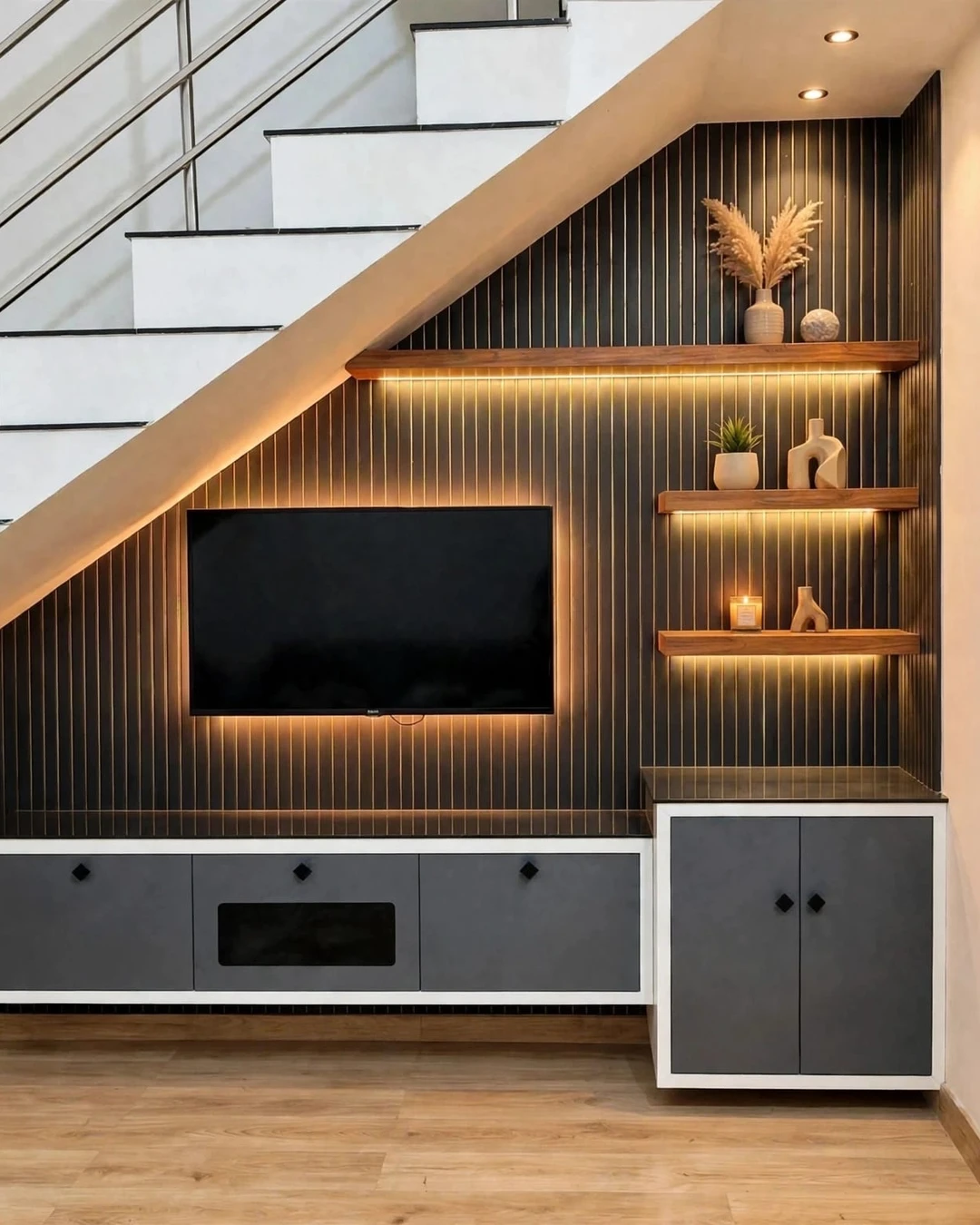
TV walls get touched constantly — kids reaching for the remote, guests steadying themselves on the stairs, you dusting around the screen. High-gloss black shows every fingerprint within an hour, and under a staircase the light rakes across the surface and shows them twice.
Matte, textured or wood finishes forgive. Dark matte panels have a second gift: when the TV is off, the black screen disappears into the wall instead of hanging there like a blank rectangle. Run your palm across a sample in the shop — if it marks there, it will mark ten times worse in your living room.
The practical point: Choose matte or textured finishes for anything at hand height — gloss belongs above the reach of small hands.
Leave Breathing Room Around the Screen
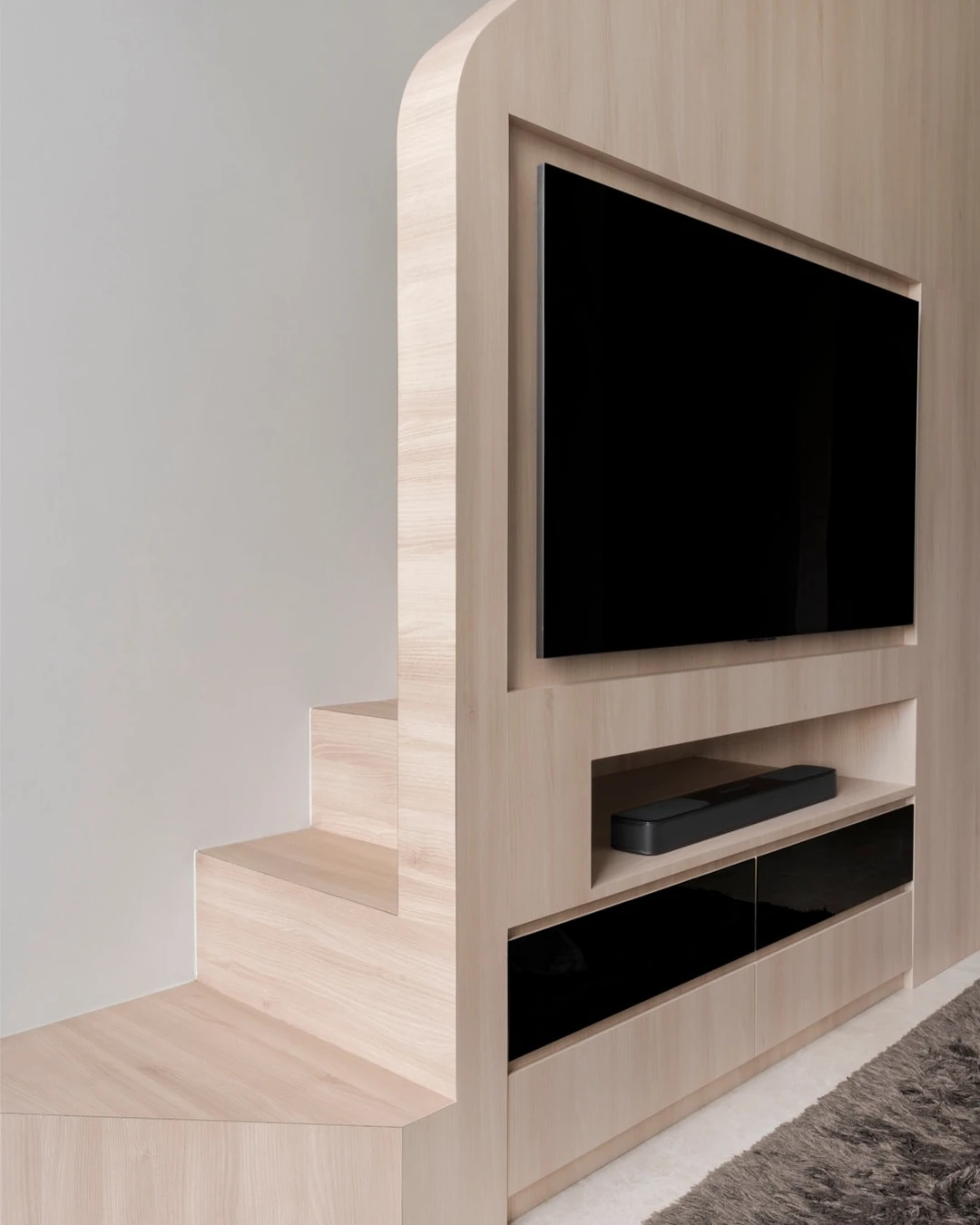
Screens crammed edge-to-edge into their niche look squeezed, however expensive the unit. A few inches of empty panel on each side lets the TV breathe, makes the wall feel designed rather than stuffed, and gives the heat somewhere to go.
Three inches on each side and two above is the rule that works in most rooms. It also leaves room for the mount, the cables and the day you upgrade to a slightly bigger screen — which, honestly, most of us do.
The practical point: Leave at least three inches of clear panel on each side of the screen and two inches above it.
When the Staircase Is the Star, Keep the Unit Quiet
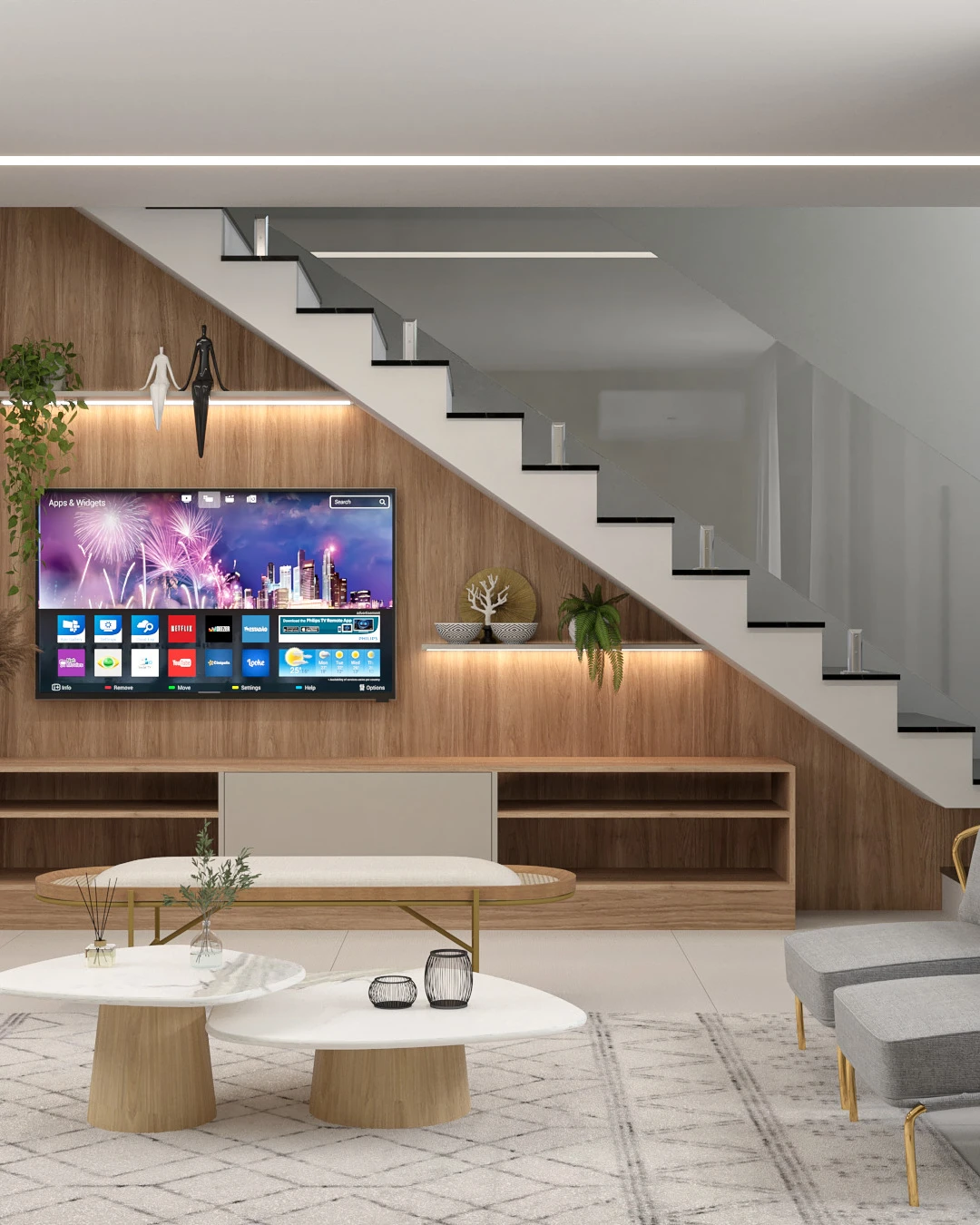
Some staircases are the best thing in the room — floating treads, glass rails, a beautiful line running up the wall. A TV unit that tries to compete with that turns the wall into a shouting match, and the staircase always loses something.
Let the staircase carry the drama and the unit carry the TV. Low, plain, quiet colours, one repeated material — the same wood or the same metal as the rail — and nothing else asking for attention. The TV in this photo shows its home screen, and even that feels busy next to the stairs.
The practical point: Repeat one staircase material in the unit and keep everything else plain — the stairs stay the star.
Your Staircase Wall, Sorted
Slopes stop being a problem the moment you let them decide the layout. Measure first, hide the cables, give the sound and the screen room to breathe — the rest is taste, and taste is the fun part.
Which of the fourteen would change your living room most? Start there, and the wall will tell you what it needs next. A TV unit and a console table share the same enemy — clutter — so if the hallway side needs the same treatment, see How to Style a Narrow Console Table Without the Clutter.